Mobilizing the Economy and the Home Front
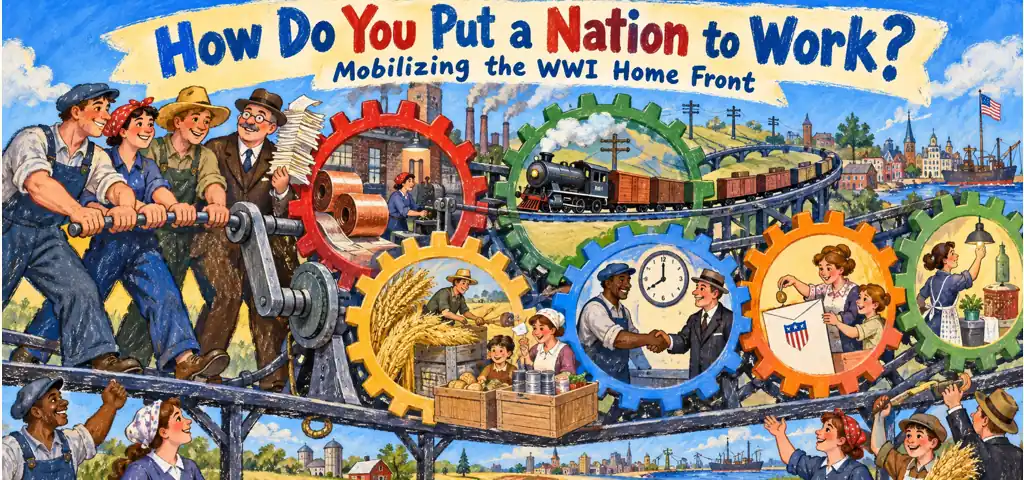
Chapter 7 of the CLEP History of the United States II study guide on Effortless Math covers Mobilizing the Economy and the Home Front: the key terms, the core ideas, and worked examples showing how this topic is tested on the exam.
CLEP History of the United States II, Chapter 7
Mobilization began before the declaration
Congress created the Council of National Defense in 1916. Six cabinet secretaries formed the council, while an advisory commission brought business, labor, medical, and transportation expertise into planning. The body did not command the whole economy. It gathered information, encouraged state and local defense councils, and prepared coordination before April 1917. This prewar origin matters because mobilization grew by adding agencies and negotiated authority to an existing administrative network.
The draft built a mass army
The Selective Service Act of May 1917 required men within designated ages to register and used local boards to classify them. About twenty-four million registered over the course of the war, and nearly three million entered military service through the draft. Local administration made mobilization legible to communities and carried local racial and class bias. The act differed from Civil War substitution and bounty systems: the federal government asserted a broad obligation and assigned implementation through thousands of boards.
The War Industries Board coordinated priority
The War Industries Board became the central agency for industrial coordination under Bernard Baruch in 1918. It set priorities for scarce raw materials, encouraged standardization, negotiated prices, and steered government orders. It did not nationalize American manufacturing or possess smooth control over every contract. Its influence arose from the federal government's enormous purchasing power and its ability to determine which producers received materials and transportation. Coordination could reshape private production without transferring factory ownership.
Railroads entered temporary federal operation
Congestion showed that competing private railroads could not efficiently move troops, coal, food, and war orders as one system. Wilson placed the railroads under the United States Railroad Administration in December 1917. Federal operation coordinated routes, equipment, and rates while companies remained privately owned and received compensation. The arrangement illustrates a distinct instrument: direct temporary operation, stronger than voluntary cooperation but different from permanent public ownership.
Food and fuel policy mixed law and persuasion
Herbert Hoover's Food Administration used licensing, price measures, publicity, and voluntary "wheatless" or "meatless" conservation under the Lever Food and Fuel Control Act. It did not issue the household coupon ration books associated with the Second World War. The Fuel Administration under Harry Garfield regulated coal distribution and promoted fuel-saving days. Both agencies tried to redirect consumption so exports could sustain armies and allies, using moral appeal alongside statutory authority over firms.
The government financed an expensive war
Congress raised income and excess-profits taxes, but borrowing supplied most wartime funds. Liberty Loan drives sold bonds through banks, workplaces, schools, parades, and patriotic publicity. The Federal Reserve supported the financial system and encouraged member banks to lend against bond purchases. Broad participation made finance a public ritual, yet social pressure could blur the line between voluntary purchase and coerced loyalty. Mobilization reached households through savings, taxes, prices, and surveillance as well as through military service.
Labor received a wartime bargain
The National War Labor Board, created in April 1918, asked workers not to strike and employers not to lock them out. In return, it recognized workers' right to organize, endorsed an eight-hour day in many cases, and arbitrated wages and conditions. Union membership and real wages rose in important industries, though benefits were uneven and employers expected to recover authority after the emergency. The board managed continuity of production through reciprocal restraint rather than simply outlawing unions.
Congress delegated reorganization power
The Overman Act of May 1918 authorized Wilson during the war and for a limited period afterward to redistribute functions among executive agencies and create coordinating arrangements by executive order. It was an unusually broad delegation, justified by administrative speed. The act did not suspend Congress or give the president permanent authority to rewrite the government. It shows how emergency coordination altered constitutional practice through a statute with a time boundary.
Mobilization moved workers and families
War orders expanded northern industry just as European immigration fell. Employers recruited Black southerners and Mexican workers, women entered new occupations, and farm labor shifted. These movements helped production but intensified housing shortages, discrimination, and conflict. The federal government sometimes warned employers against racial exclusion while tolerating segregation elsewhere. A labor shortage could open a job without providing equal wages, secure housing, union membership, or political power.
Military logistics spread influenza
The 1918 influenza pandemic traveled through crowded camps, troop trains, ports, and ships. Mobilization assembled young adults from different communities and moved them rapidly across the nation and Atlantic. Public-health officials faced wartime censorship, shortages, and pressure not to disrupt production or morale. The war did not create the virus, but the institutional machinery built to concentrate and transport people accelerated its reach. This is a causal mechanism linking administration to unintended biological consequence.
identify the instrument
A prompt describes three policies: priority ratings for copper, unified routing of freight cars, and appeals for wheatless meals.
Mobilization was powerful but improvised
The wartime state expanded purchasing, planning, arbitration, transportation, taxation, and public health. Its agencies often overlapped, depended on voluntary compliance, or arrived late. Business leaders and labor representatives entered government, giving expertise and organized interests access. The result was neither laissez-faire nor a fully planned economy. It was a temporary administrative network whose authority came from statutes, executive orders, procurement, negotiation, patriotic pressure, and emergency claims.
Watch the history in motion
This short lesson adds voices, images, and chronology to the ideas you just studied.
Video: WORLD WAR I: On the Homefront [APUSH Unit 7 Topic 6] Period 7: 1898-1945, Heimler's History.
Try four CLEP-style questions
- A manufacturer keeps title to its factory but receives priority access to copper only after accepting a production schedule. Which form of mobilization is illustrated?
- Permanent nationalization of basic industry
- Local draft-board classification
- Judicial review of an executive wartime reorganization
- Household rationing by coupon
- Federal coordination through allocation and purchasing power
- Why did the government sell Liberty Bonds in addition to increasing wartime taxes?
- Borrowing drew current private savings into war finance while leaving future public revenue responsible for servicing the debt.
- Bond sales permanently removed the need for Congress to collect revenue after the fighting ended.
- Bonds transferred ownership of war industries to the households that purchased them.
- Loan drives financed state militias, whereas federal taxes could be spent only on the Navy.
- Borrowing reduced the government's current purchasing power so civilian demand could expand without competition.
- Which comparison best explains why troop movement and industrial recruitment could have unlike intended purposes but similar social consequences?
- Both were designed to reduce population movement between military camps and industrial regions.
- Both ended local boards' need to classify people or coordinate scarce housing.
- Both moved concentrated populations, spreading disease or straining housing and services.
- Both guaranteed equal housing, health care, and treatment in destination communities.
- Both operated through household bond purchases rather than transportation and recruitment systems.
- A food program uses voluntary household conservation campaigns while licensing firms that handle essential supplies. Why is "voluntary" alone an incomplete description?
- Voluntary appeals transferred food production to federal ownership.
- Licensing made household conservation a criminal sentence imposed by local boards.
- Persuasion directed at consumers operated alongside regulatory power over businesses and distribution.
- Business regulation prevented the agency from using publicity.
- The two instruments belonged to different wars and could not operate together.
Check your answers and reasoning
Independent preparation. CLEP is a registered trademark of the College Board, which does not endorse this lesson.

Related to This Article
More math articles
- Ratio Tables
- AP Cybersecurity Log Analysis: Follow the Evidence (2027 Prep)
- How to Graph Solutions to One-step and Two-step Linear Inequalities
- How to Make Inferences from Data? (+FREE Worksheet!)
- What Level of Maths Is Tested on the PSAT/NMSQT®?
- Separate description from judgment
- NYSTCE Grades 1-6 Math (222) Worksheets: FREE & Printable
- Fourth Grade Writing: Opinion, Informative, and Narrative Expectations Explained
- Finding Derivatives Made Easy! Derivative of A Chain of Functions
- CLEP U.S. History I 044: Alien and Sedition Acts and the Election of 1800
















What people say about "Mobilizing the Economy and the Home Front"?
No one replied yet.