CLEP U.S. History I 044: Alien and Sedition Acts and the Election of 1800
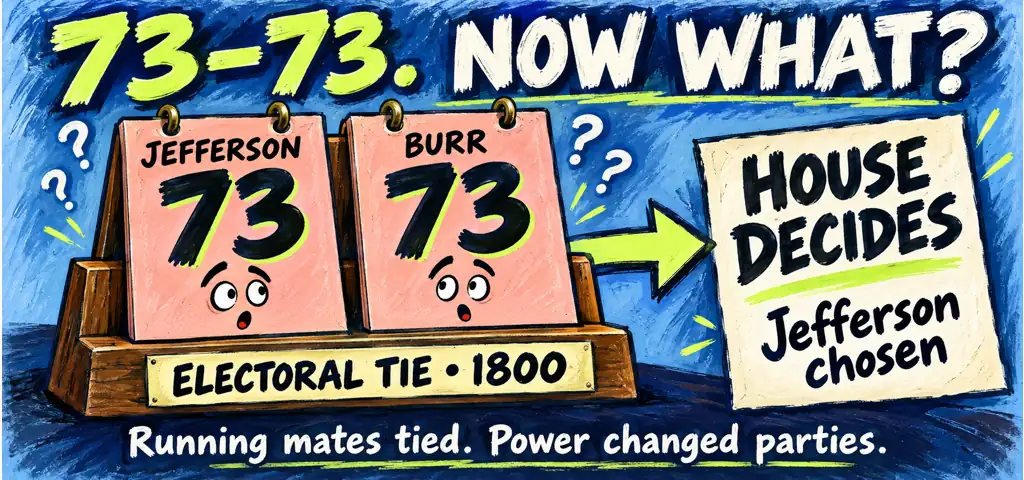
Lesson 8.6 of Chapter 8 of the U.S. History to 1877 study guide on Effortless Math covers CLEP U.S. History I 044: Alien and Sedition Acts and the Election of 1800: the key terms, the core ideas, and worked examples showing how this topic is tested on the exam.
U.S. History to 1877 | Chapter 8 | Lesson 8.6
Relations with revolutionary France deteriorated after Jay’s Treaty. French vessels seized American ships, and French intermediaries demanded payments during the XYZ Affair. Public anger fueled an undeclared naval conflict, the Quasi-War, and gave Federalists political momentum. In 1798 the Federalist Congress passed four Alien and Sedition Acts. The naturalization law lengthened the residency period for citizenship. Alien laws expanded presidential authority over noncitizens, especially in wartime. The Sedition Act made specified forms of false, scandalous, and malicious criticism of the federal government punishable. Federalists claimed that war danger and organized falsehood required protection. In practice, prosecutions targeted Republican editors and politicians, making civil liberties and partisan advantage inseparable.
Madison and Jefferson secretly drafted the Virginia and Kentucky Resolutions. They argued that the federal government had exercised undelegated power and that states could judge constitutional violations. Kentucky’s language moved toward the idea that states could nullify unconstitutional acts. Virginia emphasized interposition. Other states rejected the resolutions, and no unified constitutional mechanism resulted. The arguments nevertheless supplied later states’ rights advocates with a vocabulary that Madison himself would resist when applied to unilateral nullification.
President Adams weakened his own party’s hard-liners by pursuing peace with France. The election of 1800 then produced an Electoral College tie between Republican running mates Thomas Jefferson and Aaron Burr, because electors did not cast separate presidential and vice-presidential ballots. The House of Representatives chose Jefferson after a prolonged contest. The Twelfth Amendment later required separate votes for the two offices.
The election is sometimes called the “Revolution of 1800.” That phrase should not imply an absence of vicious campaigning or constitutional danger. It highlights that control passed from one organized party to another without civil war or military intervention. Jefferson did not dismantle the entire Federalist state. He retained useful fiscal practices while reducing some taxes and military spending. Peaceful transfer gave electoral opposition legitimacy.
Watch the topic in context
This History For Humans lesson supplies a second explanation of the same period. Note where chronology, cause, and perspective connect.
Video: Major Events of Adams' Presidency: The Quasi War with France, Alien & Sedition Acts, History For Humans.
Check your understanding
- The Sedition Act generated special controversy because it
- lengthened the residency period for naturalization
- punished specified criticism of the federal government and its officials
- authorized detention of enemy aliens during a declared war
- permitted removal of noncitizens judged dangerous by the president
- required newspapers to obtain a federal publishing license
- The election of 1800 is historically important chiefly because it
- removed the House from disputed presidential elections
- ended Federalist influence throughout the federal government
- allowed an outgoing administration to cancel an opposition victory
- transferred national power peacefully between organized rival parties
- used separate electoral votes for president and vice president
- Deep Practice: select all that apply. The crisis of 1798-1800 included
- the XYZ Affair
- the Quasi-War
- Alien and Sedition Acts
- Virginia and Kentucky Resolutions
- the Treaty of Guadalupe Hidalgo
- Deep Practice: open response. Why is “peaceful transfer” a better description of 1800 than “complete policy revolution”?
Write a brief response using a named fact from the lesson.
Open the answers and reasoning
Independent preparation. CLEP is a registered trademark of the College Board, which does not endorse this lesson.

Related to This Article
More math articles
- The Best Grade 7 Math Book for New Mexico Students
- Descent, Residence, and Authority
- Society and Social Structure
- Lenses and Optical Instruments
- The competitive quantity maximizes total surplus under key assumptions
- Free Grade 5 Math Worksheets for Massachusetts Fifth Graders: 49 MCAS-Aligned PDFs with Solutions
- Fiscal policy
- The Best Grade 7 Math Book for Virginia Students
- The Best Grade 8 ELA Practice Tests for New Hampshire Students
- Primary and Secondary Sources





















What people say about "The Alien and Sedition Acts and 1800"?
No one replied yet.