CLEP U.S. History I 045: Jeffersonian Ideals and Governing Realities
Lesson 9.1 of Chapter 9 of the U.S. History to 1877 study guide on Effortless Math covers CLEP U.S. History I 045: Jeffersonian Ideals and Governing Realities: the key terms, the core ideas, and worked examples showing how this topic is tested on the exam.
U.S. History to 1877 | Chapter 9 | Lesson 9.1
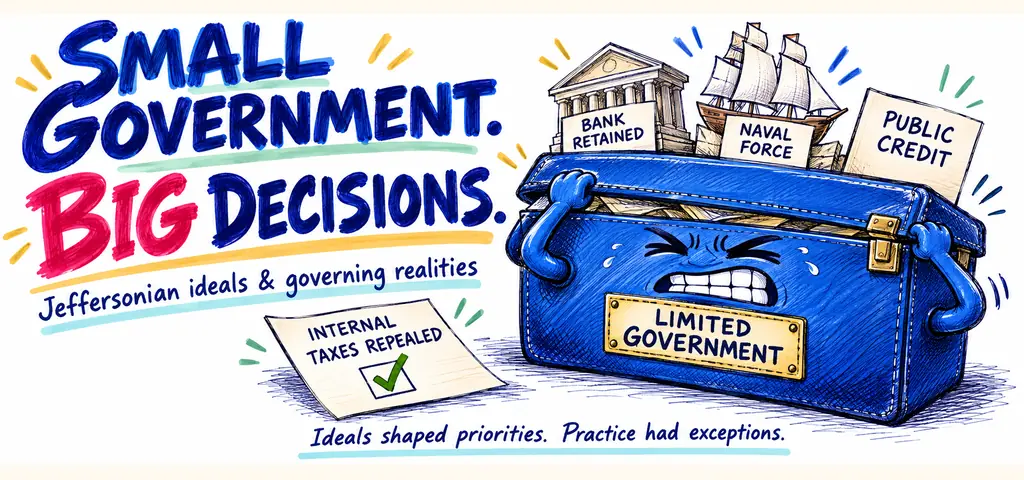
Jefferson described an ideal republic of independent farmers, low taxes, limited debt, economical administration, and public vigilance against concentrated power. His administration repealed internal taxes, reduced military spending, and allowed the Sedition Act to expire. Congress abolished several Federalist judgeships created at the end of the Adams administration, and Jefferson pardoned people convicted under the Sedition Act. These choices made the party change of 1801 tangible.
Yet Jefferson did not dismantle Hamilton’s entire system. The national bank continued, customs revenue remained essential, and the government honored the funded debt while Treasury Secretary Albert Gallatin reduced it. Jefferson used executive authority vigorously in foreign affairs. He sent naval forces against Tripoli after demands from the Barbary states threatened American shipping. His administration also pursued former vice president Aaron Burr after Burr’s western activities raised fears of conspiracy. The treason trial ended in acquittal under Chief Justice John Marshall’s narrow reading of the constitutional definition, illustrating that presidential suspicion did not determine judicial guilt.
The most obvious tension came from slavery. Jefferson’s agrarian language celebrated independent producers, but plantation wealth and national expansion depended increasingly on enslaved labor. Congress ended legal U.S. Participation in the international slave trade in 1808, at the earliest date the Constitution permitted a federal prohibition, yet domestic slave trading expanded. Jefferson himself held people in slavery. A full account must distinguish the prohibition of overseas importation from abolition of slavery.
Political democratization also had boundaries. Republican victories weakened the Federalist Party and broadened partisan participation among white men, but voting requirements remained state matters and most women, enslaved people, free Black people in many jurisdictions, and Native people stood outside formal power. Jeffersonian republicanism reduced some federal burdens without creating universal equality.
A focused video lesson
CrashCourse traces the people and chronology behind this lesson. Listen for the evidence that sharpens the written account, then try the questions below.
Video: Thomas Jefferson & His Democracy: Crash Course US History #10, CrashCourse.
Check your understanding
- Which policy most clearly fulfilled Jefferson’s promise of economical government?
- creation of the Bank of the United States
- repeal of internal federal taxes
- passage of the Sedition Act
- increase of the standing army
- assumption of state debts
- The federal law that took effect in 1808 prohibited
- slavery throughout the federal territories
- interstate sale of enslaved people
- enslaved labor in plantation agriculture
- importation of enslaved people from abroad
- slaveholding within the District of Columbia
- Deep Practice: select all that apply. Jeffersonian governing realities included
- retention of funded debt
- naval war against Tripoli
- continuation of the national bank
- executive pursuit of Burr
- abolition of slavery
- Deep Practice: open response. Give one example of Jeffersonian restraint and one of energetic federal action.
Write a brief response using a named fact from the lesson.
Open the answers and reasoning
Independent preparation. CLEP is a registered trademark of the College Board, which does not endorse this lesson.

Related to This Article
More math articles
- What’s The Best Laptop For Online Math Teachers?
- School prayer
- Pictographs and Tally Charts
- Eigenvalue and Eigenvector Calculator (2×2 and 3×3)
- Surface Area and Volume Formulas: Complete Reference for 2026
- Full-Length ACT Math Practice Test
- Oral arguments
- HSPT Math-Test Day Tips
- Scientific Notation Converter (Free, Both Ways)
- Taylor Series Uncovered: Transforming Functions into Useful Approximations

















What people say about "Jeffersonian Ideals and Governing Realities"?
No one replied yet.