CLEP U.S. History I 046: Louisiana Purchase and Western Exploration
Lesson 9.2 of Chapter 9 of the U.S. History to 1877 study guide on Effortless Math covers CLEP U.S. History I 046: Louisiana Purchase and Western Exploration: the key terms, the core ideas, and worked examples showing how this topic is tested on the exam.
U.S. History to 1877 | Chapter 9 | Lesson 9.2
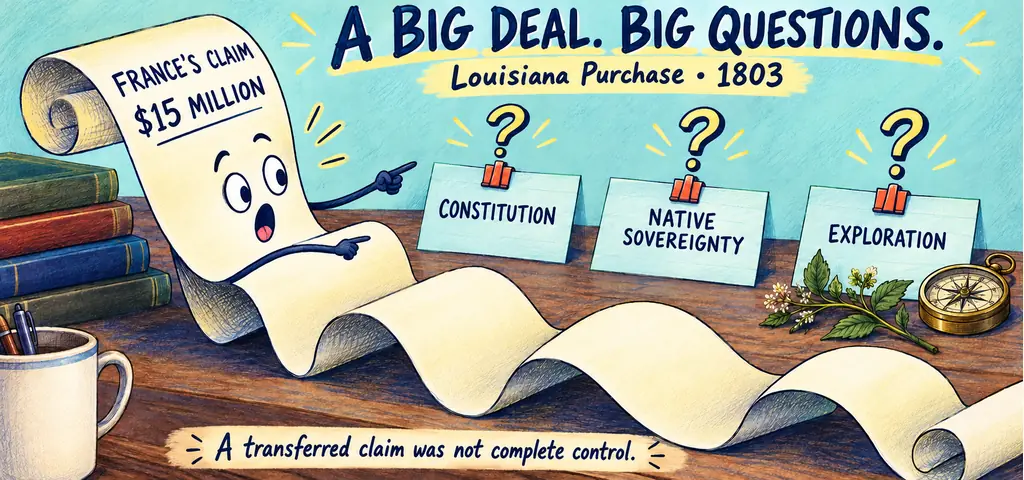
Spain had transferred Louisiana to France, and Napoleon’s control of New Orleans threatened the outlet on which western farmers depended. Jefferson sent negotiators seeking New Orleans and nearby territory. Napoleon instead offered all Louisiana. War in Europe and the failure of France’s attempt to restore control in Saint-Domingue reduced his interest in an American empire. The United States purchased France’s claim in 1803 for about $15 million.
The acquisition doubled the nation’s claimed area and secured the Mississippi corridor, but it raised a constitutional problem. Jefferson had long favored strict construction, and the Constitution did not expressly list a power to acquire territory. He considered an amendment, then accepted the treaty-making power and Congress’s authority over territory as sufficient, partly because delay could lose the opportunity. The episode illustrates a governing reality: strict construction could yield to strategic advantage. It did not mean the land was empty or that France had complete control to transfer. Native nations lived throughout it and retained their own claims and power.
Jefferson commissioned Meriwether Lewis and William Clark to cross the continent, gather geographical and scientific knowledge, build diplomatic relations, and explore a commercial route. Their Corps of Discovery traveled from 1804 to 1806. Sacagawea, a Lemhi Shoshone woman living with Hidatsa people and married to interpreter Toussaint Charbonneau, aided communication and travel. Native communities supplied knowledge, food, horses, and diplomacy essential to the expedition. Zebulon Pike led other expeditions into the Southwest and upper Mississippi region.
Exploration turned information into power. Maps, reports, plant and animal specimens, and diplomatic contacts supported commerce and future expansion. The expedition did not discover an unoccupied wilderness, nor did it establish uncontested U.S. sovereignty. It moved through homelands linked by existing trade and political networks. The purchase therefore changed the balance among empires and created an American legal claim while intensifying pressure on Native sovereignty.
See the history take shape
Use this lesson from mrs.pagotto to review the period and its central historical problem. Pause when the video reaches the turning point named above.
Video: Ch 10 2 The Louisiana Purchase and Exploration, mrs.pagotto.
Check your understanding
- The immediate U.S. strategic concern behind the Louisiana negotiations was access to
- naval facilities along the Chesapeake
- the St. Lawrence River through British Canada
- New Orleans and the lower Mississippi River
- Spanish ports on the Florida peninsula
- trading posts around the upper Great Lakes
- Jefferson’s constitutional concern arose because
- the treaty power did not extend west of the Mississippi River
- an amendment had to precede congressional consideration of any treaty
- Congress rather than the president possessed the power to transfer sovereignty
- admission of territory required prior consent from the existing states
- the Constitution did not expressly grant a power to acquire territory
- Deep Practice: select all that apply. Lewis and Clark’s mission involved
- scientific observation
- diplomacy with Native nations
- geographical mapping
- commercial exploration
- negotiating binding land cessions for immediate American settlement
- Deep Practice: open response. Why is “doubling the claimed territory” more precise than “taking control of empty land”?
Write a brief response using a named fact from the lesson.
Open the answers and reasoning
Independent preparation. CLEP is a registered trademark of the College Board, which does not endorse this lesson.

Related to This Article
More math articles
- Two-Step Equations Practice — Solve for x (Free Drills)
- What Kind of Math Is on the CHSPE Test?
- Freedom of assembly
- Supporting Details
- PSAT Math FREE Sample Practice Questions
- FREE 8th Grade PARCC Math Practice Test
- Order of Operations (Introduction) for 4th Grade
- Implementation
- The Best Grade 2 Math Worksheets for New Hampshire Students
- How to Find Fractional and Decimal Percentages


















What people say about "The Louisiana Purchase and Western Exploration"?
No one replied yet.