Work Control: Hold the Work, Control the Hazard
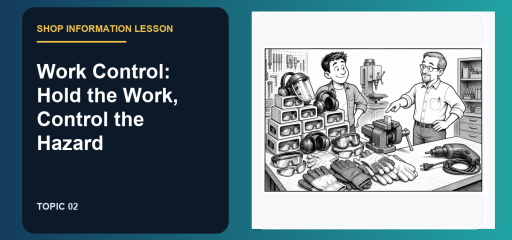
The most tempting wrong answer in a shop situation is often 'hold it tighter.' Hands are not a substitute for a vise, clamp, or guide. When stock shifts, the tool can bind, grab, or move toward the person using it.
Treat stock that could spin, slide, lift, or twist when force is applied as the lead evidence. It points toward the setup that will let the operation happen with control rather than guesswork.
What does work control mean?
Work control means keeping the material stable while the tool does its job. A vise, clamp, fence, guide, or support prevents twisting, slipping, kickback, and hand exposure. If the work cannot stay still, the operation is not ready to begin.
Which clues should you notice first?
Before choosing an answer, translate the picture into a job statement. stock that could spin, slide, lift, or twist when force is applied should make you think about the action, the workpiece, and the amount of control required.
- Working clue: stock that could spin, slide, lift, or twist when force is applied
- Best next move: use the proper workholding device or guide instead of a hand near the hazard
- Why it matters: the right setup protects the work, the tool, and the person using it.
How do the close choices differ?
| Tool or idea | What it does |
|---|---|
| A clamp | holds material in place for an operation |
| A glove | does not replace workholding near moving parts |
Close choices often reward a vague answer such as “either one could work.” Compare A clamp and A glove by the result each one produces, then choose the one the task actually requires.
Put the clue into a shop decision
Imagine that a question or illustration gives you stock that could spin, slide, lift, or twist when force is applied. Before you look for a familiar name, say what the work actually needs: use the proper workholding device or guide instead of a hand near the hazard. Then test each choice against the physical result. A choice that cannot produce the needed result is out, even if it belongs to the same general family. This is also where the difference between A clamp and A glove becomes useful. One clear reason is enough to reject a close distractor.
Watch the skill in context
Shop Safety And The Knowing Right Tool For Job by Northern New York Parts – Small Engine Repairs is a useful visual companion to this lesson. While you watch, pause when the working end contacts the material and name the action before the presenter explains it.
Use this four-step routine
- Predict where the cutting or driving force will go.
- Ask whether the piece can rotate or slide.
- Choose a vise, clamp, fence, or support.
- Keep hands outside the tool path.
Try the decision, then check your reasoning
- You see stock that could spin, slide, lift, or twist when force is applied. What detail should lead your decision? The condition that changes the tool choice or safe setup is the first clue.
- What is the best response when the task calls for stock that could spin, slide, lift, or twist when force is applied? Use the proper workholding device or guide instead of a hand near the hazard.
- How is A clamp different from A glove? A clamp holds material in place for an operation; A glove does not replace workholding near moving parts.
- What should you do if the tool, setup, or workpiece does not match the job? Pause and correct the mismatch before applying more force.
Keep building your shop vocabulary
Use the ASVAB topic archive to move through the lessons in a practical order. A productive study habit is to describe the clue aloud before checking the answer. That turns recognition into a repeatable decision.
Related lessons:

Related to This Article
More math articles
- Why Inequality Persists
- Matrix Calculator (2×2 Add, Multiply, Determinant & Inverse)
- Confidence Interval for a Proportion Calculator (Free)
- Recognizing Other Viewpoints
- 6th Grade Common Core Math Worksheets: FREE & Printable
- Coordination and Subordination
- Convert Rational Numbers to a Fraction
- Interpreting charts, graphs, and polling data
- Overview of the PSAT / NMSQT Mathematics Test
- Integral Approach to Cumulative Growth






















What people say about "Work Control: Hold the Work, Control the Hazard"?
No one replied yet.