Screws, Bolts, Nuts, and Washers
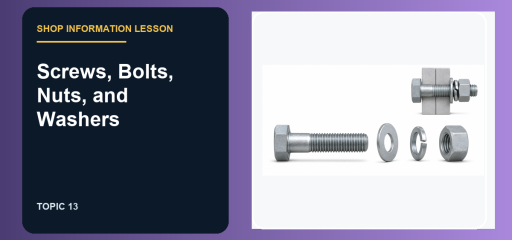
Fastener questions become manageable when you separate the parts. First identify what turns. Then identify what receives the threads. Finally notice whether a washer is there to spread load, seal, or help prevent loosening.
The practical task here is to match the fastener system to the material, access, and load-spreading need. In a real shop, that choice controls the work before it becomes a mistake that is harder to undo.
What does screws, bolts, nuts, and washers mean?
Threaded fasteners hold parts together by converting turning force into clamping force. A screw engages a threaded material or pilot hole, a bolt usually works with a nut, and a washer can spread load, protect a surface, or help resist loosening depending on its design.
Which clues should you notice first?
Read the noun and the verb together. In this topic, threads, a nut, a washer, or a request to hold two parts together is not scenery; it is the detail that tells you what the tool or setup must accomplish.
- Working clue: threads, a nut, a washer, or a request to hold two parts together
- Best next move: match the fastener system to the material, access, and load-spreading need
- Why it matters: the right setup protects the work, the tool, and the person using it.
How do the close choices differ?
| Tool or idea | What it does |
|---|---|
| Flat washer | spreads load and protects the surface |
| Lock washer | helps resist loosening in the intended assembly |
The distinction between Flat washer and Lock washer is useful because the tools may appear in the same answer set while doing different jobs. Match the stated feature, not the broad category.
Put the clue into a shop decision
Imagine that a question or illustration gives you threads, a nut, a washer, or a request to hold two parts together. Before you look for a familiar name, say what the work actually needs: match the fastener system to the material, access, and load-spreading need. Then test each choice against the physical result. A choice that cannot produce the needed result is out, even if it belongs to the same general family. This is also where the difference between Flat washer and Lock washer becomes useful. One clear reason is enough to reject a close distractor.
Watch the skill in context
How to Use Nuts and Bolts by Advanced engineering technologies is a useful visual companion to this lesson. Use the video to reinforce the visible clue and the safe setup, not to memorize a brand or a particular model.
Use this four-step routine
- Identify the parts being joined.
- Check whether both sides are accessible.
- Match the head and thread to the task.
- Use a washer only for its stated purpose.
Try the decision, then check your reasoning
- You see threads, a nut, a washer, or a request to hold two parts together. What detail should lead your decision? The condition that changes the tool choice or safe setup is the first clue.
- What is the best response when the task calls for threads, a nut, a washer, or a request to hold two parts together? Match the fastener system to the material, access, and load-spreading need.
- How is Flat washer different from Lock washer? Flat washer spreads load and protects the surface; Lock washer helps resist loosening in the intended assembly.
- What should you do if the tool, setup, or workpiece does not match the job? Pause and correct the mismatch before applying more force.
Keep building your shop vocabulary
Use the ASVAB topic archive to move through the lessons in a practical order. For your next review, cover the tool name, state the job in a few words, and then predict the feature you would expect to see.
Related lessons:

Related to This Article
More math articles
- 4th Grade NYSE Math Worksheets: FREE & Printable
- Machine Controls: Guides, Guards, and Work Support
- How to Solve Word Problems of Elapsed Time
- Question order
- The Ultimate OAR Math Course (+FREE Worksheets)
- How to Solve Composition of Functions? (+FREE Worksheet!)
- ALEKS Math Placement Review and FAQs
- Dual federalism
- Nevada Smarter Balanced Grade 7 Math Worksheets: 95 Free Printable Skill PDFs
- Types of Evidence






















What people say about "Screws, Bolts, Nuts, and Washers"?
No one replied yet.