5 Algebra 1 Books: Choose the Right Study Guide
Choose an Algebra 1 book by the help you need: explanations, worked solutions, independent practice, or a second way to see a concept. This guide compares five books and explains what to check before buying for self-study, homeschool, tutoring, or class support.
Quick answer: The best Algebra 1 book depends on how you learn. For self-study, pick one with short lessons and full worked solutions, such as No-Nonsense Algebra by Richard W. Fisher. For lots of practice, The Humongous Book of Algebra Problems by W. Michael Kelley shows every step. Nervous beginners often like Painless Algebra. Our own Algebra I for Beginners is also listed below, and we say so openly.
How this guide was prepared: we checked the publishers’ descriptions and an approved sample of our own book. This is a comparison of features and learner fit, not a hands-on effectiveness test or a ranking of the whole market. Effortless Math publishes Algebra I for Beginners. Amazon links below are affiliate links; we may earn a commission at no extra cost to you.
Five Algebra 1 books at a glance
Use this shortlist to decide which samples to inspect. The order is not a score.
- Algebra I for Beginners
A guide with worked examples and printable practice. - No-Nonsense Algebra, 2nd Edition
Short lessons with accompanying videos. - The Humongous Book of Algebra Problems
Working through annotated solutions. - Painless Algebra, 5th Edition
Illustrated review with chapter checks. - High School Algebra I Unlocked
Concept review and alternative approaches.
What each book offers
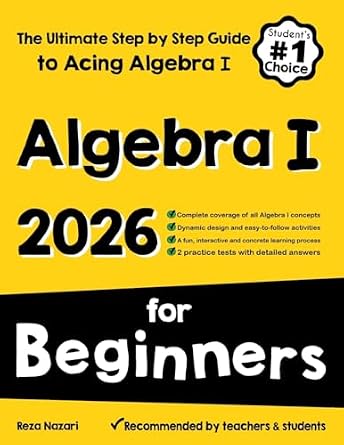
Algebra I for Beginners
Effortless Math
The approved sample shows short explanations, a number-line illustration and worked solutions before the learner moves on. Consider it if you want to read a model and then practise a similar skill.
Before buying: Open the sample pages to judge the pace. The Effortless Math store offers a printable PDF; the Amazon listing is a separate purchase path. Check the format and edition on the destination you choose.
No-Nonsense Algebra, 2nd Edition
Richard W. Fisher · Math Essentials
Math Essentials lists a Pre-Algebra review, worked solutions, chapter reviews, a final exam and online video tutorials for each lesson. Consider this combination if you want a written lesson and a second explanation on screen.
Before buying: Check the publisher’s video access directions before buying. The second-edition paperback is ISBN 9780999443330; the publisher lists a different ISBN for its DVD option.

The Humongous Book of Algebra Problems
W. Michael Kelley · DK
The publisher describes an algebra workbook with notes that fill in omitted solution steps. It is worth considering when you can start a problem but need help understanding the transitions in the worked solution.
Before buying: Inspect the contents against your course before buying. The publisher lists paperback ISBN 9781592577224. An annotated problem book and a school’s assigned course textbook can serve different purposes.

Painless Algebra, 5th Edition
Lynette Long · Barron’s
The publisher lists equations, inequalities, graphing, roots and radicals, with illustrations, tips, plain-language math boxes and Brain Tickler quizzes. Consider it if visual explanations and frequent checks suit your study routine.
Before buying: The publisher identifies this edition for grades 6–9 and lists paperback ISBN 9781506268064. Match its topics to your syllabus; a grade range alone does not establish a school-course match.

High School Algebra I Unlocked
The Princeton Review
The publisher lists guided examples, different approaches to problems, chapter drills, self-assessments and answer explanations. Topics include functions, systems, polynomials and quadratics. Consider it if you want to compare methods and then try independent practice.
Before buying: Paperback ISBN 9781101882191 was published in 2016. Its publisher description mentions ACT- and SAT-like questions; that does not make it a current exam-specific preparation guide.

How to choose a book for self-study or class support
Open a sample on a topic you already recognise, such as solving a linear equation. Read the explanation, cover the worked solution, and try the next step yourself. A useful sample lets you follow the reasoning and check where your work diverges.
- Compare the contents with your course. Look for the actual topics you need, not just “Algebra” on the cover. A school may require a particular textbook or edition.
- Check the answer support. A final answer helps you mark work; explained solutions help you diagnose a missed step. For independent study, inspect both the practice and the available explanations.
- Choose the format you will use. A printable PDF and a shipped paperback are separate products. Confirm the selected format, edition, delivery and returns on the seller’s page.
- Check companion access. If videos or online resources matter to you, read their access instructions. Do not assume every format or used copy includes the same access.
- Start with one suitable resource. You do not need all five books. Add another only when it solves a specific gap, such as more practice or a clearer explanation.
Which book should I consider for independent study?
Start by comparing the sample explanations and answer support in Algebra I for Beginners and No-Nonsense Algebra. If you prefer alternative methods, also inspect High School Algebra I Unlocked. The right choice depends on which explanation you can follow without someone filling in missing steps.
Does an older publication date make an algebra book unusable?
The basic algebra does not change each year. Check topic coverage, readability, answer support and your school’s requirements. For a current exam, use the exam provider’s current specifications as well; a general Algebra 1 book is not proof of full exam coverage.
Try a free Algebra 1 study route before buying
Open the Algebra 1 Online Center, choose one topic, read its lesson and try the matching practice resource. This helps you decide whether you need more explanation, more practice, or both. Existing worksheet resources stay free to use under their own directions.
If you want to inspect our guide next, open Algebra I for Beginners and its book preview. Compare a lesson sample with your learning needs before choosing the PDF or a separate paperback listing.
Publisher sources and edition checks
These sources identify the books and the features discussed above. Seller prices and availability can change; check the destination before ordering.
Algebra 1 books compared side by side
Here is a quick way to match a book to a student. One note in fairness: Algebra I for Beginners is written and sold by Effortless Math, so weigh our opinion of it with that in mind.
| Book | Author or publisher | Best for | Style |
|---|---|---|---|
| Algebra I for Beginners | Reza Nazari, Effortless Math (our book) | Students starting from scratch | Short lessons, practice sets, answer keys |
| No-Nonsense Algebra | Richard W. Fisher | Self-study and homeschool | Short daily lessons with review |
| The Humongous Book of Algebra Problems | W. Michael Kelley | Extra practice and checking work | Hundreds of problems with notes on each step |
| Painless Algebra | Lynette Long, Barron’s | Anxious or rusty learners | Friendly explanations, light practice |
| High School Algebra I Unlocked | The Princeton Review | Students who want strategy and test-style review | Concept review with practice questions |
How to study Algebra 1 on your own
A good book only helps if you use it steadily. Pick one main book and stay with it, rather than jumping between three. Study for 30 to 45 minutes most days. Read the lesson, copy one worked example by hand, then do the practice set without looking at the answers. Check every answer, and redo any problem you missed the next day.
Keep a short list of mistakes you make often, such as sign errors or forgetting to distribute a negative. Review it before each session. Every two or three chapters, do a mixed review so older skills stay fresh. If one topic stays confusing after two tries, watch a free video lesson on it, then return to the book. Steady practice beats long weekend cram sessions.
Frequently Asked Questions
What is the best Algebra 1 textbook?
The best Algebra 1 textbook is the one that matches how you learn. A student studying alone usually needs short lessons and complete worked solutions, while a student already in a class may need extra practice more than long explanations. Compare sample pages from two or three books, and check that the edition covers linear equations, functions, systems, exponents and quadratics.
What is the best Algebra 1 book for self-study?
For self-study, look for a book with clear explanations, many worked examples and an answer for every practice problem, so you can check yourself without a teacher. No-Nonsense Algebra offers short lessons with videos, and The Humongous Book of Algebra Problems explains each step in the margin. Work one section a day and redo missed problems before moving on.
What is the best Algebra 1 workbook?
A good Algebra 1 workbook gives plenty of practice for each skill, mixed review sections and a full answer key. It suits students who already understand the lessons from class but need more repetitions. For example, after learning to solve 3x + 5 = 20, a workbook might give twenty similar equations so subtracting first, then dividing, becomes automatic.
What is Algebra 1 used for?
Algebra 1 teaches you to describe and solve problems with variables, and those skills show up in later math, science, budgeting and many careers. If a phone plan costs $20 plus $5 per gigabyte, the equation C = 20 + 5g lets you find the cost of any amount of data. Algebra 1 is also the foundation for geometry, Algebra 2 and SAT or ACT math.
What is the difference between Algebra 1 and Algebra 2?
Algebra 1 covers the basics: linear equations and inequalities, slope, functions, systems of equations, exponent rules, polynomials, factoring and an introduction to quadratics. Algebra 2 builds on that with complex numbers, polynomial and rational functions, exponential and logarithmic functions, and often sequences and trigonometry. Most students need solid Algebra 1 skills before starting Algebra 2.
Is there a free Algebra 1 textbook online?
Yes. Free options include OpenStax Elementary Algebra 2e, which you can read online or download as a PDF, and CK-12’s free algebra materials. Free lessons and worksheets are also a good way to try a study routine before buying a book. If you later buy one, check the edition and sample pages so the topics match your course.

Related to This Article
More math articles
- 4th Grade MEAP Math Practice Test Questions
- The Ultimate PERT Math Course (+FREE Worksheets & Tests)
- Political association and party membership
- 6th Grade ACT Aspire Math FREE Sample Practice Questions
- Constitutional compromises over representation
- The Best Grade 4 ELA Practice Tests for Maryland Students
- Free Grade 6 English Worksheets for Maryland Students
- 7th Grade Math Worksheets for Georgia (Milestones): 95 Free Printable PDFs
- The Best Grade 3 ELA Practice Tests for Utah Students
- Full-Length 7th Grade ACT Aspire Math Practice Test-Answers and Explanations





What people say about "Best Algebra 1 Textbooks and Books for Self-Study"?
No one replied yet.