Mastering the Basics: The Significance of “Algebra I for Beginners” in Your Back-to-School List

Algebra replaces numbers with letters so that one statement can describe every case at once, which is why it underpins every later math course. Below: what algebra adds to arithmetic, the reasoning skills it builds, and how a beginner’s course sequences the first topics.
Why Algebra is Essential
Algebra, a primary branch of mathematics, introduces you to a world where symbols and letters replace numbers, serving as placeholders in formulas and equations. While these letters and symbols may seem puzzling at first glance, their mastery will unfold a new world of understanding that you’ll be glad you entered. Here’s why:
Building Blocks of Mathematics
Algebra is not just a stand-alone subject; it’s the foundational bedrock upon which higher-level mathematics is built. A solid grasp of algebraic concepts translates to an easier journey through the complex landscapes of calculus, geometry, and trigonometry. Imagine algebra as your trusty compass in the vast wilderness of mathematics, guiding you through unexplored terrains with ease and confidence.
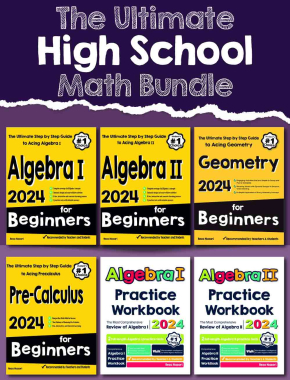
The Absolute Best Book to Ace Pre-Algebra
Enhancing Critical Thinking Skills
Beyond its mathematical applications, algebra has a profound impact on developing one’s critical thinking skills. The abstract thought processes inherent in algebra, like piecing together parts of an equation or identifying patterns, stimulate your cognitive faculties, supporting problem-solving capabilities and logical reasoning. It’s like a gym workout for your brain, strengthening mental muscles you’ll use throughout your life.
Real-world Applications of Algebra
Contrary to common misconception, algebra isn’t a cryptic discipline confined to the four walls of a classroom. Instead, it permeates every corner of our daily lives, often in ways we may not even realize. From managing finances and calculating expenses to figuring out the most efficient route for a road trip, algebra finds its way into plenty of practical scenarios. Picture it as a secret language of the world around us, waiting to be decoded.
Starting with ‘Algebra I for Beginners’
As the title aptly suggests, “Algebra I for Beginners” is a comprehensive book crafted with the express purpose of opening the door to the fascinating world of algebra for newcomers. It’s akin to your very first step into an exciting journey of exploration and discovery in the field of mathematics.

Overview of ‘Algebra I for Beginners’
Algebra I for Beginners breaks down the potentially intimidating world of algebra into manageable, easily digestible sections. Much like constructing a building, the book begins with the rudimentary bricks of basic arithmetic operations. Once you’re comfortable with these fundamentals, the book proceeds to layer more advanced concepts, gradually and consistently, ensuring you never feel overwhelmed.
Key Topics Covered in the Book
In terms of content, Algebra I for Beginners is a comprehensive sweep across key algebraic concepts. It acquaints you with linear equations, quadratic equations, polynomials, and functions, among other vital topics. Each of these serves as a pillar in your understanding of algebra, forming an integral part of your mathematical toolkit.
The Best Algebra Prep Resource
Advantages of Starting with ‘Algebra I for Beginners’
Why opt for Algebra I for Beginners? Simply put, the book is your key to decoding the mystical language of algebra. It offers a gentle and steady introduction to the subject, nurturing your understanding from the ground up, thereby laying a solid foundation for your progression in the subject.
Incorporating ‘Algebra I for Beginners’ in Your Back-to-School List
The merits of including Algebra I for Beginners in your back-to-school list are plentiful and significant.
Setting a Strong Foundation
Firstly, the book aids students in grasping the fundamental concepts of algebra, which serves as the bedrock upon which more advanced mathematical studies are built. Think of it as planting a seed that will grow into a tree of mathematical knowledge.
Boosting Confidence in Mathematics
Secondly, by making algebraic concepts accessible and easy to understand, Algebra I for Beginners instills a newfound sense of confidence in students toward mathematics. It’s the equivalent of having a supportive friend guiding you along an unfamiliar path.
Making Advanced Math More Approachable
Lastly, a solid foundation in algebra paves the way for other advanced mathematics subjects, making them less intimidating and more welcoming. It’s like having a flashlight in a dark room, revealing the path ahead.
Final Words
mastering algebra is not a destination but a journey. It begins with Algebra I for Beginners, a stepping stone setting you on the path to conquering more complex math subjects. Make sure it finds its place in your back-to-school list and prepare yourself for an exciting adventure in the world of mathematics!
FAQs
What is algebra for beginners?
Beginner algebra is the step from arithmetic to using letters, called variables, for numbers you do not know yet. Instead of 5 + ? = 12, you write x + 5 = 12 and solve to get x = 7. A first Algebra I course usually covers expressions, order of operations, solving one-step and two-step equations, inequalities, and graphing straight lines.
What are some algebra tips for beginners?
Master integers and fractions first, since most algebra mistakes are really arithmetic slips. Whatever you do to one side of an equation, do to the other. Write every step on its own line so you can find errors. Check each answer by substituting it back: if 3x − 4 = 11 gives x = 5, then 3 × 5 − 4 = 11 confirms it.
What is basic algebra?
Basic algebra is the set of rules for working with variables, expressions and equations. It includes combining like terms (3x + 2x = 5x), using the distributive property (2(x + 4) = 2x + 8), and solving equations by undoing operations in reverse order. These skills are the foundation for Algebra II, geometry proofs, trigonometry and later calculus.
How can a beginner understand algebra?
Think of an equation as a balanced scale: both sides weigh the same, so any change must be made to both sides to keep it balanced. Start with small, everyday problems, such as “I have $20 and tickets cost $4 each; how many can I buy?”, which is 4t = 20, so t = 5. Short daily practice builds understanding faster than occasional long sessions.

Related to This Article
More math articles
- Pattern Power: How to Unravel Division Trends Across Expanding Place Values
- How to Study, Use IFUs, and Verify Sources
- PSAT 8/9 Calculators: Bluebook Options and 5 Handhelds
- Quadrilaterals and Rectangles
- Bureaucracy, Pluralism, Elite Theory, and the Power Elite
- Converting Units of Weight/Mass for 4th Grade
- 3D Shapes for 5th Grade: Faces, Edges, and Vertices
- 6th Grade WVGSA Math Worksheets: FREE & Printable
- Indiana Algebra 1 Free Worksheets: Free Skill-Targeted Algebra 1 Worksheets with Answer Keys
- ASWB Three-Option Questions: Use Evidence to Eliminate a Distractor (2027 Prep)



What people say about "Algebra I for Beginners: What It Covers"?
No one replied yet.