Community, Gemeinschaft, and Gesellschaft
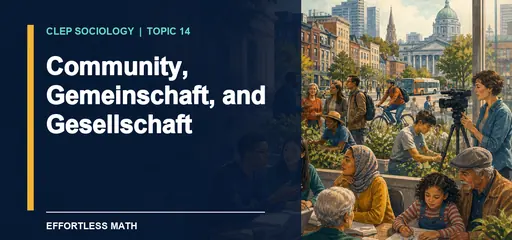
Chapter 14 of the CLEP Sociology study guide on Effortless Math covers Community, Gemeinschaft, and Gesellschaft: the key terms, the core ideas, and worked examples showing how this topic is tested on the exam.

CLEP Sociology – Chapter 14
Community, Gemeinschaft, and Gesellschaft
CLEP Introductory Sociology · Chapter 14
Community, Gemeinschaft, and Gesellschaft
A community can be a population connected by place, sustained interaction, shared identity, or obligation. These features often overlap, but they need not. A resident can feel attached to a neighborhood while knowing few neighbors, and a dispersed network can maintain strong ties without one territory.
Ferdinand T”onnies contrasted Gemeinschaft with Gesellschaft. Gemeinschaft describes relationships experienced as personal, lasting, and rooted in kinship, tradition, or shared life. Gesellschaft describes more impersonal relationships organized around formal roles, contracts, and individual aims.
These are ideal types, not a claim that villages contain only warmth or cities contain only isolation. A city congregation can exchange long-term personal care, while a rural bank relies on specialized offices and contracts. One family business can contain loyalty and formal wage rules at the same time.
Louis Wirth argued that large size, density, and social heterogeneity encourage specialized, segmental, and relatively impersonal ties. His urbanism thesis describes a tendency. It does not claim that friendship, family, or solidarity disappear in cities.
Claude Fischer’s subcultural approach emphasizes that large cities can support specialized networks. Enough people may share a less common identity, occupation, art, language, or interest to sustain institutions and close ties. Urban scale can therefore create new forms of community.
Digital communication complicates place without erasing it. A neighborhood group can coordinate online and act locally. A disability-rights community can exchange support across great distance. Researchers ask whether members maintain interaction, mutual aid, identity, and obligation rather than assuming that a screen makes the tie unreal.
Community measures should be separated. Contact frequency, trust, mutual aid, shared identity, organizational participation, and place attachment can move differently. A survey response saying “I belong here” does not prove that neighbors exchange care.
Strong internal ties can include and exclude. A close network may provide jobs, child care, and emergency aid to members while making newcomers feel unwelcome. Social capital is a resource in relationships, but access to those relationships is unequal.
Neighborhood change can disrupt community without eliminating every tie. Rising rents may disperse residents while they preserve contact. New residents may build a different set of institutions. The population, place, and social network can change on different schedules.
To classify a relationship, ask what makes it binding. Continuing obligation based on kinship, tradition, and shared history points toward Gemeinschaft. A specialized transaction governed by office and contract points toward Gesellschaft. Real cases often combine both.
Place alone does not create community. Residents of one apartment tower may remain strangers, while former residents scattered across several states exchange care, money, news, and obligations every week. Researchers can map interaction, mutual aid, shared identity, participation, and the consequences of breaking group expectations. A postal boundary is useful evidence for proximity, but it cannot establish belonging by itself.
Gemeinschaft and Gesellschaft are ideal types of relationships rather than stages running from a rural past to an urban future. A city neighborhood may contain kin-based care and long personal memory, while a small town bank uses contracts, formal offices, and calculated exchange. The same person can move between both patterns during one day. Personal ties can provide trust and support, yet they can also exclude outsiders or enforce conformity. Formal relations can feel impersonal while giving strangers predictable rights. On a CLEP item, follow the relationship: personal obligation and tradition point toward Gemeinschaft, while office, contract, and limited-purpose exchange point toward Gesellschaft.
Evidence about community should show repeated ties or obligations. Researchers might count visits, child-care exchanges, emergency loans, association meetings, or messages among residents. Interviews can reveal who feels entitled to ask for help and who remains outside the circle. High interaction may produce solidarity, conflict, or both. A neighborhood campaign can unite residents around a park while exposing disagreement about policing, noise, or who belongs. Community names a social relationship whose outcomes remain open.
Quick review: Community can rest on place, interaction, identity, or obligation. Gemeinschaft emphasizes personal and tradition-rooted ties. Gesellschaft emphasizes formal roles and calculated exchange. Both can appear in urban or rural settings, and strong solidarity can coexist with exclusion.
Watch the lesson connection
What Are Gemeinschaft and Gesellschaft Societies? gives you a second explanation of the ideas surrounding this lesson. As you watch, pause when the lesson concept appears and explain how the example fits.
Use this lesson for CLEP practice
Write one original example, one close nonexample, and one observation that would help you choose between them. This turns vocabulary recognition into the kind of applied reasoning the exam expects.

Related to This Article
More math articles
- Top 10 Tips You MUST Know to Retake the FTCE Math Test
- How to Solve Word Problems Involving Multiplying Mixed Numbers?
- Chief executive
- TExES Core Subjects Math Worksheets: FREE & Printable
- The Ultimate 6th Grade MAP Math Course (+FREE Worksheets)
- State sovereignty
- The Best Grade 7 ELA Practice Tests for Montana Students
- Disability rights
- The Ultimate Pre-Algebra Course (+FREE Worksheets)
- Seventeenth Amendment



















What people say about "Community, Gemeinschaft, and Gesellschaft | CLEP Sociology"?
No one replied yet.