Sheet-Metal and Electrical Hand Tools
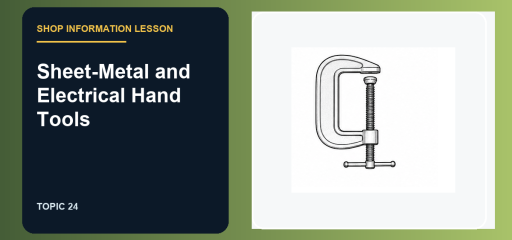
These tools often look alike because they all have handles and jaws. The difference is in the working end and the result. Does it shear a sheet, bend a seam, strip insulation, or grip a conductor? One verb can settle the question.
Good shop judgment has a sequence: notice the condition, decide what the work requires, then act. Here, that means you should choose the tool that performs the stated controlled action.
What does sheet-metal and electrical hand tools mean?
Sheet-metal and electrical tools are chosen for a specific controlled action. Snips shear thin sheet, seamers bend or form edges, nibblers remove narrow paths of metal, and electrical hand tools grip, strip, cut, or crimp conductors without being substitutes for live-work training.
Which clues should you notice first?
Start with the evidence you could point to in a picture. thin sheet, a formed seam, insulation, wire, or a conductor terminal gives you a concrete reason to eliminate choices that cannot handle the stated job.
- Working clue: thin sheet, a formed seam, insulation, wire, or a conductor terminal
- Best next move: choose the tool that performs the stated controlled action
- Why it matters: the right setup protects the work, the tool, and the person using it.
How do the close choices differ?
| Tool or idea | What it does |
|---|---|
| Aviation snips | shear sheet metal along a cut line |
| Hand seamer | bends or forms a sheet-metal edge |
Think in outcomes rather than appearances. The relevant question is whether the job needs what Aviation snips does or what Hand seamer does.
Put the clue into a shop decision
Imagine that a question or illustration gives you thin sheet, a formed seam, insulation, wire, or a conductor terminal. Before you look for a familiar name, say what the work actually needs: choose the tool that performs the stated controlled action. Then test each choice against the physical result. A choice that cannot produce the needed result is out, even if it belongs to the same general family. This is also where the difference between Aviation snips and Hand seamer becomes useful. One clear reason is enough to reject a close distractor.
Watch the skill in context
Nibblers vs Single Cut Shears vs Double Cut Shears – Cutting Sheet Metal – Right Tool For the Job by Ohio Power Tool is a useful visual companion to this lesson. Use this as a short observation exercise: identify the material, the action, and the control before you move on.
Use this four-step routine
- Read the action verb.
- Identify the material.
- Check the working edge or jaw.
- Use only the tool designed for that operation.
Try the decision, then check your reasoning
- You see thin sheet, a formed seam, insulation, wire, or a conductor terminal. What detail should lead your decision? The condition that changes the tool choice or safe setup is the first clue.
- What is the best response when the task calls for thin sheet, a formed seam, insulation, wire, or a conductor terminal? Choose the tool that performs the stated controlled action.
- How is Aviation snips different from Hand seamer? Aviation snips shear sheet metal along a cut line; Hand seamer bends or forms a sheet-metal edge.
- What should you do if the tool, setup, or workpiece does not match the job? Pause and correct the mismatch before applying more force.
Keep building your shop vocabulary
Use the ASVAB topic archive to move through the lessons in a practical order. Build speed only after you can explain the choice. Clear reasoning is what makes recognition reliable under time pressure.
Related lessons:

Related to This Article
More math articles
- Smarter Balanced Grade 6 Math Free Worksheets: 72 Printable Standards-Aligned PDFs with Answer Keys
- 5th Grade PARCC Math FREE Sample Practice Questions
- Dividing by 1-Digit Numbers (No Remainders) for 4th Grade
- Symbols, Language, and Linguistic Relativity
- 8th Grade NDSA Math Worksheets: FREE & Printable
- Policy Mix, Transmission, Rules, and Lags
- Community, Gemeinschaft, and Gesellschaft
- Qualitative, Content, and Existing-Record Methods
- Subtracting Decimals for 5th Grade: Regrouping and Practice
- SAT Math Flashcards (Free Online: Formulas, Terms & Concepts)






















What people say about "Sheet-Metal and Electrical Hand Tools"?
No one replied yet.