CLEP U.S. History I 085: Irish and German Immigration
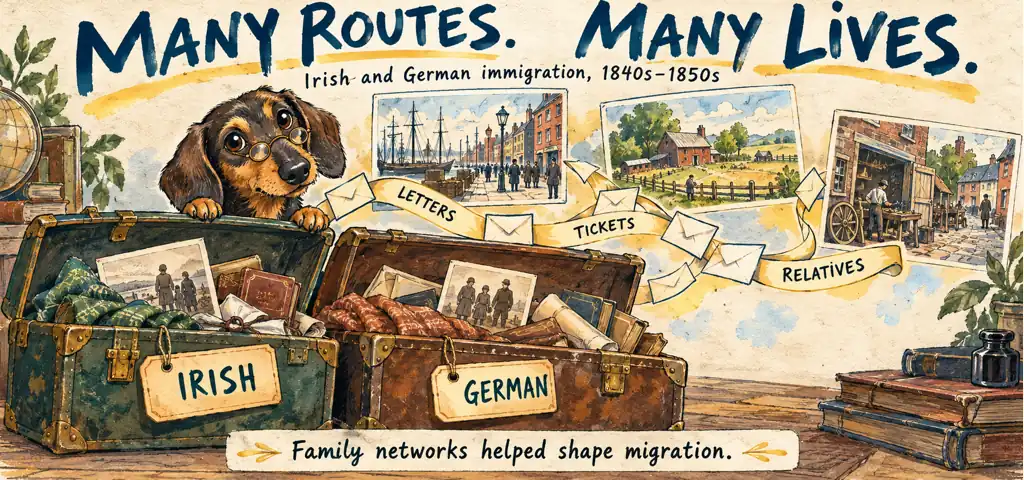
Lesson 16.1 of Chapter 16 of the U.S. History to 1877 study guide on Effortless Math covers CLEP U.S. History I 085: Irish and German Immigration: the key terms, the core ideas, and worked examples showing how this topic is tested on the exam.
U.S. History to 1877 | Chapter 16 | Lesson 16.1
The Great Famine drove mass Irish migration after 1845. Many migrants arrived poor, Catholic, and dependent on wage work in eastern cities. They built parishes, mutual-aid societies, newspapers, and political networks. Irish workers entered construction, domestic service, docks, factories, and canal work, often facing signs and practices that excluded them. Their political participation could offer protection and jobs, but Irish communities were not politically uniform. Conflict over slavery, labor competition, and the Civil War draft later exposed deep divisions.
German migration rose after failed revolutions in 1848, though economic pressure and family networks also mattered. German migrants included farmers, artisans, professionals, and political refugees. Many moved to the Midwest as well as cities, sustaining German-language schools, churches, newspapers, and associations. Some Forty-Eighters supported abolition, public education, and the Republican Party. Others followed different political paths.
Migration worked through chains rather than isolated individual decisions. Letters, prepaid tickets, remittances, relatives, and familiar institutions lowered risk and directed newcomers toward particular neighborhoods or towns. Class, region, religion, age, and date of arrival all changed experience inside the broad labels “Irish” and “German.” The categories are useful only when a comparison states its scale and avoids turning a statistical tendency into a personal stereotype.
A focused video lesson
Selah Social Studies traces the people and chronology behind this lesson. Listen for the evidence that sharpens the written account, then try the questions below.
Video: Irish and German Immigration 1840-1860, Selah Social Studies.
Check your understanding
- The sharp rise in Irish immigration in the late 1840s was driven most directly by
- failed continental revolutions in 1848.
- the Great Famine.
- existing Irish chain-migration networks alone.
- repeal of Britain’s Corn Laws.
- reports of California gold discoveries.
- The label “Forty-Eighters” most directly associates many German migrants with
- conservative restoration after the Congress of Vienna.
- the Irish campaign to repeal the Act of Union.
- U.S. territorial expansion after the Mexican War.
- liberal and nationalist revolutions.
- Britain’s Chartist petition movement.
- Select all institutions immigrants used to build community:
- churches,
- newspapers,
- mutual-aid societies,
- schools,
- political organizations.
- State one useful broad contrast and one caution when comparing Irish and German migrants.
Write a brief response using a named fact from the lesson.
Open the answers and reasoning
Independent preparation. CLEP is a registered trademark of the College Board, which does not endorse this lesson.

Related to This Article
More math articles
- FREE 5th Grade NYSE Math Practice Test
- The Ultimate CLEP College Algebra Formula Cheat Sheet
- The Ultimate 6th Grade NSCAS Math Course (+FREE Worksheets)
- Free Grade 6 English Worksheets for Vermont Students
- Free Grade 6 English Worksheets for Nebraska Students
- Platforms, Algorithms, Data, and Surveillance
- Best Math Websites for Students
- Price discrimination requires separation and limited resale
- 10 Most Common 4th Grade FSA Math Questions
- How to Multiply Exponents? (+FREE Worksheet!)






















What people say about "Irish and German Immigration"?
No one replied yet.