CLEP U.S. History I 043: Federalists and Democratic-Republicans
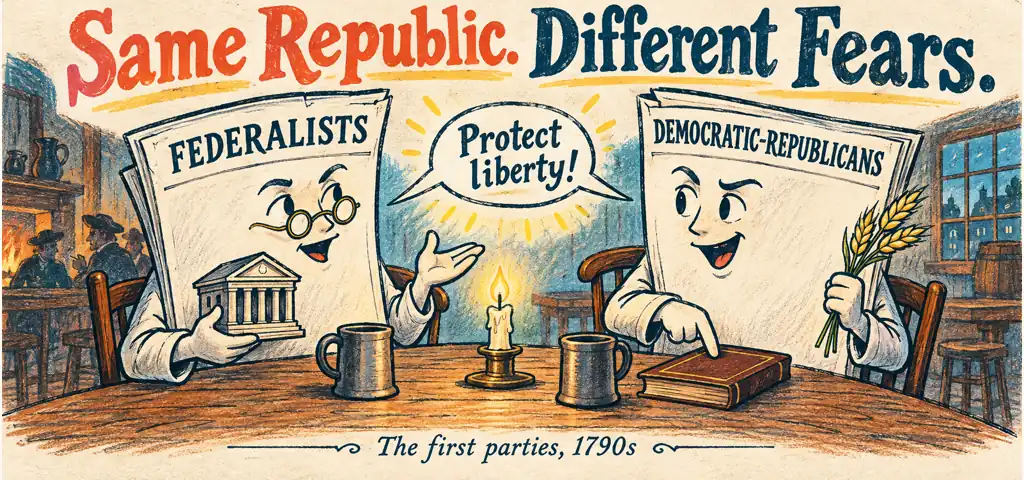
Lesson 8.5 of Chapter 8 of the U.S. History to 1877 study guide on Effortless Math covers CLEP U.S. History I 043: Federalists and Democratic-Republicans: the key terms, the core ideas, and worked examples showing how this topic is tested on the exam.
U.S. History to 1877 | Chapter 8 | Lesson 8.5
The Constitution does not establish political parties, and many founders associated parties with selfish factions. Yet sustained disagreements required organization. Hamilton’s allies became Federalists. Jefferson and Madison’s supporters became Democratic-Republicans, often called Republicans at the time. Their conflict involved more than personality. Federalists favored energetic national administration, broad construction of federal powers, public credit, commercial development, and diplomatic accommodation with Britain. Democratic-Republicans stressed limited federal power, strict construction, agrarian independence, sympathy for revolutionary France, and vigilance against concentrated financial and executive authority.
Social patterns were real but not absolute. Federalists were especially strong among merchants, creditors, professionals, and established groups in New England and commercial towns. Democratic-Republicans gained support among southern planters, small farmers, artisans, and immigrants, and they built organizations across regions. Enslaved people, most women, and many propertyless men had no formal vote, but political discussion extended beyond voters. Newspapers, pamphlets, taverns, parades, civic societies, and public celebrations made politics participatory and often bitter. Partisan editors treated policy disagreement as a struggle for the Revolution’s survival.
The parties also interpreted the same ideals differently. Both claimed to defend republican liberty. Federalists argued that stable finance and lawful administration protected the republic from disorder and foreign manipulation. Republicans warned that debt, a standing army, executive secrecy, and an alliance with commercial elites could reproduce corruption associated with Britain. Neither side maps perfectly onto a modern party. Federalists could defend centralized power while distrusting mass democracy. Republicans could invoke equality while many leaders held people in slavery and protected state power where it supported their interests.
The election of 1796 demonstrated the emerging system’s awkward fit with the original electoral rules. John Adams, a Federalist, became president. Jefferson, the Republican runner-up, became vice president. The executive branch thus contained rival leaders. Party competition had become national before constitutional machinery had adapted to it.
Watch, then test the claim
Watch this account from History with Ms. H with one question in mind: which evidence makes the lesson's strongest claim hold up?
Video: The First Political Parties of the US: Federalist vs Democratic Republicans | History with Ms. H, History with Ms. H.
Check your understanding
- Which position was most characteristic of Democratic-Republicans in the 1790s?
- broad construction for federal corporations
- elimination of state governments
- hereditary executive office
- permanent alliance with Britain
- sympathy for revolutionary France
- Federalists generally viewed Hamilton’s public-credit system as
- a means to strengthen national stability
- an unconstitutional surrender to France
- a plan to abolish commerce
- protection for state currencies only
- an attack on creditors
- Deep Practice: select all that apply. Partisan mobilization occurred through
- newspapers
- civic societies
- parades
- tavern discussion
- a constitutionally created party bureau
- Deep Practice: open response. Explain why saying “Federalists favored order while Republicans favored liberty” is too simple.
Write a brief response using a named fact from the lesson.
Open the answers and reasoning
Independent preparation. CLEP is a registered trademark of the College Board, which does not endorse this lesson.

Related to This Article
More math articles
- Family and Religion
- Handling First, Best, and Next Questions
- Grade 3 Math: Multiplication Facts (0-5)
- A Comprehensive Collection of Free SHSAT Math Practice Tests
- The Best Algebra 1 Book for Rhode Island Students
- FREE 6th Grade MEAP Math Practice Test
- The Best Grade 7 Math Book for Kansas Students
- The Best Grade 5 ELA Practice Tests for Oregon Students
- The Best Grade 2 English Worksheets for Illinois Kids
- 5th Grade TNReady Math Worksheets: FREE & Printable















What people say about "Federalists and Democratic-Republicans"?
No one replied yet.