Political Socialization: How Political Beliefs Form
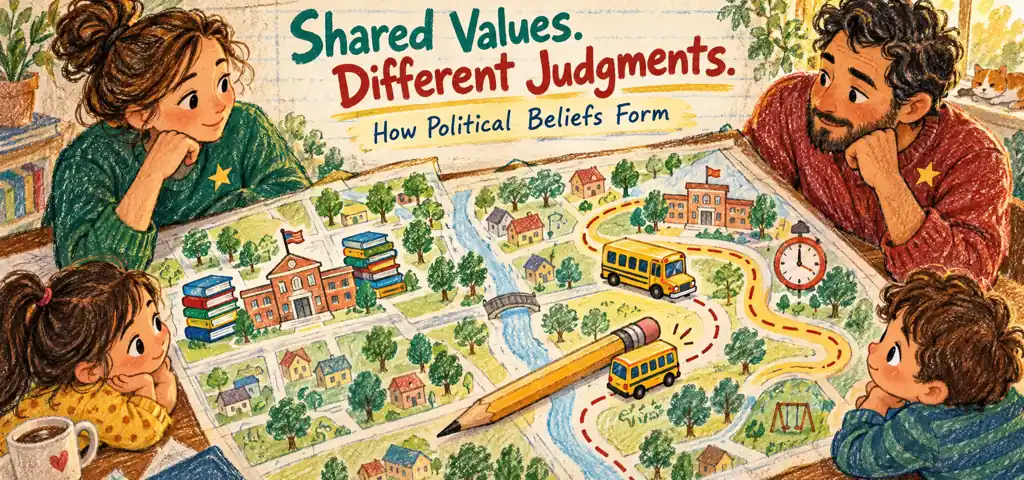
an earlier lesson explained where political learning occurs. Here the focus shifts from the socializing source to the attitude itself: how a person evaluates a particular policy, official, institution, or principle at a given time.
A political attitude joins an object to an evaluation. Predispositions such as values, identities, and prior beliefs supply a starting orientation. Current considerations(cost, fairness, personal consequence, trusted information, or expected results)make particular features of the object favorable or unfavorable. The final judgment reflects which considerations are available and how much weight the person gives each one.
The governing rule for political socialization: how political beliefs form
Some attitudes are readily recalled because the person has considered the object often. Others are assembled when a question is asked from the considerations most accessible at that moment. Specific wording or fresh information will usually matter more for a new, unfamiliar proposal than for a long-held judgment tied to identity or repeated experience.
Political Socialization: How Political Beliefs Form: the legal or political boundary
Two parents who both value equal educational opportunity. A school-boundary proposal would reduce crowding at one campus but lengthen travel for some children. One parent gives the greatest weight to equal resources and supports the plan. The other gives the greatest weight to travel time and opposes it. Their shared predisposition still matters, but it does not mechanically determine the same evaluation because the policy activates competing considerations.
Reason through an example of political socialization: how political beliefs form
A poll reports 58 percent support for a proposal. Name two features of the attitude that this percentage cannot reveal by itself.
Check your reasoning
Attitudes develop through socialization, identity, interests, information, elite cues, events, and policy experience. Different sources can reinforce or cross-pressure one another. Ideology organizes beliefs about government, society, and policy.
Video lesson: Political Socialization: How Political Beliefs Form
Heimler's History gives a focused explanation of this topic in Political SOCIALIZATION [AP Gov Review, Unit 4 Topic 2].
If the player does not load, watch this lesson directly on YouTube.
Connect this lesson to the larger course
For a broader map connecting political socialization: how political beliefs form to political culture, public opinion, and ideology, use the AP U.S. Government and Politics learning hub.

Related to This Article
More math articles
- Equivalent Rates
- The Best Grade 7 ELA Practice Tests for New Jersey Students
- Top 10 SSAT Middle-Level Math Practice Questions
- FREE ALEKS Math Practice Test
- Reconstruction Governments, Black Officeholding, and Federal Enforcement
- How to Find Complex Roots of the Quadratic Equation?
- Who is the Greatest Mathematician of all time?
- 49 Free New Mexico NM-MSSA Grade 5 Math Worksheets — Print, Practice, and Check the Answer Key
- The Best Grade 3 ELA Practice Tests for New Jersey Students
- New Deal coalition



















What people say about "Political Socialization: How Beliefs Form"?
No one replied yet.