How Traditional News Media Shapes Politics
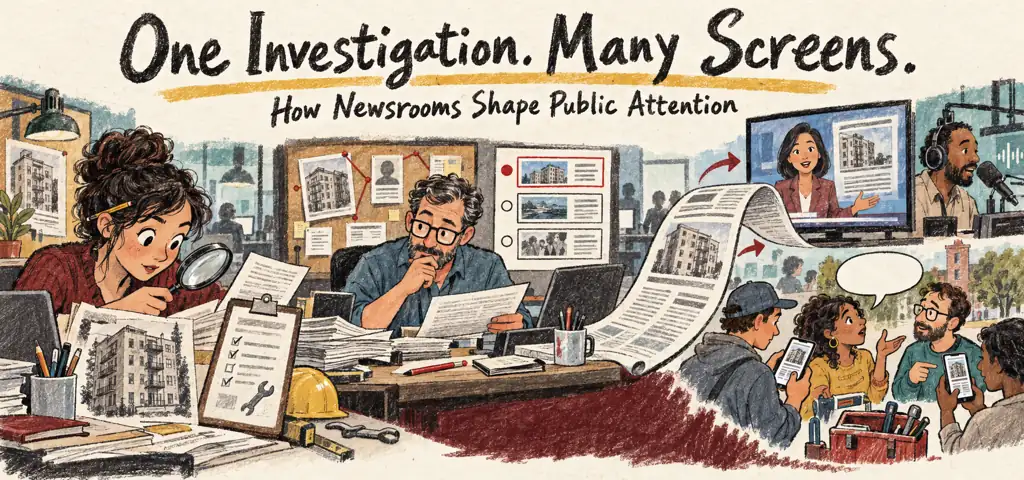
A report that reaches you through television or a social feed may have begun in a newspaper newsroom. Traditional outlets still originate much of the reporting that other media summarize, quote, and circulate.
Editors and reporters work under deadlines: they gather evidence, verify claims, decide what leads, and correct mistakes in a publication for which an identifiable organization is responsible. Those routines create accountability without guaranteeing neutrality or accuracy.
How Traditional News Media Shapes Politics: the working rule
Follow both the reporting and its later circulation. Placement, sourcing, corrections, and original documents reveal what the newsroom did. Audience evidence reveals whether the work changed attention, belief, or preference.
How Traditional News Media Shapes Politics: limits and hard cases
Traditional outlets still matter even in a fragmented system because their original reporting is frequently repeated by broadcasters, aggregators, and social-media users. Evaluate their influence by tracing who produced the information, who encountered it, and which outcome changed. A prominent story can broaden public attention without persuading readers to adopt the newsroom’s apparent position. Professional routines such as verification, attribution, correction, and separation of reporting from commentary can improve reliability, but they do not eliminate selection or error. That chain becomes visible when a city newspaper obtains inspection records showing repeated safety violations at public housing complexes. A television station summarizes the findings, candidates discuss them, and residents share screenshots online. The newspaper produced the reporting, but many citizens encountered it elsewhere. If housing rises on the public agenda, that finding concerns attention. If support for one repair plan rises, persuasion requires separate evidence. Counting only newspaper subscribers would understate the report’s reach. Do not treat “traditional” as a synonym for accurate, unbiased, or obsolete. It describes an institutional form with editors, reporting routines, and recognizable responsibility for publication. Those features make verification and correction possible, but their value depends on how faithfully they are used. When you read a media scenario, begin with the work the outlet actually performed. Gathering original documents is reporting. Deciding prominence is an editorial choice. Exposing misconduct serves accountability. And a later change in public priorities is an audience effect. Evidence and process matter more than a blanket assumption that every legacy outlet is neutral or every newer source is unreliable.
A new case involving how traditional news media shapes politics
For Traditional news media, distinguish agenda setting, framing, and priming from persuasion, and do not infer causation from simultaneous changes in coverage and opinion. Give one concrete example.
Check your reasoning
Newspapers, broadcast networks, radio, and professional newsrooms use editorial gatekeeping to select and verify stories. Their reach and business models have changed, but they remain important sources for agenda setting, investigation, and common political information. Digital platforms reduce publication and mobilization costs, accelerate communication, and permit direct candidate-to-voter contact.
Video lesson: How Traditional News Media Shapes Politics
CrashCourse gives a focused explanation of this topic in Media Institution: Crash Course Government and Politics #44.
If the player does not load, watch this lesson directly on YouTube.
Connect this lesson to the larger course
For a broader map connecting how traditional news media shapes politics to participation, parties, elections, interest groups, and media, use the AP U.S. Government and Politics learning hub.

Related to This Article
More math articles
- The Best Grade 8 ELA Practice Tests for Arkansas Students
- The Best Grade 4 Math Book for Utah Students
- The Ultimate 6th Grade North Carolina EOG Math Course (+FREE Worksheets)
- Double the Steps, Double the Fun: How to Solve Two-Step Inequalities
- How to Master Polynomial Functions
- Chapter 6: Federalism
- Political action committees
- How to Divide Exponents? (+FREE Worksheet!)
- How to Help Your 3rd Grade Student Prepare for the District of Columbia DC CAPE Math Test
- FREE 7th Grade PSSA Math Practice Test


















What people say about "How Traditional News Media Shapes Politics"?
No one replied yet.