CLEP U.S. History I 042: French Revolution, Neutrality, and Jay’s Treaty
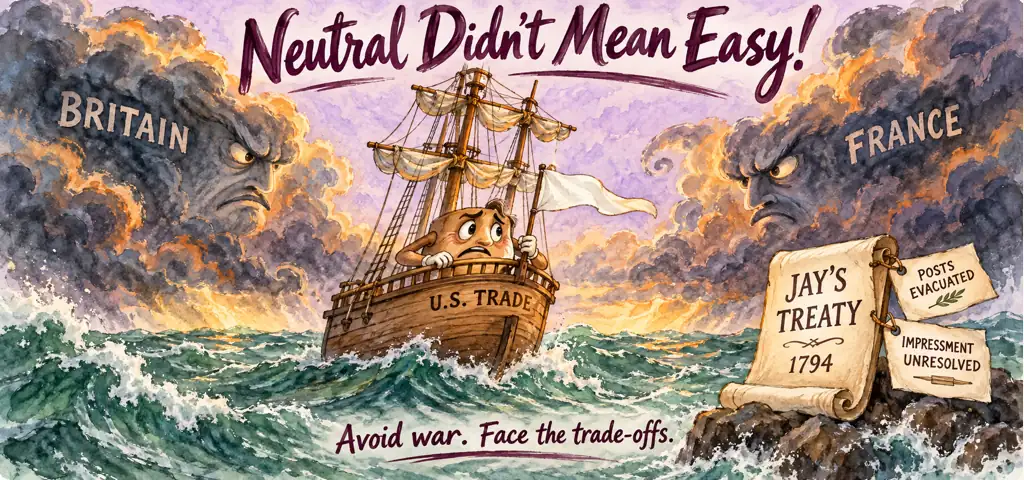
Lesson 8.4 of Chapter 8 of the U.S. History to 1877 study guide on Effortless Math covers CLEP U.S. History I 042: French Revolution, Neutrality, and Jay’s Treaty: the key terms, the core ideas, and worked examples showing how this topic is tested on the exam.
U.S. History to 1877 | Chapter 8 | Lesson 8.4
The French Revolution divided Americans because it joined familiar republican language to radical violence and European war. Many Democratic-Republicans celebrated France’s overthrow of monarchy and remembered French aid during the American Revolution. Federalists increasingly saw the revolution’s executions and instability as warnings about popular excess. When France and Britain went to war in 1793, the United States also had practical concerns: it depended heavily on Atlantic trade, possessed a small military, and remained party to the 1778 alliance with France.
Washington issued a neutrality proclamation, declaring that the United States would act impartially toward the belligerents. His administration rejected French diplomat Edmond-Charles Genêt’s effort to commission privateers and rally American support directly. The decision advanced a broad understanding of executive power in foreign affairs. Madison and other critics argued that Congress held the power to declare war and that the executive should not decide the nation’s legal posture alone. Neutrality nevertheless reflected vulnerability more than affection for Britain.
Unresolved disputes with Britain threatened that policy. British forces still occupied frontier posts, British policies interfered with American shipping, and Americans demanded compensation for seized vessels. Chief Justice John Jay negotiated a treaty in 1794. Britain agreed to evacuate the western posts and created commissions to settle certain claims, but the treaty did not end impressment or fully protect neutral shipping. Article XII would have sharply limited U.S. trade with the British West Indies. The Senate made suspension of that article a condition of consent, and the parties ratified without it. Federalists believed the imperfect agreement prevented a ruinous war and opened commercial opportunities. Democratic-Republicans condemned it as a pro-British surrender.
Spain, fearing closer Anglo-American relations, then negotiated Pinckney’s Treaty in 1795. It recognized the thirty-first parallel as the United States-Spanish Florida boundary and granted Americans navigation of the Mississippi River and a right of deposit at New Orleans. Diplomacy with one power altered calculations of another.
See the history take shape
Tom Richey offers a visual route through this topic. As you watch, compare its explanation with the source limits in the written lesson.
Video: George Washington's Foreign Policy (Neutrality, Citizen Genet, Jay Treaty, Pinckney's Treaty), Tom Richey.
Check your understanding
- Washington’s neutrality policy was most immediately intended to
- secure French aid against British-held frontier posts
- pressure Britain by permitting French privateering from American ports
- protect neutral commerce by declaring war on both belligerents
- keep a militarily weak republic out of the European war
- leave each state free to choose which belligerent to support
- A major achievement of Jay’s Treaty was Britain’s agreement to
- end impressment permanently
- transfer Canada
- evacuate frontier posts
- surrender Jamaica
- recognize the Monroe Doctrine
- Deep Practice: select all that apply. Pinckney’s Treaty provided
- a boundary at the thirty-first parallel
- Mississippi navigation rights
- a right of deposit at New Orleans
- annexation of Florida
- an agreement with Spain
- Deep Practice: open response. State one reasonable Federalist defense and one Democratic-Republican criticism of Jay’s Treaty.
Write a brief response using a named fact from the lesson.
Open the answers and reasoning
Independent preparation. CLEP is a registered trademark of the College Board, which does not endorse this lesson.

Related to This Article
More math articles
- The Best Grade 7 ELA Practice Tests for Mississippi Students
- SIFT Math Formulas
- Machine Controls: Guides, Guards, and Work Support
- The Best Grade 5 Math Book for Idaho Students
- Functionalist, Conflict, and Interactionist Views of Education
- How to Prepare for the CLEP College Mathematics Test?
- How to Discover the Solutions: “HSPT Math for Beginners” Comprehensive Guide
- Interwoven Variables: The World of Implicit Relations
- Literal Equations Worksheet with Answers PDF
- Summation (Sigma) Calculator — Evaluate Σ Series (Free)














What people say about "The French Revolution, Neutrality and Jay's Treaty"?
No one replied yet.