CLEP U.S. History I 041: Whiskey Rebellion and Federal Authority
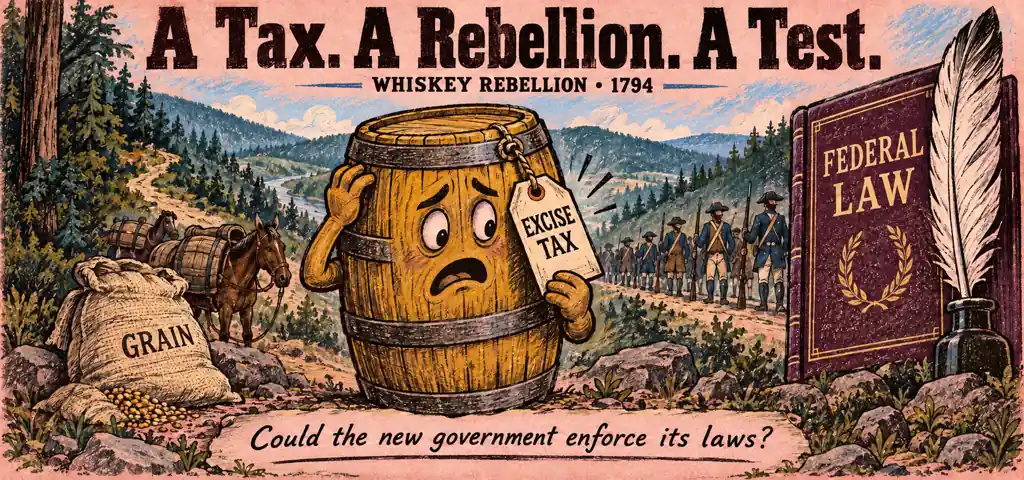
The Whiskey Rebellion was a 1794 uprising by farmers in western Pennsylvania against the 1791 federal excise tax on whiskey. President Washington called up about 13,000 militiamen, and the rebellion collapsed without a battle. The response showed that the new federal government under the Constitution could enforce its laws, in contrast with the weak government of the Articles of Confederation.
U.S. History to 1877 | Chapter 8 | Lesson 8.3
The excise on distilled spirits looked different from Philadelphia than it did in western Pennsylvania. Small farmers often converted grain into whiskey because whiskey was easier to transport across poor roads and could function as a medium of exchange. Larger distillers could pay a lower flat-rate equivalent, while scattered farmers faced cash payments and distant federal offices. Resistance drew on Revolutionary language: meetings denounced unequal taxation, collectors were intimidated, and some protestors attacked property. In 1794, after escalating resistance, Washington called state militia into federal service and personally traveled partway with a force of roughly thirteen thousand. Organized opposition dissolved with little violence.
The episode tested whether a republican government could enforce a law adopted by elected representatives. Under the Articles of Confederation, Congress could request money from states but could not tax individuals directly or reliably compel compliance. Under the Constitution, Congress had enacted an excise and the executive could enforce it. Washington first used proclamations and negotiations, then force authorized by law. Federalists presented the result as proof that liberty did not mean immunity from constitutional law. Critics feared that a distant government was using overwhelming military power against rural dissenters and that Hamilton welcomed the chance to display force.
The comparison with Shays’ Rebellion is useful but must be precise. In both cases, economically pressured rural people resisted government policy. Shays’ Rebellion exposed the Confederation government’s weakness and helped energize the movement for constitutional change. The Whiskey Rebellion displayed the new government’s capacity. It did not prove universal public acceptance, and it did not end western distrust. Washington later pardoned two men convicted of treason, mixing enforcement with restraint. The excise itself was repealed after Jefferson’s party gained power.
A focused video lesson
Use this lesson from Tom Richey to review the period and its central historical problem. Pause when the video reaches the turning point named above.
Video: The Whiskey Rebellion (APUSH Period 3), Tom Richey.
Check your understanding
- The federal response to the Whiskey Rebellion most directly demonstrated the new government’s ability to
- enforce an internal tax despite organized resistance
- require state legislatures to collect federal revenue
- treat peaceful criticism as armed insurrection
- suspend civilian courts throughout western Pennsylvania
- secure compliance by repealing the disputed excise
- Western farmers especially disliked the whiskey excise because
- their distilling economy depended chiefly on imported molasses
- whiskey made surplus grain portable and marketable in a cash-poor region
- small distillers received a more favorable effective rate than large producers
- the statute applied exclusively to counties west of the Appalachians
- its receipts went directly to eastern state governments
- Deep Practice: select all that apply. Accurate comparisons include
- both Shays’ and Whiskey involved rural resistance
- Shays’ exposed Confederation weakness
- Whiskey displayed federal enforcement power
- both ended in mass executions
- both involved disputes with public policy
- Deep Practice: open response. Why did Washington’s later pardons matter to the meaning of the episode?
Write a brief response using a named fact from the lesson.
Open the answers and reasoning
Independent preparation. CLEP is a registered trademark of the College Board, which does not endorse this lesson.

Related to This Article
More math articles
- Iowa ISASP Grade 7 Math Worksheets: 95 Free Single-Skill PDFs with Step-by-Step Keys
- Sunk costs belong to the past
- Iowa ISASP Grade 4 Math Free Worksheets: Printable PDF Practice for Algebra, Geometry & Data
- Issue voting
- Analysis, Not Summary
- Calculus Books for High School Students: Compare 5 Options
- Tehran, Yalta, Potsdam, Bretton Woods, and the United Nations
- How to Prepare for the 8th Grade STAAR Math Test?
- ACT Test Calculator Policy
- How to Measure Angles with a Protractor




















What people say about "Whiskey Rebellion (1794): Causes and Federal Response"?
No one replied yet.