YOUR ASVAB Math STUDY COMPANION
How to Pass the ASVAB Math Section & Boost Your AFQT (2026)
TL;DR: Your AFQT score opens doors in enlistment, and the way to raise it is to attack both ASVAB math subtests head-on, Arithmetic Reasoning (word problems) and Mathematics Knowledge (direct math). Drill mental math every day, lock the key formulas into…
TL;DR: Your AFQT score opens doors in enlistment, and the way to raise it is to attack both ASVAB math subtests head-on, Arithmetic Reasoning (word problems) and Mathematics Knowledge (direct math). Drill mental math every day, lock the key formulas into memory, and build pacing for the no-calculator format so you don’t freeze on test day. Even a 5-point AFQT bump can unlock more enlistment options, so every focused study session matters. Steady prep, real payoff.
Key takeaways:
- AR (word problems) and MK (direct math) are 2 of the 4 AFQT subtests.
- No calculator allowed on any ASVAB subtest.
- Branch minimums: Army 31, Navy 35, Marines 31, Air Force 36, Coast Guard 36.
- Competitive recruits aim for AFQT 50+; specific MOS jobs need 70+.
- Mental math fluency drives more score gain than any single content topic.
Your ASVAB math score does more than check a box. It directly determines your AFQT, the percentile that decides whether you can enlist at all, which branch will take you, and which jobs (MOS / rating / AFSC) you qualify for. In other words, your math score writes the first chapter of your military career.
The good news: ASVAB math is very beatable with the right plan. Most of the content is middle-school to early-high-school level. The questions are short. The format is predictable. If you commit to a focused study cycle, you can move your AFQT by 10 to 20 percentile points, sometimes more.
What Is on the ASVAB Math Section?
The ASVAB has two math subtests, and both feed your AFQT score:
Arithmetic Reasoning (AR)
- Computer (CAT-ASVAB): 15 questions, 55 minutes (adaptive).
- Paper (P&P-ASVAB): 30 questions, 36 minutes.
- What it tests: word problems involving arithmetic, percents, ratios, rates, basic probability, and simple algebra dressed up as a story.
Mathematics Knowledge (MK)
- Computer: 15 questions, 23 minutes.
- Paper: 25 questions, 24 minutes.
- What it tests: “pure math”, algebra, geometry, exponents, factoring, lines, and a touch of functions.
Together, AR + MK are half of your AFQT (the other half is Word Knowledge + Paragraph Comprehension). Math is therefore the single biggest lever you have over your enlistment options.
How AFQT Scoring Works
The AFQT is not a raw score. It is a percentile from 1 to 99 that compares you to a reference population of 18- to 23-year-olds tested in the 1997 Profile of American Youth study.

A score of 50 means you scored at or above 50% of that reference group. The minimum AFQT score for enlistment varies by branch (the most current 2026 numbers):
| Branch | Minimum AFQT (high school diploma) | With GED |
|---|---|---|
| Army | 31 | 50 |
| Navy | 31 | 50 |
| Marine Corps | 32 | 50 |
| Air Force | 31 (rarely accepted; most need 50+) | 65 |
| Coast Guard | 36 | 47 |
| Space Force | 31 (effective minimum 50+) | 65 |
Even more important than the minimum: the higher your AFQT, the more jobs you can pick. Hitting 50+ opens the most options. Hitting 65+ opens nearly everything.
The Topics That Earn the Most Points
After studying thousands of practice questions, these clusters cover the majority of ASVAB math points.
From Arithmetic Reasoning (word problems)
- Percent of, percent change, markup, and discount. The bread and butter of AR.
- Distance / rate / time problems. Memorize \(d = rt\) and three of its variants (\(r = d/t\), \(t = d/r\)).
- Work rate problems. “If Alex paints a room in 4 hours and Sam in 6 hours, how long together?”
- Ratios and proportions. “Three teachers for every 50 students, how many teachers for 350 students?”
- Average problems. “Five test scores average 82. The first four are 78, 85, 90, and 80, what is the fifth?”
From Mathematics Knowledge (pure math)
- Solving linear equations and inequalities.
- Exponent rules: \(x^a \cdot x^b = x^{a+b}\), \((x^a)^b = x^{ab}\), \(x^0 = 1\).
- Factoring simple quadratics like \(x^2 – 5x + 6\).
- Slope and \(y = mx + b\).
- Geometry: area, perimeter, the Pythagorean theorem, and the basics of triangles and circles.
If you nail these clusters, everything else is bonus points.
Recommended Practice Resources
Formulas to Memorize (No Formula Sheet on the ASVAB)
Unlike the GED and HiSET, the ASVAB does not provide a formula sheet. You must walk in knowing the basics. Burn these into memory:
- Area of a rectangle: \(A = lw\)
- Area of a triangle: \(A = \tfrac{1}{2}bh\)
- Area of a circle: \(A = \pi r^2\); circumference: \(C = 2\pi r\)
- Volume of a rectangular prism: \(V = lwh\); cylinder: \(V = \pi r^2 h\)
- Pythagorean theorem: \(a^2 + b^2 = c^2\)
- Slope: \(m = \dfrac{y_2 – y_1}{x_2 – x_1}\)
- Quadratic formula: \(x = \dfrac{-b \pm \sqrt{b^2 – 4ac}}{2a}\)
- Distance: \(d = rt\)
- Simple interest: \(I = Prt\)
- Percent change: \(\dfrac{\text{new} – \text{old}}{\text{old}} \times 100\)
If you can recite all of these from memory, you have already done what 70% of test takers don’t bother to do.
No Calculator. Train Mental Math Now.
This is the single biggest difference between the ASVAB and most other tests. There is no calculator allowed. Not on AR. Not on MK. Not even for arithmetic.
Daily 10-minute mental-math drills will quietly add 5 to 10 percentile points to your AFQT. Practice:
- Times tables through \(12 \times 12\), instant.
- Squares through \(20^2\).
- 10%, 20%, 25%, 50% shortcuts (“25% off $48” = \(48 \div 4 = 12\)).
- Fraction-to-decimal pairs: \(\tfrac{1}{2} = 0.5\), \(\tfrac{1}{4} = 0.25\), \(\tfrac{1}{3} \approx 0.33\), \(\tfrac{1}{5} = 0.20\), \(\tfrac{1}{8} = 0.125\).
A 4-Week ASVAB Math Study Plan
The ASVAB rewards a tighter, more aggressive cycle than the GED. Most enlistees prep in 3 to 6 weeks.

Week 1, Diagnostic + arithmetic foundations
- Full-length practice ASVAB (free ones from ETS or Effortless Math).
- Drill mental math 20 minutes a day.
- Master percents and proportions.
Week 2, AR word problems
- Distance, rate, time.
- Work rate.
- Averages and weighted averages.
- Simple probability.
Week 3, MK pure math
- Linear equations and inequalities.
- Exponent rules and radicals.
- Factoring and basic quadratics.
- Slope and lines.
Week 4, Geometry, timed practice, and review
- Triangle, circle, and quadrilateral formulas.
- Two full-length timed practice tests on separate days.
- Review every error.
ASVAB Test-Day Strategy
- Don’t get stuck. On the CAT-ASVAB, you cannot skip and return. Pick your best guess and move on.
- The CAT-ASVAB is adaptive. Your first 4 to 5 questions weigh heavily. Slow down on the start. Speed up later.
- Eliminate first, then guess. Even crossing out one wrong answer raises your odds from 25% to 33%.
- Sleep matters. Mental-math performance drops 10 to 15% on a tired brain.
- Time yourself in practice. AR averages 2 minutes 12 seconds per CAT question; MK averages 92 seconds. Knowing your pace at home is half the battle.
Common Mistakes That Tank AFQT Scores
- Trying to “calculate” word problems instead of setting them up first. Read, draw, label, then compute.
- Confusing percent off and percent of. “30% off $80” = \(80 – 0.30 \times 80 = 56\). “30% of $80” = $24$.
- Forgetting to check the answer makes sense. If your “distance” turns out negative, you made a sign mistake.
- Getting lazy on arithmetic. No calculator means every sloppy times-table mistake = lost AFQT points.
- Not memorizing the formulas. You will not stumble onto \(\pi r^2\) on test day. Memorize them. Today.
Free Resources to Bookmark
You are not alone. Effortless Math has built a free ASVAB math system used by tens of thousands of military hopefuls:
- ASVAB Math Worksheets, printable practice, topic-organized, with answer keys.
- The Ultimate ASVAB Math Course, a free, complete course covering AR and MK.
- ASVAB Math eBooks, full prep books with practice tests.
Frequently Asked Questions
How do you pass the ASVAB math section? Build mental math speed and know your key formulas, because no calculator is allowed on any ASVAB subtest. Study both math subtests: Arithmetic Reasoning for word problems and Mathematics Knowledge for direct algebra and geometry. A steady four-week plan with daily no-calculator drills, a practice test each week and careful mistake review moves AFQT scores more than cramming does.
How do you pass the ASVAB Arithmetic Reasoning test? Translate each word problem into a simple equation before you calculate. Most Arithmetic Reasoning questions involve percents, ratios, rates, averages or simple interest. For example, a car traveling 180 miles in 3 hours goes 180 ÷ 3 = 60 miles per hour. Underline what the question asks, estimate an answer first, and practice the arithmetic by hand.
What is passing on the ASVAB? There is no single passing score. Each military branch sets its own minimum AFQT score for enlistment, and specific jobs use line scores built from different subtests. Arithmetic Reasoning and Mathematics Knowledge both count toward your AFQT, so improving your math raises your options. Ask a recruiter for the current minimum for the branch and job you want.
How many questions are on each math section of the ASVAB? On the computer CAT-ASVAB, Arithmetic Reasoning has 15 questions in 55 minutes and Mathematics Knowledge has 15 questions in 23 minutes. On the paper version, Arithmetic Reasoning has 30 questions in 36 minutes and Mathematics Knowledge has 25 questions in 24 minutes. Check the official ASVAB website for the other subtests and any updates.
Can I pass the ASVAB without studying? Some people reach their branch minimum without studying, but it is risky, and your scores also decide which jobs you qualify for. Even two weeks of daily practice on fractions, percents, word problems and formulas can raise your Arithmetic Reasoning and Mathematics Knowledge scores. A low score means waiting before a retest, so preparing first saves time.
What should an ASVAB math section study guide include? A good ASVAB math study guide should cover fractions, decimals, percents, ratios, rates, exponents, square roots, basic algebra, and geometry formulas for area, perimeter, volume and angles. Since there is no formula sheet on the ASVAB, it should list formulas to memorize. Look for no-calculator practice with full explanations for both Arithmetic Reasoning and Mathematics Knowledge.
Your AFQT Is Your Future
Every extra hour you put into ASVAB math is an hour invested in more job options, better duty stations, bigger enlistment bonuses, and a smoother basic training. The math itself is learnable. The score is movable. Open one worksheet today. Future-you, with the job and the orders you actually want, will be glad you did.
Keep Practicing With the Right Resources
Recommended EffortlessMath Books
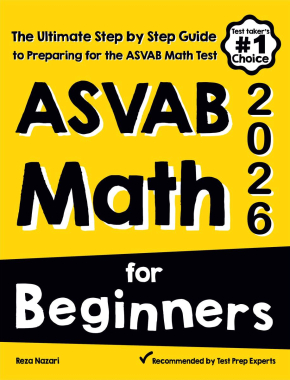
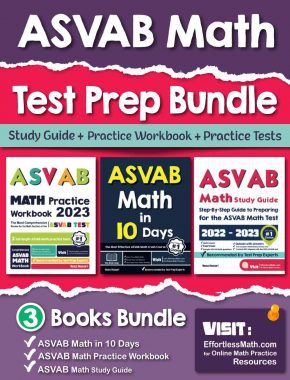
For a workbook that builds on this strategy guide, the ASVAB Math for Beginners (resource currently unavailable) walks through every AR and MK topic with worked examples. For complete enlistment-test prep with multiple full-length practice tests, see the ASVAB Math Test Prep Bundle.
Related EffortlessMath Lessons
If a topic on this page feels rusty, these short lessons go deeper:
- Free ASVAB Math practice test
- ASVAB Math Cheat Sheet
- ASVAB Math Practice Test PDF
- How to use the quadratic formula
- How to use the Pythagorean theorem
Need more ASVAB Math practice?
Use the free ASVAB Math Worksheet Creator to make a fresh one-skill worksheet with answers and step-by-step explanations. It is a good next step after a lesson, a formula review, or a missed practice-test question.
Open the worksheet creatorOpen full page
For a complete study path: pair this printable practice with ASVAB Math for Beginners and ASVAB Math Preparation Bundle.
Official source: the content of each ASVAB subtest is described on the official ASVAB Enlistment Testing Program site at officialasvab.com.

Related to This Article
More math articles
- How to Use Number Lines for Multiplication by a Negative Integer?
- SAT Calculator Policy
- 7th Grade RICAS Math Worksheets: FREE & Printable
- Free Grade 6 English Worksheets for Minnesota Students
- PARCC Math Flashcards (Free Online: Formulas, Terms & Concepts)
- The Best Grade 7 ELA Practice Tests for Missouri Students
- Kansas KAP Grade 7 Math Worksheets: 95 Free Printable PDFs Organized by Skill
- Culture Wars and the AIDS Crisis: Evidence and Public Policy
- HSPT Math FREE Sample Practice Questions
- Free Grade 5 English Worksheets for Indiana Students








What people say about "How to Pass ASVAB Math and Boost Your AFQT"?
No one replied yet.