YOUR ASVAB Math STUDY COMPANION
ASVAB Math Knowledge: Why It’s the Hardest Section (and How to Crush It)
If you're prepping for the ASVAB and somebody told you the Mathematics Knowledge section is "just like high school math, you'll be fine," I want you to take a deep breath. They're partially right. They're also partially the reason your practice scores are…
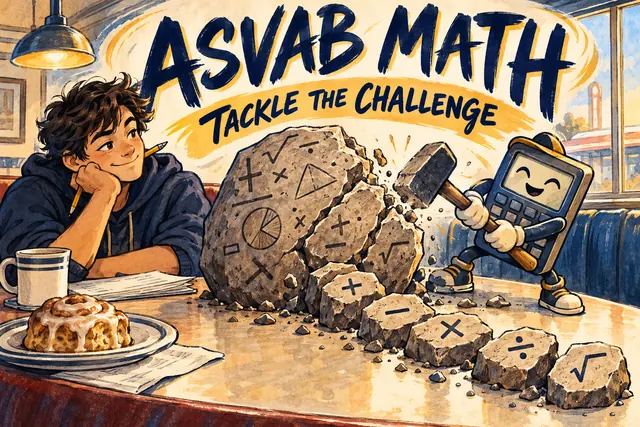
If you’re prepping for the ASVAB and somebody told you the Mathematics Knowledge section is “just like high school math, you’ll be fine,” I want you to take a deep breath. They’re partially right. They’re also partially the reason your practice scores are lower than you expected.
Mathematics Knowledge is consistently the section recruits struggle with most. Not because it’s algorithmically the hardest, Arithmetic Reasoning has more multi-step word problems, but because Math Knowledge tests stuff most people haven’t seen in years, with no calculator, under tight time pressure, and a lot of the questions are written in ways that are designed to trip you up.
I’ve been helping people prep for the ASVAB for a long time. Here’s the breakdown of why Math Knowledge is the killer, what they actually test, and exactly how to study to score the AFQT you need.
A Quick Reminder About How the ASVAB Math Sections Work
The ASVAB has two math subtests, and they’re not the same thing:
Arithmetic Reasoning (AR): Word problems. Real-world math situations. Multi-step. You have a calculator on the computerized version (no calculator on the paper version).
Mathematics Knowledge (MK): Pure math. Algebra, geometry, basic number sense. No real-world wrapper. No calculator on either version.
Together, those two scores plus your Word Knowledge and Paragraph Comprehension scores produce your AFQT (Armed Forces Qualifying Test) score. The AFQT is the gatekeeper number. Without a high enough AFQT, you can’t enlist.
For most branches:
- Army: 31 AFQT minimum (50+ recommended)
- Navy: 35 minimum
- Air Force: 31 minimum (50+ recommended for most jobs)
- Marines: 31 minimum
- Coast Guard: 40 minimum
But AFQT minimums are just the floor. To qualify for the job you actually want, you usually need a higher AFQT, often 50, 60, or even 70+. So your real target is almost never the floor.
Why Math Knowledge Is the Hardest Section (The Honest Reasons)
There are four real reasons MK trips people up.
1. No calculator. On the computerized ASVAB, you get a calculator on Arithmetic Reasoning. You don’t get one on Mathematics Knowledge. Everything is mental math or paper. If you haven’t done square roots, multi-digit multiplication, or long division by hand since 8th grade, this is a problem.
2. The questions test “forgotten” skills. Most adults haven’t thought about exponent rules, the quadratic formula, or geometric formulas since high school. The ASVAB doesn’t care that you forgot. It assumes you remember.
3. The time pressure. On the computerized version, you have 18 minutes for 16 questions. That’s just over 1 minute per question with no calculator. Slow workers run out of time.
4. The “designed traps.” A lot of MK questions look like one thing and are actually another. They’ll give you a problem that looks like simple multiplication and is actually about order of operations. Or one that looks like a basic equation and actually requires recognizing a special-case factoring pattern.
Each of those four reasons has a fix. Let me show you.
What’s Actually Tested
Mathematics Knowledge questions fall into roughly these buckets. I’ll list them in rough order of frequency.
Algebra (the biggest chunk):
- Solving linear equations and inequalities
- Solving systems of equations (basic)
- Working with exponents and roots
- Polynomial operations (adding, subtracting, multiplying)
- Factoring (especially the difference of squares, perfect squares, and simple trinomials)
- The quadratic formula
- Word-problem-to-equation translation
Number sense:
- Order of operations (PEMDAS)
- Integers and signed-number operations
- Fractions, decimals, percents
- Ratios and proportions
- Prime numbers, factors, multiples
Geometry:
- Area, perimeter, volume formulas
- Pythagorean theorem
- Properties of triangles, quadrilaterals, circles
- Parallel lines and transversal angles
- Coordinate geometry basics
A small amount of more advanced stuff:
- Function notation (occasional)
- Logarithms (rare)
- Probability and combinations (occasional)
If you locked down algebra and the geometric formulas, you’d be 80% of the way there.
The Three Highest-Use Topics to Drill
If you only have a week or two and you want the biggest score improvement, drill these three areas in this order:
1. Order of Operations and Exponent Rules
Most missed easy questions on MK aren’t from “I didn’t know algebra.” They’re from order of operations errors and exponent rule slip-ups. Examples:
- 4 + 6 × (3 – 1)² = ?
- (x³)² = ?
- x⁵ × x³ = ?
- 2⁻³ = ?
If those four questions don’t take you 30 seconds total, you have a use point. Drill until they do.
The exponent rules you need to know cold:
- xᵃ × xᵇ = xᵃ⁺ᵇ
- xᵃ / xᵇ = xᵃ⁻ᵇ
- (xᵃ)ᵇ = xᵃᵇ
- x⁻ᵃ = 1/xᵃ
- x⁰ = 1 (for any x ≠ 0)
Five rules. Memorize them like phone numbers.
2. Solving Equations Quickly
The ASVAB will hit you with equations like:
- 3x + 7 = 25
- 2(x – 4) = 12
- (x + 3) / 4 = 5
- 5x – 3 = 2x + 9
You should be able to solve each of those in under 30 seconds with paper. If you’re slower, you need drilling.
The pattern for one-variable linear equations is always: get the variable on one side, get the numbers on the other, divide. That’s it. Drill the pattern until it’s instinct.
3. The Pythagorean Theorem and Basic Geometry Formulas
The ASVAB loves the Pythagorean theorem. They’ll give you a right triangle with two sides and ask for the third. They’ll set up word problems (ladder against a wall, diagonal of a rectangle). They’ll embed it in coordinate geometry (find the distance between two points).
Know these formulas cold:
- Pythagorean theorem: a² + b² = c²
- Area of rectangle: length × width
- Area of triangle: ½ × base × height
- Area of circle: πr²
- Circumference of circle: 2πr
- Volume of rectangular prism: length × width × height
- Volume of cylinder: πr²h
That’s a lot, but most of them are familiar from middle school. The ones people forget most are circle formulas (people confuse area and circumference) and the volume of a cylinder.
A Worked Example That Shows the “Trap”
Here’s the kind of question that costs people on the ASVAB. Read it and try it before looking at the answer.
Question: If x² = 64, what are all possible values of x?
A) 8 B) -8 C) 8 and -8 D) 64
The trap is option A. Most people see x² = 64, take the square root of both sides, and write x = 8. But (-8)² is also 64. The correct answer is C.
This is the kind of question that’s “easy” once you know to watch for it, and a guaranteed miss if you don’t. The fix is awareness, when you see x² = (some number), you should reflexively think two answers. Plus and minus.
The Pacing Strategy for MK
On the computerized ASVAB, you have 18 minutes for 16 questions. About 67 seconds per question. The right pacing is roughly:
- Questions 1-5: 30-45 seconds each. These should be quick. If one takes more than a minute, you may be overthinking.
- Questions 6-11: 60-75 seconds each. The middle stretch.
- Questions 12-16: 75-90 seconds each. The harder ones.
Total: about 17 minutes if you pace well. That leaves you a tiny buffer to revisit anything you flagged.
One thing about the computerized ASVAB: you can’t skip and come back. Once you answer a question, you can’t go back to it. If you don’t know an answer, you have to commit to your best guess and move on. This makes pacing even more important, if you spend 4 minutes on question 5 and then have 14 minutes for the remaining 11 questions, you’re in trouble.
The paper version (if you take it that way) does allow you to skip and return. Different strategy applies.
How to Practice Without a Calculator
This is the part most people skip and most people regret. Mathematics Knowledge has no calculator. So your practice can’t have one either.
When you sit down to practice MK problems, physically move your phone and calculator out of reach. Use paper and pencil only. Drill mental math, multiplication tables up to 12×12, common squares (1² through 15²), common cubes (1³ through 10³).
Mental math is a skill. It atrophies. You can rebuild it in a few weeks of daily practice, but only if you actually practice it, not if you cheat with a calculator and pretend you’re getting better.
A 4-Week Study Plan
If you have a month before your test, here’s how I’d structure it.
Week 1: Fundamentals review.
- Day 1: Order of operations and PEMDAS
- Day 2: Fractions, decimals, percents (conversions and operations)
- Day 3: Signed-number operations and integers
- Day 4: Exponent rules
- Day 5: Roots and radicals
- Day 6: Mixed review of week 1 topics
Week 2: Algebra core.
- Day 1: One-variable linear equations
- Day 2: Two-variable systems
- Day 3: Inequalities
- Day 4: Polynomial operations
- Day 5: Factoring
- Day 6: Mixed review of week 2
Week 3: Geometry and harder algebra.
- Day 1: Pythagorean theorem and right triangles
- Day 2: Area and perimeter
- Day 3: Volume and surface area
- Day 4: Coordinate geometry
- Day 5: Quadratic formula and word problems
- Day 6: Mixed review
Week 4: Pacing and full-length practice.
- Day 1: Full-length practice ASVAB math (both sections)
- Day 2: Detailed review of every miss
- Day 3: Targeted drill on weakest area
- Day 4: Second full-length practice
- Day 5: Detailed review
- Day 6: Light review only, no new material
Forty minutes a day for the first three weeks. An hour a day for week 4. That’s about 18-20 hours total, enough to make a meaningful score change for most people.
What Score Should You Be Aiming For?
The AFQT score is what most recruiters care about. The relationship between MK and AFQT is roughly:
- A 50 AFQT requires about 60% correct on the math sections (rough estimate)
- A 70 AFQT requires about 80% correct
- A 90 AFQT requires near-mastery, about 90%+
Your target AFQT depends on what job you want. Talk to your recruiter about specific job requirements before you set a goal. Some jobs need a 50. Some need a 75. Some specialized intelligence or technical roles need 90+.
The general rule: aim for 10-15 points higher than the minimum for the job you want. AFQT scores can be lower on test day than on practice tests, and having a buffer protects your options.
The “Standardized Test Brain” Issue
A lot of adults coming back to math after years away aren’t lacking math knowledge. They’re lacking test-taking fluency. The ASVAB is timed, multiple choice, and structured to reward specific patterns of thinking. Even if you know the math, you can lose points by being slow or by overthinking.
The fix is volume. Take a lot of practice questions. Not full-length tests. Those are exhausting and not the right tool for daily practice. Do 20-30 questions a day, mixed difficulty, timed loosely. The goal is to build the reflexive “see problem → identify type → execute method” pattern that lets you move fast.
This is also where a topic-organized prep book beats a generic “ASVAB study guide.” A topic book lets you drill exponent rules on Monday, equations on Tuesday, geometry on Wednesday, building speed in each area. A generic study guide gives you a wall of mixed practice that’s harder to learn from.
A Few Common Mistakes I See Recruits Make
Mistake 1: Studying with a calculator. Already covered above. Drop it.
Mistake 2: Skipping mental math drills. Multiplication tables, common squares, common cubes. Boring. Essential. Drill them while you’re driving or showering. Recall = speed = points.
Mistake 3: Memorizing formulas without practicing them. Knowing that the area of a circle is πr² isn’t the same as being able to use it under pressure. Practice problems with formulas. Don’t just memorize the formulas.
Mistake 4: Practicing only at home conditions. Practice in a quiet, uncomfortable place. The MEPS testing center is not your couch. Practicing under “soft” conditions and then testing under “hard” conditions is a recipe for a drop on test day.
Mistake 5: Treating the AFQT minimum as the goal. A 31 AFQT gets you into the Army, but it doesn’t get you the job you actually want. Aim higher than the minimum. Always.
A Word on the Re-Test Rules
If you don’t get the AFQT score you need, you can retake the ASVAB. The wait times:
- First retest: 1 month after your first test
- Second retest: 1 month after your first retest
- Subsequent retests: 6 months apart
Most recruits who improve their score do so by going hard on the math for the month between attempts. Use the wait time. It’s a real opportunity.
Practice Resources
For free practice, the official ASVAB practice test at officialasvab.com is the best place to start. It’s the actual test format. Take it, get a baseline score, plan from there.
For paid practice, look for an ASVAB math book organized by topic (not just a big mixed pile of practice tests). Our ASVAB math prep books at EffortlessMath are organized this way, chapters by topic, worked examples, and full-length practice tests with explanations for every answer. The explanations matter more than you’d think. Knowing why you got something wrong is what moves your score next time.
The Bottom Line
Mathematics Knowledge is the hardest section of the ASVAB for most recruits because it tests stuff most adults haven’t touched in years, with no calculator, under time pressure. None of those reasons mean you can’t crush it. They mean you have to prepare specifically.
Drill the fundamentals. Lock down algebra. Memorize the formulas you need. Practice without a calculator. Work fast.
A month of focused study gets most people to a passing AFQT score. Two months gets most people to a competitive one. The work is real, but the test is beatable.
Your career goal is on the other side of this. Show up. Do the work. Earn it.
Looking for ASVAB math prep that drills both Arithmetic Reasoning and Mathematics Knowledge, organized by topic with explanations? Browse our ASVAB collection at EffortlessMath.
Need more ASVAB Math practice?
Use the free ASVAB Math Worksheet Creator to make a fresh one-skill worksheet with answers and step-by-step explanations. It is a good next step after a lesson, a formula review, or a missed practice-test question.
Open the worksheet creatorOpen full page
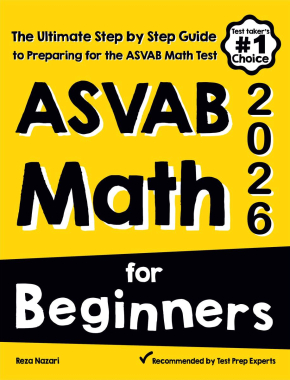
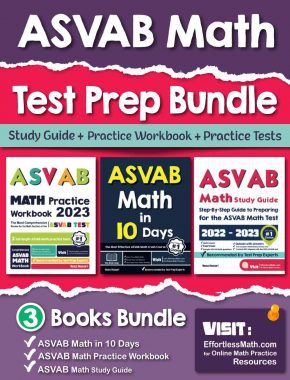
For a complete study path: pair this printable practice with ASVAB Math for Beginners and ASVAB Math Preparation Bundle.
Official source: the content of each ASVAB subtest is described on the official ASVAB Enlistment Testing Program site at officialasvab.com.

Related to This Article
More math articles
- CBEST Test Facts and FAQs
- How to Find x- and y-intercepts in the Standard Form of Equation?
- Civil service
- How to Solve Word Problems of Writing Variable Expressions
- How to Mastering Rational Expressions: A Comprehensive Guide to Multiplication and Division Techniques
- Free Grade 5 English Worksheets for Alaska Students
- Watchdog role
- 4th Grade Ohio’s State Tests Math Worksheets: FREE & Printable
- How to Write the Equation of Parabola?
- Free Grade 6 English Worksheets for Maine Students












What people say about "ASVAB Math Knowledge: The Hardest Section"?
No one replied yet.