YOUR ASVAB Math STUDY COMPANION
FREE ASVAB Math Practice Test
TL;DR: Whichever branch you're aiming for, the ASVAB math sections decide a lot. Take this free practice test covering both Arithmetic Reasoning (AR) and Mathematics Knowledge (MK) as an honest read on where you stand. No calculator allowed, just like the…
TL;DR: Whichever branch you’re aiming for, the ASVAB math sections decide a lot. Take this free practice test covering both Arithmetic Reasoning (AR) and Mathematics Knowledge (MK) as an honest read on where you stand. No calculator allowed, just like the real test, so you’ll practice working through every problem by hand. The score you get points straight at the topics worth your next study session.
Key takeaways:
- ASVAB Math has two subtests: Arithmetic Reasoning and Mathematics Knowledge.
- CAT-ASVAB: AR is 16 questions in 39 minutes; MK is 16 questions in 20 minutes.
- Paper ASVAB: AR is 30 questions in 36 minutes; MK is 25 questions in 24 minutes.
- No calculator allowed on either subtest.
- AR + MK together make up about half of your AFQT score (the enlistment-eligibility metric).
For this practice test, we’ve selected 20 real questions from past exams for your ASVAB Mathematics Practice test. You will have the chance to try out the most common ASVAB Math questions. For every question, there is an in-depth explanation of how to solve the question and how to avoid mistakes next time.
Use our free ASVAB Math practice tests and study resources (updated for 2026) to ace the ASVAB Math test! Make sure to follow some of the related links at the bottom of this post to get a better idea of what kind of mathematics questions you need to practice.
The Absolute Best Book to Ace the ASVAB Math Test
1- What is the perimeter of a rectangle with a length of \(90\) cm and a width of \(30\) cm?
A. \(180\) cm
B. \(240\) cm
C. \(270\) cm
D. \(2700\) cm
2- A truck drives at an average speed of \(16.2\) miles per hour for \(2.1\) hours. To the nearest whole mile, how far did the truck travel?
A. \(32\)
B. \(34\)
C. \(36\)
D. \(38\)
3- Which of the following numbers, when multiplied by \(6\), gives a result greater than \(120\) and less than \(180\)?
A. \(20\)
B. \(26\)
C. \(30\)
D. \(34\)
4- A teacher has \(120\) books. After donating \(12\) books, how many groups of \(12\) books does she have left?
A. \(9\)
B. \(10\)
C. \(11\)
D. \(12\)
5- Nicole’s hourly wage increased from $7.50 to $7.75. What was the percent of Nicole’s raise?
A. \(2\%\)
B. \(1.67\%\)
C. \(3.33\%\)
D. \(6.66\%\)
6- A snack machine accepts only quarters. Candy bars cost 25¢, a package of peanuts costs 75¢, and a can of cola costs 50¢. How many quarters are needed to buy two Candy bars, one package of peanuts, and one can of cola?
A. 8 quarters
B. 7 quarters
C. 6 quarters
D. 5 quarters
7- The hour hand of a watch rotates \(30\) degrees every hour. How many complete rotations does the hour hand make in \(8\) days?
A. \(12\)
B. \(14\)
C. \(16\)
D. \(18\)
8- Camille uses a \(30\%\) off coupon when buying a sweater that costs $50. If she also pays \(5\%\) sales tax on the purchase, how much does she pay?
A. $35
B. $36.75
C. $39.95
D. $47.17
9-Solve:\((x + 7)(x + 5)\) = ?
A. \(x^2 + 12x + 12\)
B. \( 2x + 12x + 12\)
C. \(x^2 + 35x + 12\)
D. \(x^2 + 12x + 35\)
10- Convert \(670,000\) to scientific notation?
A. \(6.70 × 1000\)
B. \(6.70 × 10^{−5}\)
C. \(6.70 × 100\)
D. \(6.7 × 10^5\)
11- What is the perimeter of the triangle in the provided diagram?
\( \)
\)
A. \(15,625\)
B. \(625\)
C. \(75\)
D. \(25\)
12- If \(x\) is a positive integer divisible by \(6\), and \(x < 60\), what is the greatest possible value of \(x\)?
A. \(54\)
B. \(48\)
C. \(36\)
D. \(59\)
13- There are two pizza ovens in a restaurant. Oven 1 burns four times as many pizzas as oven 2. If the restaurant had a total of 15 burnt pizzas on Saturday, how many pizzas did oven 2 burn?
A. 3
B. 6
C. 9
D. 12
14- Which of the following is an obtuse angle?
A. \(56^\circ\)
B. \(72^\circ\)
C. \(123^\circ\)
D. \(211^\circ\)
15- What is \(5231.48245\) rounded to the nearest tenth?
A. \(5231.482\)
B. \(5231.5\)
C. \(5231\)
D. \(5231.48\)
16- A circle has a diameter of 16 inches. What is its approximate area? \((π = 3.14)\)
A. 200.96
B. 100.48
C. 64.00
D. 12.56
17- Which of the following is the correct calculation for 7!?
A. \(7 × 6 × 5 × 4 × 3 × 2 × 1\)
B. \(1 × 2 × 3 × 4 × 5 × 6\)
C. \(0 × 1 × 2 × 3 × 4 × 5 × 6 × 7\)
D. \(1 × 2 × 3 × 4 × 5 × 6 × 7 × 8\)
18- The equation of a line is given as: \(y=5x-3\). Which of the following points does not lie on the line?
A. \((1, 2)\)
B. \((−2, −13)\)
C. \((3, 18)\)
D. \((2, 7)\)
19- What is the distance between the points \((1, 3)\) and \((−2, 7)\)?
A. 3
B. 4
C. 5
D. 6
20- Solve:\(x^2 – 81 = 0\), \(x\) could be?
A. 6
B. 9
C. 12
D. 15
Best ASVAB Math Prep Resource for 2026
Answers:
1- B
Perimeter of a rectangle = \(2 × length + 2 × width\) =
\(2 × 90 + 2 × 30 = 180 + 60 = 240\)
2- B
\(Speed =\frac{distance}{time }\)
\(16.2=\frac{distance}{2.1}⇒ distance=16.2×2.1=34.02\)
Rounded to a whole number, the answer is \(34\).
3- B
Let’s review the choices provided and find their sum.
\(a. 20 × 6 = 120\)
\(b. 26 × 6 = 144\) ⇒ is greater than 120 and less than 180
\(c. 30 × 6 = 180\)
\(d. 34 × 6 = 204\)
Only choice b gives a number that is greater than 120 and less than 180.
4- A
\(120 – 12 = 108\)
\(\frac{108}{12} = 9\)
5- C
percent of change = \(\frac{change}{original \space number}\)
\(7.75 – 7.50 = 0.25\)
percent of change = \(\frac{0.25}{7.50}\) = 0.0333
\(⇒ 0.0333 × 100 = 3.33\%\)
6- B
Two candy bars costs 50¢ and a package of peanuts cost 75¢ and a can of cola costs 50¢. The total cost is: \( 50 + 75 + 50 = 175\)
175 is equal to 7 quarters. \(7 × 25 = 175\)
7- C
Every day the hour hand of a watch makes 2 complete rotation. Thus, it makes 16 complete rotations in 8 days.
\(2 × 8 = 16\)
8- B
\(30\% × 50 =\frac{30}{100} × 50 = 15 \)
The coupon has $15 value. Then, the selling price of the sweater is $35.
\(50 – 15 = 35\)
Add \(5\%\) tax, then:
\(\frac{5}{100} × 35 = 1.75 \) for tax
then:
\(35 + 1.75 = $36.75\)
9- D
Use FOIL (First, Out, In, Last) method.
\((x + 7)(x + 5) = x^2 + 5x + 7x + 35 = x^2 + 12x + 35\)
10- D
In scientific notation form, numbers are written with one whole number times 10 to the power of a whole number. Number 670,000 has 6 digits. Write the number and after the first digit put the decimal point. Then, multiply the number by 10 to the power of 5 (number of remaining digits). Then:
\(670,000 = 6.7 × 10^5\)
11- C
Perimeter of a triangle = side 1 + side 2 + side 3 \(= 25 + 25 + 25 = 75\)
12- A
From the choices provided, 36, 48 and 54 are divisible by 6. From these numbers, 54 is the biggest.
13- A
Oven 1 = 4 oven 2
If Oven 2 burns 3 then oven 1 burns 12 pizzas.\( 3 + 12 = 15\)
14- C
An obtuse angle is an angle of greater than \(90^\circ\) and less than \(180^\circ\).
15- B
5231.48245 rounded to the nearest tenth equals 5231.5
(Because 5231.48 is closer to 5,231.5 than 5,231.4)
16-A
Diameter = 16
then: Radius = 8
Area of a circle =\(πr^2\) ⇒ \(A = 3.14(8)^2 = 200.96\)
17- A
\(7! = 7 × 6 × 5 × 4 × 3 × 2 × 1\)
18- C
Let’s review the choices provided. Put the values of \(x\) and \(y\) in the equation.
A. \((1, 2) ⇒ x = 1 ⇒ y = 2\) This is true!
B. \((−2, −13) ⇒ x = -2 ⇒ y = -13\) This is true!
C. \((3, 18) ⇒ x = 3 ⇒ y = 12\) This is not true!
D. \((2, 7) ⇒ x = 2 ⇒ y = 7\) This is true!
19- C
Use distance formula:
\(d=\sqrt{((x_1-x_2)^2+(y_1-y_2)^2 )} = \sqrt{((1-(-2))^2+(3-7)^2 )}\)
\(\sqrt{(9+16)} = \sqrt{25} = 5\)
20- B
\((x^2 \space – \space 81 = 0 ⇒ x^2 = 81 )\) ⇒ \(x\) could be \(9\) or \(-9\).
Looking for the best resource to help you succeed on the ASVAB Math test?
More from Effortless Math for ASVAB Test …
If you are preparing for ASVAB Math Test, check out ASVAB Math: Complete Guide and Study Tips
Looking for the best prep books for the ASVASB Math test?
Check out our list of the five best ASVAB math study guides that will help you prepare for the ASVAB Math Test.
The Best Books to Ace the ASVAB Math Test
Have any questions about the ASVAB Test?
Write your questions about the ASVAB or any other topics below and we’ll reply!
Recommended EffortlessMath Books
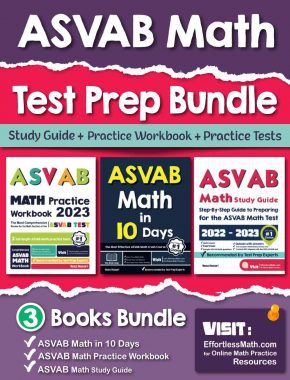
If you want a structured workbook to study alongside this practice test, the ASVAB Math for Beginners (resource currently unavailable) walks through every AR and MK topic. For full AFQT prep with multiple full-length practice tests, see the ASVAB Math Test Prep Bundle.
Frequently Asked Questions
How many math sections are on the ASVAB?
Two: Arithmetic Reasoning (AR) and Mathematics Knowledge (MK). AR focuses on word problems and applied math. MK focuses on pure algebra, geometry, and number theory. Both subtests feed into your AFQT score, the primary measure for enlistment eligibility.
Is a calculator allowed on the ASVAB Math?
No. No calculators are permitted on any ASVAB section, including AR and MK. This applies to both the computer-adaptive (CAT-ASVAB) and paper-and-pencil versions. Practice arithmetic and basic algebra by hand before test day.
What AFQT score do I need to enlist?
Each service branch sets its own minimum. As of 2025, the Army requires 31, the Navy 31, the Air Force 31 (35 without a high school diploma), the Marines 31, the Coast Guard 36, and the Space Force 31. Higher scores open more job (MOS) options.
How is the AFQT calculated?
AFQT = (2 × VE) + AR + MK, where VE is your Verbal Expression standard score and AR + MK are your math standard scores. The result becomes a percentile from 1 to 99. A 50 means you scored better than 50% of test-takers on the reference population.
What math topics does the ASVAB cover?
AR: fractions, decimals, percents, ratios and proportions, basic algebra word problems, and rate/distance/time problems. MK: algebra (linear and quadratic equations, exponents, factoring), geometry (area, volume, angles, Pythagorean theorem), and basic number theory.
How long are the ASVAB Math subtests?
CAT-ASVAB: AR is 16 questions in 39 minutes; MK is 16 questions in 20 minutes. Paper-and-pencil ASVAB: AR is 30 questions in 36 minutes; MK is 25 questions in 24 minutes. The paper version gives you slightly less time per question on MK.
Can I retake the ASVAB?
Yes. You can retake after a 30-day wait, then another 30-day wait for a second retake, then a six-month wait for any further retakes. Your highest score from any sitting is what’s used for enlistment eligibility.
Is CAT-ASVAB harder than the paper version?
The content is the same, but CAT-ASVAB is adaptive, harder questions yield more points per correct answer; incorrect answers lead to easier follow-ups. Most testers find CAT slightly more time-efficient. Score scales are equivalent between the two formats.
How long should I study for the ASVAB Math?
For an AFQT in the 50s, plan on 4 to 8 weeks of daily study (30-60 min). For 65+, plan on 8 to 12 weeks. Focus on arithmetic word-problem fluency for AR and algebra mechanics (factoring, exponents, linear equations) for MK. Drill without a calculator from day one.
Where can I find more ASVAB practice?
EffortlessMath has the ASVAB Math Formula Cheat Sheet, the ASVAB Math for Beginners workbook, and the full ASVAB Math Test Prep Bundle with multiple practice tests.
Related EffortlessMath Lessons
If a topic on this practice test feels rusty, these short lessons go deeper:
- ASVAB Math Formula Cheat Sheet
- How to use the Pythagorean theorem
- How to use the quadratic formula
- Rules of exponents
- Order of operations (PEMDAS)
Need more ASVAB Math practice?
Use the free ASVAB Math Worksheet Creator to make a fresh one-skill worksheet with answers and step-by-step explanations. It is a good next step after a lesson, a formula review, or a missed practice-test question.
Open the worksheet creatorOpen full page
For a complete study path: pair this printable practice with ASVAB Math for Beginners and ASVAB Math Preparation Bundle.

Related to This Article
More math articles
- Montana MAST Grade 4 Math Free Worksheets: Free Printable PDF Worksheets with Full Solutions
- 10 Most Common 3rd Grade Common Core Math Questions
- Protest rights
- CLEP College Math Flashcards (Free Online: Formulas, Terms & Concepts)
- Marx, Durkheim, and Weber
- How to Mastering Rational Expressions: A Comprehensive Guide to Multiplication and Division Techniques
- Competing Visions of Modernity: The New Woman, Mass Entertainment, and the Lost Generation
- How to Determine Arc Length Using Integration
- Louisiana Grade 2 Math Worksheets — Free Printable PDFs
- 10 Most Common 4th Grade IAR Math Questions




What people say about "Free ASVAB Math Practice Test"?
No one replied yet.