PMP AI Scenarios: Assess Value, Risk and Human Oversight (2027 Prep)
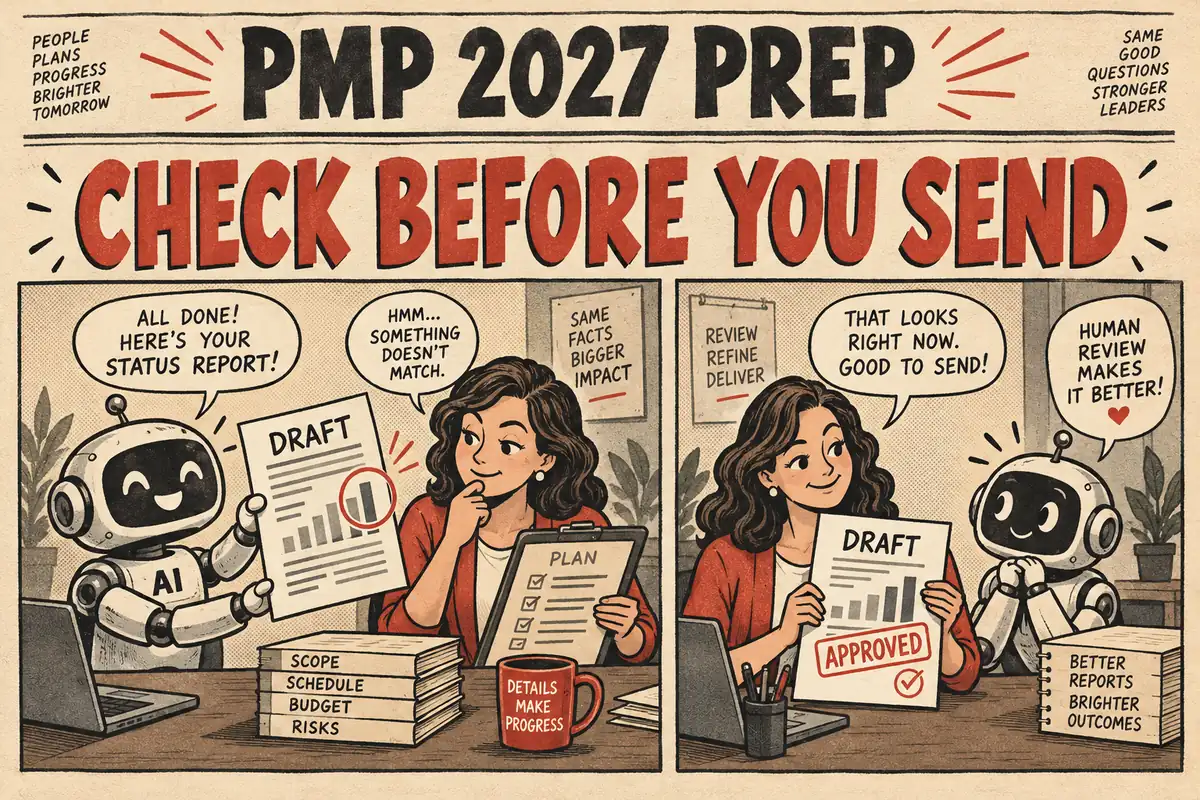
The weekly report says the warehouse launch is complete. The delivery lead's note says two acceptance checks are still open. An AI assistant wrote the report from a folder of project notes, and the sponsor is waiting for it.
Pause the send. You have a specific claim to check before a stakeholder acts on it. A polished paragraph cannot tell you whether those acceptance checks passed, especially when the assistant has combined an old forecast with a current issue record.
For PMP preparation, work through the project facts behind an AI-assisted decision, including the records the team can use and the authority assigned to the person reviewing the output. The fictional case below follows a status draft from its proposed use to a corrected communication, with a change in circumstances that tests whether your reasoning still holds. It contains no official or recalled exam questions.
Place AI within the current PMP study scope
PMI's current exam-update page includes AI among the topics in the exam launched in July 2026. PMI current exam-update page The 2027 label on this article identifies its preparation edition. It does not announce a separate exam redesign.
Use the current PMP Examination Content Outline to organize your studies. Relevant tasks cover communication and project status, value delivery, governance, compliance and risk, which gives this case several connections to the work described in the outline. Study those connections. They do not establish a separate AI domain or a guaranteed number of AI questions.
The public PMI AI standard overview describes human review of AI outputs and ethical and legal considerations. That overview is useful background. We have not reviewed the full standard here, and its publication page does not make this article a complete PMP syllabus.
Read the permissions before using the tool
In our invented warehouse project, the organization permits an approved internal assistant to draft weekly reports from designated project records. A delivery lead checks completion evidence. The project manager approves routine status messages within the communication plan, while changes to the committed launch milestone require a separate approval route.
Those are case facts. Another organization could assign these responsibilities differently. Keep the assigned roles beside the case so you can distinguish an output review from a decision that exceeds the project manager's authority and needs a different approval route.
Now add a restriction. Supplier pricing and employee records are outside this assistant's approved data set. Uploading the whole project folder would breach the fictional policy even if the intended report contained no confidential wording.
Check the inputs first. Removing a sensitive sentence from the final message would not undo an unauthorized upload, so the permitted source set matters before the assistant starts drafting.
Describe the benefit you are trying to obtain
The team wants to reduce the time spent assembling a routine report while keeping stakeholders informed about readiness. That gives you two things to observe during the pilot: the total preparation effort and whether the finished message accurately describes the launch for the stakeholders who will use it.
Suppose the old process takes forty minutes. The assistant drafts in five, then the reviewer spends twenty-five checking and correcting the result. Total preparation takes thirty minutes, leaving a ten-minute saving in this invented run.
Count the review. Comparing forty minutes with the five-minute draft would exaggerate the saving. A single run also cannot establish a stable productivity gain, especially when the next report might require the reviewer to resolve a discrepancy with several people before it can be released.
For a pilot, record the total effort across comparable reports and note corrections or missed issues. Choose suitable measures. These illustrative measures are our teaching choices, with no claim that PMI prescribes this pilot design.
Trace the completion claim to its evidence
The assistant's draft says, "All warehouse acceptance checks are complete, and launch readiness is confirmed." A current issue record lists two checks as open, with an owner assigned to each and no completion evidence attached to either record. The delivery lead confirms that neither has passed.
Keep the report unsent while that discrepancy is resolved. Compare the draft with the dated acceptance records and the people responsible for them, then correct the status using the evidence you actually have. An older planning note predicting completion cannot establish that it happened.
The comparison table shows the fictional evidence trail. Each row connects a claim to a source and a consequence for the message, so a reviewer can explain the correction instead of simply ticking a box marked checked.
A possible corrected sentence is, "Two acceptance checks remain open, and launch readiness has not been confirmed." Add the responsible person's next update time if it has been agreed. Avoid inventing a completion date to make the report feel reassuring.
| Draft claim | Current evidence | Implication |
|---|---|---|
| All checks complete | Two acceptance checks open | Correct completion status |
| Readiness confirmed | Delivery lead has not confirmed it | State readiness is unconfirmed |
| Launch can proceed | Milestone impact still being assessed | Avoid an unsupported commitment |
Separate correction from a milestone decision
Correcting the report does not authorize a revised launch commitment. In this case, the project manager can issue a truthful routine status update, but the committed milestone follows the specified approval route.
Assess the effect. The two open checks might have no effect on the launch date if they can be completed within the remaining time. They could also reveal a problem requiring a change. Ask the delivery lead for the evidence needed to evaluate that impact.
If the resulting proposal exceeds the authority defined in the case, prepare its impact and follow the approval route. Keep proposed and approved dates distinct in the communication. A sponsor's desire for a quick answer does not make an unapproved proposal a commitment.
The PMP Examination Content Outline includes governance escalation thresholds and approved change execution. Our specific role assignments come from this fictional project. Read the authority stated in any study scenario before deciding who can approve its next action.
Change one fact and reconsider the response
Try a variation. This time the completion records are current and consistent, the permitted assistant drafts an accurate report, and the designated reviewer has finished checking it. No milestone change or other escalation trigger is present.
Use the approved workflow. Sending every routine report to the steering committee would add a step that this case does not require. The earlier hold arose from a real discrepancy, so carrying it into a clean case would ignore the changed facts.
For another variation, the assistant has already sent the incorrect completion claim to the sponsor. Now the problem includes a misleading communication that has reached its audience. Follow the project's correction and incident procedures, assess any decisions made from the claim, and involve the responsible owners.
Timing changes the work. Before release, you can hold a draft. After release, correcting the local file alone leaves the sponsor with the wrong message. State which audience needs the correction and who owns that communication.
Give the human reviewer a defined job
A human-in-the-loop process includes a person in the workflow. The PMI human-in-the-loop article explains the value of human oversight alongside generative AI. In our case, the reviewer needs access to current evidence and enough authority to hold the report when a claim cannot be supported.
Make the check concrete. The delivery lead confirms acceptance status, and the project manager checks that the outgoing message reflects that status and follows the communication plan. A name beside an approval field would tell you little if neither person had looked at the source records.
Keep useful traces according to the organization's rules. For this learning case, a draft version, the disputed claim and its supporting record would let you reconstruct the correction. Real projects must apply their own retention and access requirements rather than copying a public spreadsheet into a sensitive workflow.
Practice the reasoning on a fresh case
Download the blank AI decision practice log (CSV) for fictional study cases. It has fields for the proposed use, permitted inputs, evidence, decision owner, release condition and follow-up. Use invented or properly authorized information, and leave real confidential project details out of a public study exercise.
Write one sentence explaining why an action fits the case. "Hold this draft because the current acceptance record contradicts its completion claim" identifies the condition that supports the action. "Always escalate AI" skips the facts you need to evaluate.
Then alter a condition. Give the team a verified report, remove an approval permission, or move the event from before sending to after sending. Explain how that specific change affects the next action without claiming that your explanation predicts an exam answer.
Our PMP study hub collects PMP study resources. Use the current outline to choose your next topic, then return to the log with a fresh case about an AI-assisted estimate or supplier comparison. Record the evidence you would need before accepting its recommendation.
2027 preparation edition. Official public sources checked October 11, 2026. Warehouse records, role assignments, numerical example, report wording and variations are original fictional teaching material. No official or recalled exam questions, guaranteed answers, score predictions or claim of reviewing the full AI standard. Follow current PMI specifications and the authority stated in a scenario.

Related to This Article
More math articles
- ACT Math: Test-Taking Strategies
- Deciphering Change: Differential Equations in Daily Life
- How to Understand the Concept of Scale Changes: Area and Perimeter
- CLEP U.S. History I 059: Wage Labor, Class, and Early Unions
- Other Punctuation Marks
- Free Grade 3 English Worksheets Aligned to Common Core (CCSS)
- Speedy and public trial
- Applying Floor And Ceiling Functions: Practical Examples And Solutions
- Printable Grade 1 Math Worksheets with Answers
- How to Prepare for Maths Exams?














What people say about "PMP AI Scenarios: Assess Value, Risk and Human Oversight (2027 Prep)"?
No one replied yet.