How to Get a 36 on ACT Reading: 5 Strategies for the Enhanced ACT
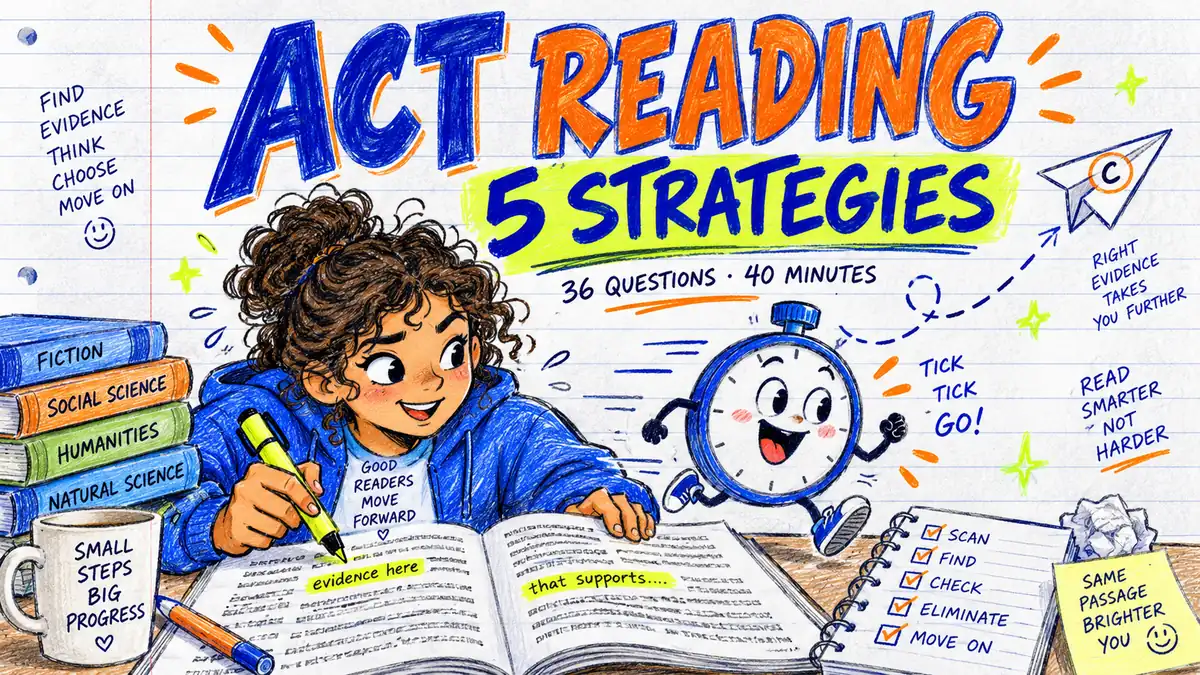
Two ACT Reading answers sound right. The clock keeps moving. Go back to the passage. Which choice has support in the text?
To work toward a 36 on ACT Reading, practice precise evidence checking, choose a reading method you can sustain, and rehearse the current 36-question section within 40 minutes. The five strategies below include an original passage example and a pacing plan. A perfect score takes accurate work across the section, and no strategy guarantees it.
Watch the hand-drawn lesson. Then try the passage example and pacing routine.
Watch this lesson on YouTube · English captions available.
Use the enhanced ACT Reading format
The enhanced ACT Reading section has 36 questions in 40 minutes. Of those questions, 27 are scored and nine are embedded field-test questions. See ACT’s official section structure and enhanced ACT FAQs.
Attempt every question. The unscored ones are unidentified. Use current-format practice when rehearsing timing. Older material can still give you reading practice, but its timing may describe a different version of the test.
ACT’s official reading advice recommends careful passage reading and referring back to the text. It describes four passage sections, including one with two shorter passages. Build your timing around both reading and answering.
1. Find support before accepting an answer
Locate the evidence for a detail question. Find the clues behind an inference. A choice can mention the correct topic while changing what the author says about it.
Watch for changes in scope. “Some residents” does not mean “all residents.” “May contribute” does not mean “is the only cause.” When two choices seem plausible, compare their wording against the evidence.
Try an original reading example
When the neighborhood garden opened, Lena kept her plot near the gate. She wanted to greet visitors, though interruptions often slowed her planting. By midsummer, she had begun leaving a basket of spare gloves beside the entrance. New volunteers reached for them before asking where to start.
Which statement is best supported by the passage?
- Lena moved her plot to avoid speaking with visitors.
- The garden required all visitors to bring their own gloves.
- Lena made it easier for new volunteers to begin helping.
- Lena finished planting earlier than every other gardener.
Show the answer and reasoning
C is best supported. Lena leaves spare gloves at the entrance, and new volunteers use them as they prepare to help. A contradicts her wish to greet visitors and invents a move. B adds a requirement the passage never states. D adds a comparison the passage never makes.
This short example illustrates evidence checking. It is an independent teaching example.
2. Compare reading methods in practice
Begin with ACT’s advice to read the passage carefully. During preparation, examine what happens when you annotate heavily versus when you mark only a few useful references. Record your accuracy and completion time.
Try brief notes about each paragraph’s role. Detailed notes can cost time when you could simply find the detail again. Keep notes that help you locate evidence. Reduce notes that merely copy the passage.
Change one habit at a time. Compare accuracy and completion time across several fresh passages before deciding whether the method helps. A single easy passage can flatter almost any approach.
3. Collect straightforward points efficiently
A clearly located detail may be quicker to resolve than a question asking about the whole passage’s purpose. If a question has you circling the same choices, mark it and move on when your test interface or booklet allows. Return with the remaining time.
If jumping among questions makes you lose your place, a more sequential approach may work better. Check your accuracy after each attempt.
4. Revisit big-picture questions with the full passage in mind
Main-idea and purpose questions ask you to account for the whole passage, so check whether an answer describes its overall argument or only a vivid example from one paragraph.
Try answering those questions after you have worked through several details, especially when your first reading leaves you uncertain. Ask what the beginning, middle, and ending contribute to the author’s overall point. For paired passages, track each author’s view before deciding how the texts relate.
5. Pace by passage as well as by question
Forty minutes across four passage sections gives an average budget of ten minutes per section. Treat that as a starting checkpoint. Leave room to adjust.
| After completing | Approximate elapsed time |
|---|---|
| Passage section 1 | 10 minutes |
| Passage section 2 | 20 minutes |
| Passage section 3 | 30 minutes |
| Passage section 4 | 40 minutes |
Adjust these checkpoints using your practice record. If you want review time at the end, finish earlier sections somewhat ahead of the ten-minute average. If you have approved timing accommodations, build a plan around your authorized time.
Keep working when an answer remains uncertain. ACT does not penalize incorrect multiple-choice answers, so make your best choice for every question. The official structure and strategy guide explains guessing and pacing.
Review missed answers and lucky guesses
For each uncertain answer, record what you chose, what the passage supports, and why the tempting alternative fails. Name the error precisely: an unsupported inference, a detail mistaken for the main idea, a misunderstood word, or a timing decision.
Choose one recurring error for your next focused session. Check your reasoning on fresh material. Use official ACT practice alongside independent resources so you remain familiar with the test maker’s questions and instructions.
A useful review entry might read: chose D | passage gives no comparison with other gardeners | added an unsupported detail | check comparisons on the next passage. Watch for that error on your next passage.
Continue with 50 full-length ACT Reading practice tests
Our Enhanced ACT Reading Complete Prep by Reza Nazari includes 32 reading topics, worked questions, chapter practice, and answer explanations. It offers 50 distinct full-length Reading practice tests, all available online, with 36 questions and a 40-minute practice limit per form.
Ten of those same tests also appear in the book/PDF. They are matching versions, so there are 50 distinct tests total. This resource focuses on Reading. Choose separate preparation for the other ACT sections.
Questions about aiming for a 36
How many questions can I miss and still get a 36?
Use the scoring information supplied with an official practice form. Do not assume one universal raw-score conversion. Scores on this independent book’s forms do not provide a validated conversion to official ACT scores.
How often should I take a full section?
Leave enough study time between full sections to review your decisions and practice a weak skill. Choose one habit to check.
For your next session, try the evidence-checking habit on a fresh passage. Write the support for every answer you were unsure about before consulting the explanation.
This article, video, and book are independently produced and are not affiliated with or endorsed by ACT. No resource guarantees a 36.

Related to This Article
More math articles
- Two-Step Equations Practice — Solve for x (Free Drills)
- 8th Grade PEAKS Math Worksheets: FREE & Printable
- FREE 6th Grade Georgia Milestones Assessment System Math Practice Test
- Free Math Worksheet Generator (Printable PDF + Answer Key)
- Conflict, White-Collar Crime, and Corporate Power
- Algebra Puzzle – Challenge 31
- Students Effective Use of Math Skills in Other Academic Disciplines
- CLEP U.S. History I 007: Powhatan Relations and Warfare
- The Ultimate FSA Algebra 1 Course (+FREE Worksheets)
- Standard Form of a Circle



What people say about "How to Get a 36 on ACT Reading: 5 Strategies"?
No one replied yet.