GED Social Studies Practice Questions: 10 Skills to Check Before Test Day

These GED Social Studies practice questions start with a turnout chart: 40% last year and 50% this year. Is that a 10% increase? Try the calculation before reading on. The distinction between percent change and percentage points is one of ten skills you can check here.
GED Social Studies practice should connect source reading, civics and history concepts, and numerical evidence. Try the ten original questions below. Write your answers first. Then open the explanations and use a missed skill to choose your next lesson.
Watch this lesson on YouTube · English captions available.
Start with the source and the question
GED Social Studies gives you 70 minutes with no break. You work with social studies concepts, historical information, sources, and numerical or graphical evidence. Check the official GED subject overview for the current format.
The official Social Studies guidance emphasizes reasoning from supplied information. Review civics, U.S. history, economics, and geography, then practice using those ideas to interpret a document or graphic.
These short teaching questions were written for this article. They are separate from the book tests and the video quiz. They illustrate useful skills rather than reproduce the length or difficulty of a complete exam.
10 GED Social Studies practice questions with answers
1. Use a map scale
On a map, 1 centimeter represents 12 kilometers. Two towns are 3.5 centimeters apart along a straight line on the map. What straight-line distance does that represent?
Show answer and explanation
42 kilometers. Multiply 3.5 by 12. This is the straight-line distance. A road between the towns could follow a longer route. Check what distance the question asks for.
2. Separate percent change from percentage points
A community’s voter turnout rises from 40% to 50%. What is the increase in percentage points, and what is the relative percent increase?
Show answer and explanation
10 percentage points and a 25% relative increase. Subtract 40 from 50 for the percentage-point change. For the relative increase, divide the 10-point change by the original 40%: 10 ÷ 40 × 100 = 25%. The original value is the base.
3. Apply supply and demand carefully
A storm damages much of a region’s tomato crop. Demand for tomatoes stays the same. In a simplified supply-and-demand model, what would you expect to happen to the equilibrium price?
Show answer and explanation
The equilibrium price would tend to rise. The damaged crop reduces supply while demand remains unchanged. The question specifies a simplified model. In an actual market, imports, storage, and other changes can affect prices too.
4. Put events in chronological order
A source lists the Declaration of Independence in 1776, ratification of the U.S. Constitution in 1788, and the start of the Civil War in 1861. Which event comes between the other two?
Show answer and explanation
Ratification of the U.S. Constitution. The supplied dates put 1788 after 1776 and before 1861. Use the information in the source to build a quick timeline.
5. Interpret a political cartoon’s symbols
A fictional cartoon shows a resident carrying a bag labeled “public concerns” toward a government door. A giant stack of paperwork blocks the entrance. What criticism does the cartoon most directly suggest?
Show answer and explanation
Bureaucratic procedures can obstruct public access to government. The doorway represents access, and the paperwork forms a barrier. The description does not identify a political party or show that all government workers ignore residents.
6. Identify a primary source
A researcher studies a 1912 factory strike. Which is a primary source for workers’ experiences: a diary written by a participant during the strike, or a textbook chapter written in 2024?
Show answer and explanation
The participant’s diary. It is a firsthand account from the event. The textbook is a later interpretation. A primary source can still contain bias or errors, so evaluate its author, purpose, and limits.
7. Recognize federalism
A passage describes a system in which a national government and state governments each exercise authority under a constitution. Which principle does this illustrate?
Show answer and explanation
Federalism. The clue is the division of authority between levels of government. Separation of powers concerns the distribution of functions among branches of government.
8. Recognize a check on another branch
The president vetoes a bill passed by Congress. Which constitutional idea does this action illustrate?
Show answer and explanation
Checks and balances. The executive branch checks legislative action through the veto. This example concerns the relationship between branches, rather than the division between national and state authority.
9. Limit a conclusion to the available evidence
A town report says, “Library visits rose from 8,000 in April to 10,000 in May after Saturday hours were added.” Which conclusion is supported: visits increased by 2,000, or Saturday hours caused every additional visit?
Show answer and explanation
Visits increased by 2,000. Subtract 8,000 from 10,000. The sequence is consistent with Saturday hours contributing to the increase, but the sentence does not establish the cause of every additional visit.
10. Read the units in an employment table
A fictional town report gives the following employment figures. How many jobs were added between 2019 and 2024?
| Year | Jobs (thousands) |
|---|---|
| 2019 | 12 |
| 2024 | 15 |
Show answer and explanation
3,000 jobs. Subtract 12 from 15 to get 3, then apply the table’s unit: 3 thousand jobs. An answer of 3 jobs overlooks the units. The table gives the size of the change, but no explanation for why employment increased.
Turn your answers into a short study plan
Give yourself one point for each fully correct response. On Question 2, check both calculations. The total is feedback about these examples, not an official GED readiness score.
If maps and percentages caused trouble, work on scales, units, and the starting value in percent calculations. If federalism and checks and balances were confusing, draw separate diagrams for levels of government and branches of government. If you chose an overly broad conclusion, underline the exact evidence that supports each answer.
Return to a fresh mixed set after that focused review. During a timed attempt, notice where you reread material and which questions consume the most time. Use that information to adjust your approach.
Continue with 50 full-length Social Studies practice tests
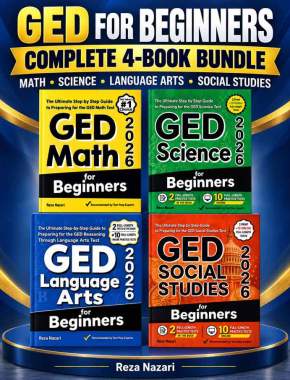
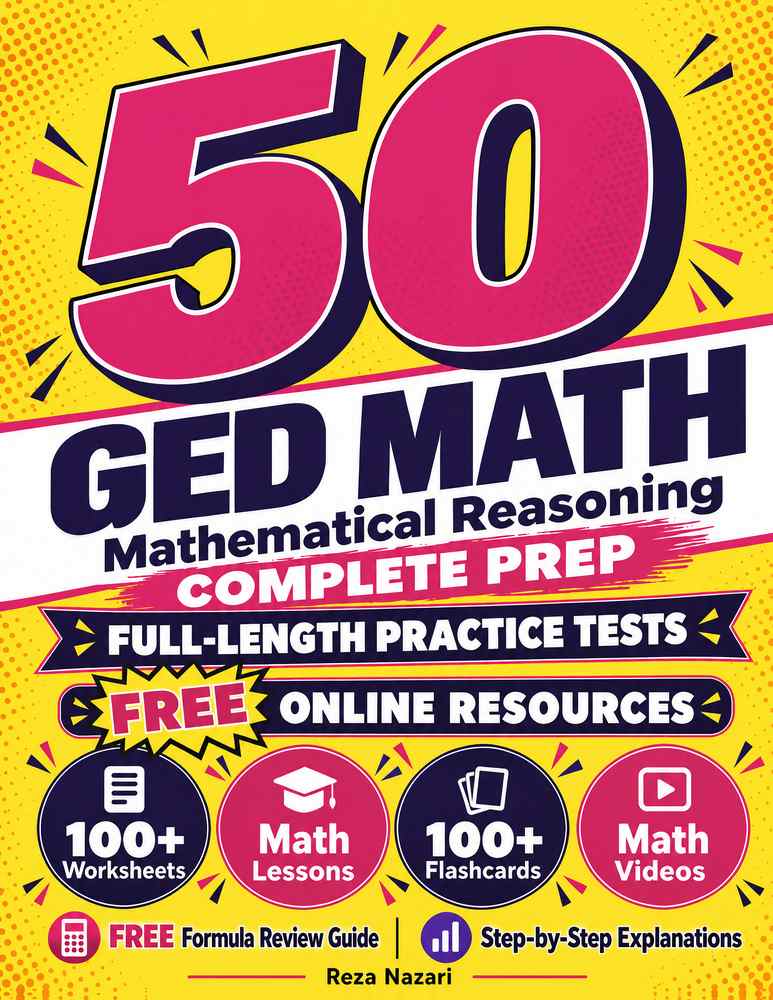
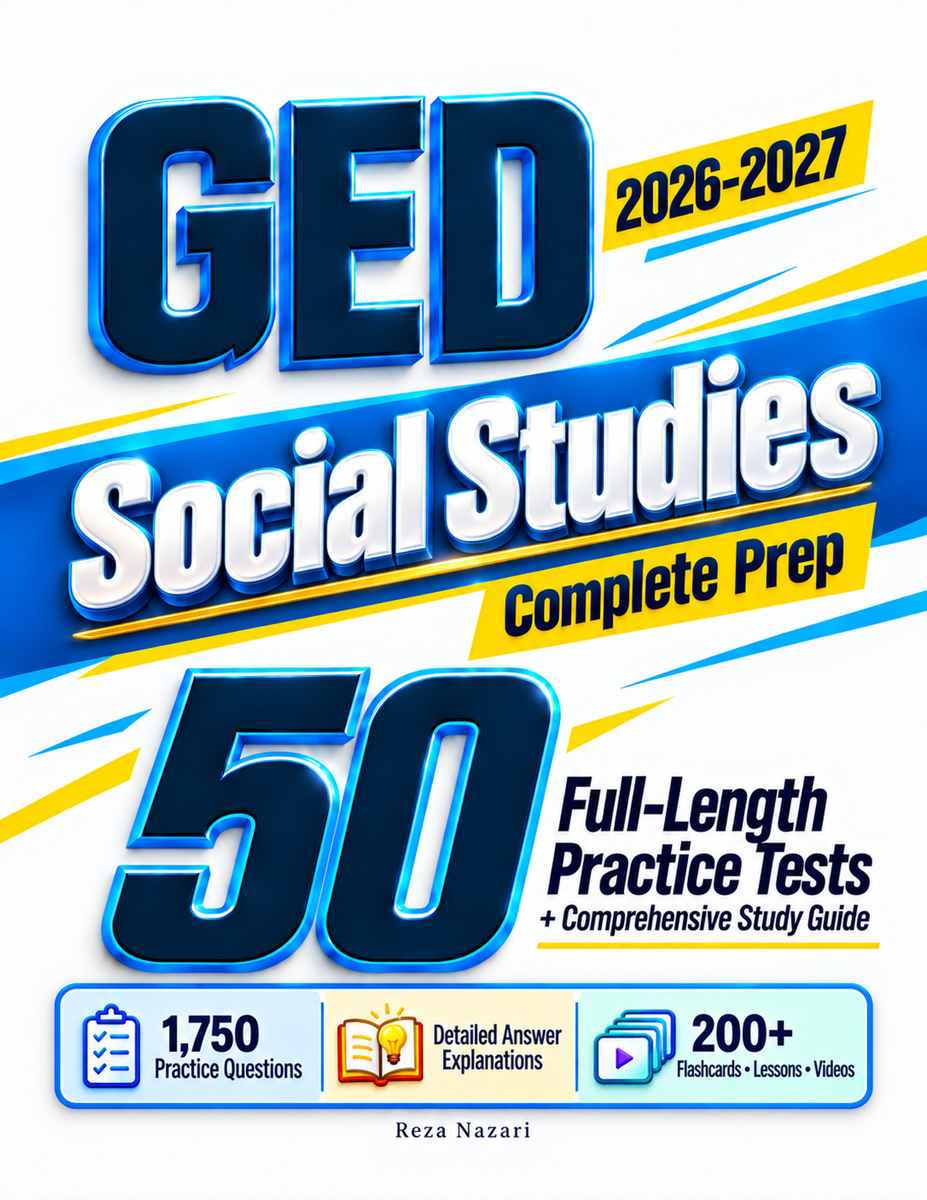
Our GED Social Studies Complete Prep by Reza Nazari includes guided review and 50 distinct full-length practice tests: ten in the book/PDF and 40 additional online. The collection has 1,750 test questions, with 35 questions per practice form.
Use the lessons to revisit civics, history, economics, and geography. Then use the answer explanations to check how a source supports the correct choice. Online companions to the ten book tests repeat those forms. The total remains 50 distinct tests.
Questions about GED Social Studies review
Should I memorize a long list of historical dates?
Study major ideas and historical context, and practice reasoning from the information supplied. A source may provide the dates you need. Reading it carefully and understanding cause, sequence, or perspective helps you use those dates.
Does 10/10 mean I am ready for the official test?
This short quiz checks a small set of skills. It cannot establish readiness for a full exam. Use broader practice and official GED readiness resources before making a test-day decision.
For connected lessons and review, visit our GED Social Studies Online Center. Choose the skill that slowed you down today and give it your next study session.
These are original, independent teaching examples. Effortless Math’s article and book are not affiliated with or endorsed by GED Testing Service. Practice results do not guarantee passing.

Related to This Article
More math articles
- MoGEA Math Flashcards
- 7th Grade Math: Topics, Standards, and Free Practice
- Convert Between Improper Fractions and Mixed Numbers
- Wartime Science, Medicine, and Technology
- GED Math Prep Books: Compare Study Guides and Formats
- How to Reduce Rational Expressions to the Lowest Terms?
- Counterclaims and Rebuttals
- The Double V Campaign and the Second Great Migration
- The Law of Sines
- Ideological groups






What people say about "GED Social Studies Practice Questions: 10 with Answers"?
No one replied yet.