How Many Questions Do You Need to Pass GED Math?
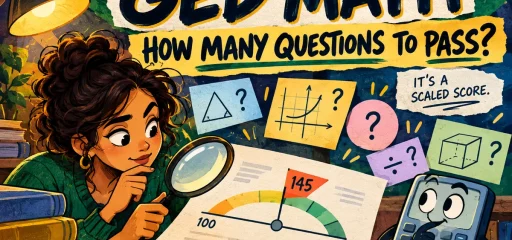
Quick answer: There is no fixed number of questions. You pass GED math with a scaled score of 145 out of 200, and GED Testing Service does not publish its raw-to-scaled conversion. The test has about 46 questions, some worth more than one point. GED Testing Service suggests practicing until you answer about 65% correctly, which is roughly 30 questions.
“How many questions do I need to get right?” is the first thing most GED students ask about the math test, and it is a fair question. The honest answer is a little more complicated than a single number, because the GED is scored in points and then converted to a scale. This post explains how that works, gives you a careful target you can practice toward, and shows how to check your readiness before you pay for the real test.
The Short Answer: Points, Not a Fixed Number of Questions
To pass the GED Mathematical Reasoning test, you need a scaled score of 145 on a scale of 100 to 200. GED Testing Service does not publish a fixed number of correct answers that equals 145. Its own scoring explainer says that “the number of points you earn in each section is scored, not the number of questions answered correctly.”
Three things make a fixed “X questions to pass” impossible to promise:
- Some questions are worth more than one point. A drag-and-drop or fill-in-the-blank item with two parts can carry more than one point, so two students with the same number of correct answers can earn different raw scores.
- There are multiple test forms. Each form is balanced so that a 145 means the same skill level, but the exact raw points needed can shift slightly from form to form.
- The conversion is not public. GED Testing Service does not release its raw-to-scaled score tables.
So any website that says “you need exactly 30 questions” is estimating. Below, we show you how to make a sensible estimate of your own.
GED Math Score Chart
Every GED subject, including math, uses the same 100 to 200 scale and the same four performance levels. These ranges come from GED Testing Service’s passing score page and its test-taker brochure:
| Score range | Performance level | What it means |
|---|---|---|
| 100 to 144 | Below Passing | You need to retake the math test |
| 145 to 164 | Pass / High School Equivalency | Math counts toward your GED credential |
| 165 to 174 | GED College Ready | May exempt you from college placement tests or remedial math at some colleges |
| 175 to 200 | GED College Ready + Credit | Some colleges may award college credit; the college decides |
Scores are not averaged across subjects. You need at least 145 on each of the four tests, so a strong science score cannot make up for a 140 in math. For more on the scale, see our post on how the GED math test is scored.
How Many Questions Are on the GED Math Test?
The GED math test has about 46 questions. GED Testing Service’s main pages describe the time and format but do not print a question count, and the number can vary slightly by form. The 46 figure comes from state adult education materials such as the South Carolina GED subject flyer. Here is the format as of October 2026, from the official GED test subjects page:
| Feature | GED Mathematical Reasoning |
|---|---|
| Total time | 115 minutes, including 2 minutes for instructions and final review |
| Structure | Two parts with a 3-minute break between them |
| Part 1 | No calculator (a short set of questions) |
| Part 2 | On-screen TI-30XS calculator available (you may bring your own TI-30XS at a test center) |
| Provided | Formula sheet and calculator reference sheet |
| Question types | Multiple choice, drag and drop, fill-in-the-blank, select an area (hot spot), drop-down |
| Content | About 55% algebraic problem solving, 45% quantitative problem solving |
The calculator rules matter for your plan, so read our GED calculator guide before test day and practice with the TI-30XS layout.
A Careful Rule of Thumb for Practice
Since the real conversion is not published, the most useful number comes from GED Testing Service itself. In its scoring explainer, it suggests practicing with sample questions “until you can answer about 65% or more of them” correctly. That is study advice, not a scoring cutoff, but it gives you something concrete to aim for.
Applied to a 46-question test, 65% works out like this:
| Practice accuracy | About how many of 46 | How to read it |
|---|---|---|
| Below 55% | Fewer than 25 | Keep building core skills before testing |
| About 65% | About 30 | GED’s suggested practice target |
| 75% or more | About 35 or more | A comfortable cushion for test-day nerves |
Treat these as practice targets, not a promise of a 145. Some prep publishers repeat a 60% to 65% figure as well, but none can show an official conversion table, so the safest approach is to aim above the minimum and confirm with a GED Ready score.
Use GED Ready to Check Your Real Readiness
GED Ready is the official practice test from GED Testing Service. According to the GED educator handbook, it is half the length of the real test, and it reports a score on the same 100 to 200 scale with one of three color-coded results (GED Ready guidance):
| GED Ready color | Score | Label | Suggested next step |
|---|---|---|---|
| Green | 145 to 200 | Likely to Pass | Schedule the real test |
| Yellow | 134 to 144 | Too Close to Call | Study a bit more, then retake GED Ready |
| Red | 100 to 133 | Not Likely to Pass | Spend more time on the skills in your study plan |
GED Ready also gives you a personalized study plan listing the skills you missed. That list is more useful than any raw-score estimate, because it tells you exactly what to fix.
What This Means for You: A Worked Plan
Here is how to turn the numbers into a plan. Suppose you take a full-length practice test and get 24 of 46 questions right, about 52%. You want to reach at least 30 (65%), and ideally 34 or more.
- Sort your misses. With about 55% algebra, roughly 25 of the 46 questions are algebraic and about 21 are quantitative (these are approximations based on the official content split). Count how many you missed in each group.
- Find the cheap points. Quantitative skills like percents, ratios, unit rates, mean and median, and area are often the fastest to fix. Picking up 3 or 4 of these closes half the gap.
- Then attack algebra. Solving linear equations and inequalities, reading slope from a graph, and evaluating functions show up again and again. Two or three more correct algebra answers gets you to the target.
- Don’t throw away Part 1. The no-calculator questions are usually basic arithmetic, but a single slip costs a point. Practice fractions, decimals and order of operations by hand.
- Confirm with GED Ready. When your practice tests sit at 65% or higher two or three times in a row, take GED Ready. Green means book the test.
Not sure where to start? Our free GED math diagnostic takes about 10 minutes and shows your weakest topics. If you have a deadline, the 30-day GED math plan lays out a week-by-week schedule.
Which Topics to Study First
The GED assessment guide for math lists the targets the test measures. If your time is short, prioritize in this order:
- Number sense: fractions, decimals, percents, ratios and proportions, order of operations, exponents and square roots.
- Linear equations and inequalities: solving them, writing them from word problems, and checking answers.
- Graphs and functions: slope, intercepts, reading coordinate graphs, and evaluating f(x).
- Geometry with the formula sheet: area, perimeter, volume, and the Pythagorean theorem. You do not need to memorize these formulas, but you must know which one to use.
- Data: mean, median, mode, range, and reading tables and charts.
- Quadratics: factoring and evaluating simple quadratic expressions, often the most demanding topic on the test.
Our article on the hardest math on the GED test covers the topics that trip students up most, and the GED math online center has a lesson and worksheet for each skill.
Aiming Higher Than 145
A 145 earns your credential, but a 165 can save you time and money later. For example, Texas public colleges accept a GED Mathematical Reasoning score of 165 as an exemption from the TSI (TSIA2) math requirement under 19 TAC Rule 4.54. Other states and colleges have their own policies, so ask the admissions office at any school you are considering. If you already passed but have not yet received your credential, GED Testing Service notes you may be able to retake a subject to raise your score. Retake rules and waiting periods vary by state and by whether you test online or at a test center, so check your state’s rules on GED.com.
Practice Quiz: 10 GED Math Questions
Answer each question and press Submit to see your result right away.
Answer each question and press Submit to see your result right away.
Frequently Asked Questions
What percentage do you need to pass the GED math test?
There is no official percentage. GED math is scored on a 100 to 200 scale, and 145 passes. GED Testing Service does suggest practicing until you can answer about 65% or more of sample questions correctly, which is roughly 30 of 46 questions. Treat that as a practice target, not a cutoff.
Is 145 a good GED math score?
A 145 is a passing score and counts toward your high school equivalency credential. If you plan to go to college, aim higher: 165 to 174 is GED College Ready, which can exempt you from placement tests or remedial math at some colleges, and 175 or above may earn college credit.
Can you use a calculator on the GED math test?
Yes, on the second part. The first part of the test does not allow a calculator. For the rest, an on-screen TI-30XS is available, and at a test center you may bring your own TI-30XS. A calculator reference sheet and a formula sheet are provided.
How long is the GED math test?
The Mathematical Reasoning test lasts 115 minutes, which includes 2 minutes for instructions and final review. It is split into two parts with a 3-minute break between them. That works out to a little over two minutes per question, so pacing practice is worth the time.
Does GED Ready predict your real GED math score?
GED Ready is the official practice test and is half the length of the real test. It reports a score on the same 100 to 200 scale with three bands: green (145 to 200, likely to pass), yellow (134 to 144, too close to call) and red (100 to 133, not likely to pass).
How many times can you retake the GED math test?
Retake policies are set by each state and can differ for online and test center testing. Many states allow repeat attempts, sometimes with a waiting period after several tries. Log in to GED.com and check your state's rules before you schedule a retake.
Sources
- GED.com: Test Subjects
- GED.com: Understanding GED Scores
- GED.com: How to Get a Passing Score on the GED Test
- GED.com: Using the GED Ready Practice Test
- GED Educator Handbook (GED Testing Service)
- Passing the Test brochure, 6th edition (GED Testing Service)
- Assessment Guide for Educators: Mathematical Reasoning (GED Testing Service)
- South Carolina DEW: GED Test Subject Flyers
- 19 TAC Rule 4.54 (Texas TSI exemptions, via Cornell LII)

Related to This Article
More math articles
- Full-Length Accuplacer Math Practice Test-Answers and Explanations
- Disinfectant Families and Safe Use
- Domestic policy
- How to Determine the Missing Number when Multiplying Decimals by Powers of 10
- How to Draw Geometric Shapes with given condition?
- Overview of the GED Mathematical Reasoning Test
- Transitions Between Sections
- The Best Grade 3 ELA Practice Tests for Massachusetts Students
- 5th Grade IAR Math Worksheets: FREE & Printable
- Newton’s Method Calculator (Free, with Iteration Table)














What people say about "How Many Questions to Pass GED Math? Score Chart"?
No one replied yet.