The Great Society, the War on Poverty, and Federal Education Policy
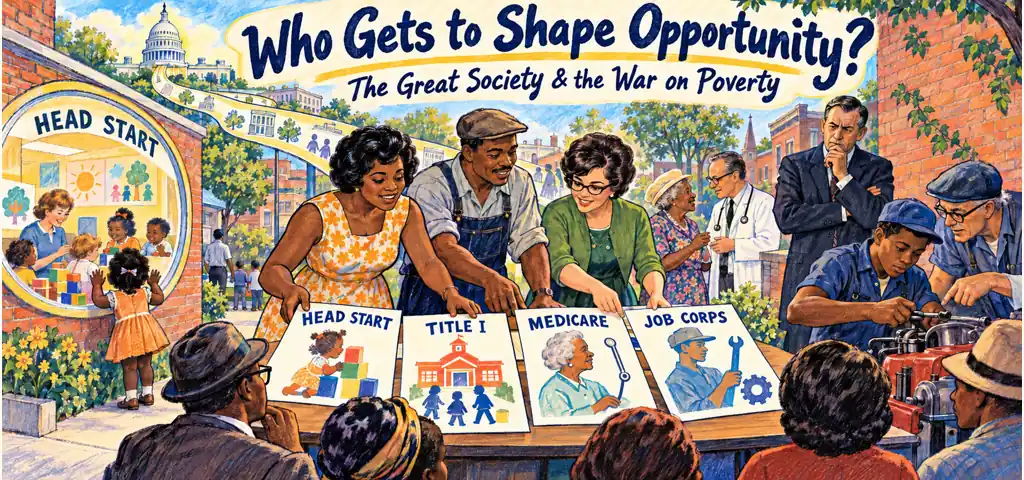
Chapter 13 of the CLEP History of the United States II study guide on Effortless Math covers The Great Society, the War on Poverty, and Federal Education Policy: the key terms, the core ideas, and worked examples showing how this topic is tested on the exam.
CLEP History of the United States II, Chapter 13
Johnson turned a landslide into a crowded legislative window
Lyndon Johnson's victory in 1964 enlarged liberal majorities in Congress. The administration used that opening to pursue health insurance, education aid, immigration reform, voting rights, environmental protection, consumer safety, culture, and antipoverty policy. The Great Society extended parts of the New Deal but worked in a different economy. It sought to widen access within postwar abundance as well as protect households against insecurity. The number of laws makes institutional distinctions essential.
Harrington described poverty hidden by the image of affluence
Michael Harrington's The Other America argued that tens of millions remained poor in rural areas, inner cities, old age, and unstable work. Poverty could be socially invisible to middle-class consumers traveling on new highways and living in separated suburbs. His book did not provide the administration's program line by line. It helped make persistent poverty a national political problem during a period commonly described through growth and consumption.
The Economic Opportunity Act built programs and local conflict
The 1964 act created the Office of Economic Opportunity and supported Job Corps, VISTA, Head Start, legal services, and community action. The requirement for "maximum feasible participation" invited poor residents into planning. Mayors and established agencies sometimes saw community-action boards as rivals for money and authority. A program could therefore provoke conflict even when local actors agreed that poverty existed. The dispute concerned who defined need, hired staff, and controlled federal funds.
Head Start and Title I worked at different points
Head Start provided preschool education, health screening, nutrition, and family services to children from low-income households. Title I of the 1965 Elementary and Secondary Education Act sent federal aid to districts serving concentrations of low-income children. The programs shared an effort to reduce educational disadvantage but differed in age group and administrative channel. Neither created a single national curriculum or transferred ordinary school control to Washington.
Medicare and Medicaid divided health coverage by eligibility
The 1965 Social Security amendments created Medicare for older Americans and certain later eligible groups, with federal administration and payroll-supported hospital insurance. Medicaid formed a federal-state program for categories of low-income people, with state administration inside federal rules. Age and income are the quickest first distinction. Funding, administration, and covered populations add precision. Confusing the names turns a straightforward item into guessing.
Food aid mixed purchasing with a federal subsidy
The Food Stamp Act of 1964 made the program permanent. Eligible households bought food stamps and received additional purchasing value, with later reforms changing the purchase requirement. In the Mississippi Delta, local officials sometimes resisted food programs while families faced severe hunger. Fannie Lou Hamer's Freedom Farm Cooperative later joined food production, land access, and economic independence. Hunger policy reveals how national authorization still depended on local access and administration.
Federal education policy widened without erasing state control
The Higher Education Act of 1965 expanded grants, loans, and institutional support, including need-based assistance. The Bilingual Education Act of 1968 supported programs for students with limited English proficiency. Congress also funded libraries, teacher preparation, and educational research. Federal money grew, but states, districts, schools, and colleges continued to make many decisions about curriculum, staffing, admission, and implementation. Funding capacity and operating authority remained layered.
The 1965 immigration law replaced national-origins quotas
The Immigration and Nationality Act of 1965 abolished the national-origins formula and emphasized family reunification and occupational preferences, subject to numerical limits and later complications. It also imposed the first broad numerical ceiling on immigration from the Western Hemisphere, altering legal migration from Mexico and nearby countries. The reform widened some routes while closing or constraining others. Its long-term demographic effects exceeded many sponsors' expectations.
The Great Society reached culture, information, safety, and aging
The National Foundation on the Arts and Humanities Act created the NEA and NEH in 1965. Congress chartered the Corporation for Public Broadcasting in 1967 as a private nonprofit supported by public funds, insulating programming from direct agency control. The Freedom of Information Act created a public right to request federal records subject to exemptions. Other laws aided older Americans, regulated motor-vehicle safety, and prohibited age discrimination in employment. These measures broaden the meaning of social policy beyond cash benefits.
War and political change narrowed the legislative opening
Vietnam spending competed for money and public attention. Urban uprisings, inflation, white backlash, southern realignment, and Republican gains in the 1966 midterms weakened the coalition behind further domestic legislation. Programs continued, but the high-volume lawmaking of 1964-1966 slowed. Causation should remain plural. The war mattered, yet elections, racial conflict, fiscal strain, and disputes over administration also changed what Congress would pass.
Welfare-rights organizers learned the rules they were judged by
The National Welfare Rights Organization treated recipients as political actors rather than passive clients. Local groups studied caseworker manuals, identified benefits officials had overlooked, accompanied applicants, and appealed arbitrary denials. They also challenged intrusive home inspections and demanded adequate income. Technical knowledge mattered because county discretion shaped access to Aid to Families with Dependent Children. Learning an agency's own rules let recipients convert a private encounter with a caseworker into a collective claim about due process, dignity, and material need.
follow money through the institution that uses it
A federal statute sends aid to a poor school district, but achievement remains unequal.
Watch the history in motion
This short lesson adds voices, images, and chronology to the ideas you just studied.
Video: What Were LBJ's "Great Society" Programs? | History, HISTORY.
Try four CLEP-style questions
- Which program most directly invited poor residents to participate in planning local antipoverty projects?
- Medicare hospital insurance
- Title I aid for districts serving low-income pupils
- The National Endowment for the Humanities
- The Office of Economic Opportunity's community-action program
- The Corporation for Public Broadcasting
- Which comparison of Medicare and Medicaid is accurate?
- Medicare began as a state-administered welfare benefit, while Medicaid operated through a single federal insurance office.
- Medicare centered on age-based federal coverage, while Medicaid joined federal funds to state programs for eligible low-income groups.
- Medicare financed construction of public hospitals, while Medicaid replaced employer insurance for the national workforce.
- Medicare targeted low-income families across age groups, while Medicaid primarily covered retirees through Social Security.
- Medicare began with the Social Security Act of 1935, while Medicaid was a temporary New Deal relief program.
- What changed most directly under the Immigration and Nationality Act of 1965?
- Refugee admissions replaced both family relationships and occupational skills as the ordinary admission categories.
- Numerical limits ended for permanent immigrants arriving from either the Eastern or Western Hemisphere.
- The former Mexican farm-labor agreement became the principal route to permanent citizenship.
- Asian immigrants became ineligible for the family-reunification preferences available to European applicants.
- The national-origins quota formula gave way to family and occupational preferences within numerical limits.
- Why did community-action programs often produce conflict with mayors and established agencies?
- Federal law required the programs to replace elected city councils.
- Participants received voting rights only while enrolled in an antipoverty program.
- Local boards could claim authority over staff, funds, and priorities that officials had controlled.
- The programs prohibited cooperation with schools, churches, and nonprofit groups.
- Congress assigned every grant directly to neighborhood organizations without federal review.
Check your answers and reasoning
Independent preparation. CLEP is a registered trademark of the College Board, which does not endorse this lesson.

Related to This Article
More math articles
- Doubling Down on Roulette: A Math Walk-Through of Why It Burns Out
- Probability and Statistics for Beginners: A Friendly Intro
- Traffic Control, One-Way Workflow, and Ergonomics
- Geometry Puzzle – Challenge 72
- How to Prepare for the THEA Math Test?
- 7th Grade SBAC Math Worksheets: FREE & Printable
- 5 Best Laptops for Math Teachers
- Wisconsin Forward Grade 7 Math Worksheets: 95 Free Printable PDFs Covering Every Skill
- FREE 8th Grade NYSE Math Practice Test
- The Best Grade 5 ELA Practice Tests for Montana Students
















What people say about "The Great Society and the War on Poverty"?
No one replied yet.