Malcolm X, Black Power, and Urban Uprisings
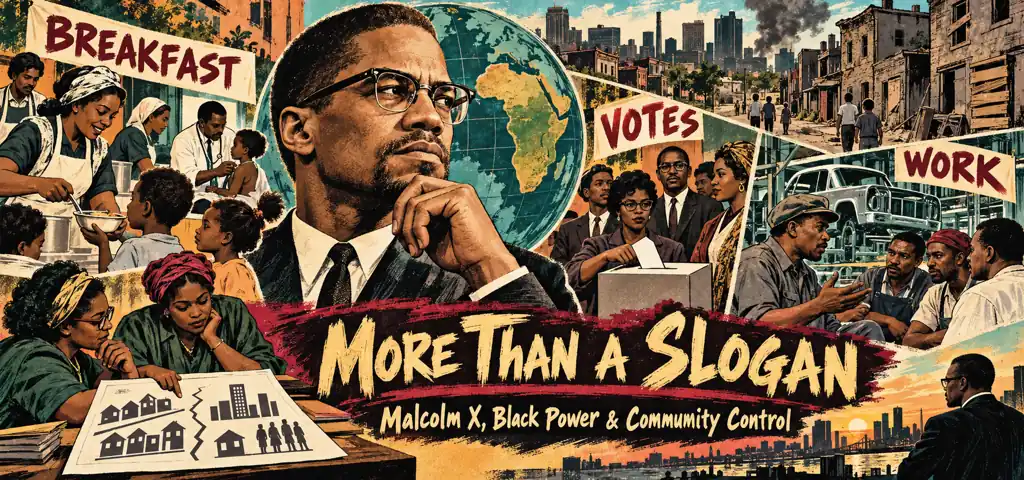
Chapter 13 of the CLEP History of the United States II study guide on Effortless Math covers Malcolm X, Black Power, and Urban Uprisings: the key terms, the core ideas, and worked examples showing how this topic is tested on the exam.
CLEP History of the United States II, Chapter 13
Malcolm X changed while keeping power at the center
As a Nation of Islam minister, Malcolm X criticized integration, warned against dependence on white approval, and defended Black self-respect and self-defense. After leaving the Nation in 1964, he made the pilgrimage to Mecca, formed new organizations, and became more open to cooperation across racial lines while retaining a strong analysis of colonialism and Black political power. Treating one speech as his permanent position misses that development.
Black Power named control as well as pride
During the 1966 March Against Fear in Mississippi, Stokely Carmichael popularized the call for Black Power. The phrase could mean cultural pride, independent political organization, community control, or freedom from reliance on white-led institutions. Critics feared separatism or violence. Supporters argued that integration without bargaining power left existing institutions in command. The debate therefore concerned who set goals, selected leaders, controlled resources, and negotiated alliances.
Lowndes County supplied a political model and symbol
The Lowndes County Freedom Organization ran independent candidates in Alabama under a black-panther emblem. It emerged where Black residents formed a majority but white officials controlled government. Registration was the beginning, not the endpoint. Candidates, party rules, protection, and turnout determined whether voters could exercise power. The later Black Panther Party adopted the symbol but developed in a different place and political setting.
The Black Panther Party joined armed presence to community programs
Founded in Oakland in 1966 by Huey Newton and Bobby Seale, the Panthers monitored police activity while carrying firearms permitted under California law at the time. They also operated breakfast programs, health clinics, political education, and other community services. Federal and local agencies subjected the party to surveillance and disruption, including COINTELPRO operations. A description limited to guns misses why some neighborhoods saw the organization as a provider as well as a protest group.
Urban uprisings grew from local incidents and deeper conditions
Watts in 1965, Newark and Detroit in 1967, and many disturbances after King's assassination in 1968 began with particular confrontations. Their scale reflected broader anger over policing, housing segregation, unemployment, and public services. Calling every episode a planned political revolt invents coordination. Calling each one random crime erases the conditions that made a police encounter capable of producing days of conflict.
The Kerner Commission rejected a narrow law-and-order explanation
President Johnson's National Advisory Commission on Civil Disorders concluded in 1968 that the nation was moving toward "two societies, one black, one white, separate and unequal." It identified discrimination, segregation, unemployment, and police-community conflict. The commission recommended large investments in jobs, housing, education, welfare, and police reform. Its report did not excuse violence or claim one cause. It argued that repression alone could not repair the conditions behind recurring disorder.
Black workers challenged power inside integrated unions
In Detroit, the Dodge Revolutionary Union Movement and related groups argued that Black auto workers faced the hardest jobs, discriminatory discipline, and limited influence in union leadership. Their target was neither simply the company nor simply the union. They challenged management and the racial hierarchy within organized labor. This history complicates a tidy choice between civil rights and class politics because workers used both languages at once.
Black politics expanded into elections and national conventions
Shirley Chisholm's 1972 presidential campaign sought delegates and built a coalition including Black voters, women, young people, and poor communities. That year the National Black Political Convention met in Gary, Indiana, to debate an independent agenda across ideological differences. Neither effort created a unified Black party. Both tested how local officeholding, major-party participation, and independent organization might convert movement energy into policy power.
Sport became a stage for political speech
At the 1968 Mexico City Olympics, Tommie Smith and John Carlos raised gloved fists during the medal ceremony after winning gold and bronze in the 200-meter race. Their protest drew on the Olympic Project for Human Rights and highlighted racial inequality. The International Olympic Committee expelled them from the Games. The episode shows how a globally televised institution could amplify dissent while punishing athletes who challenged its preferred separation of sport and politics.
distinguish diagnosis from response
A commission report names segregated housing, unemployment, and police conflict after an uprising.
Malcolm X moved the freedom struggle into an international frame
After leaving the Nation of Islam, Malcolm X founded the Organization of Afro-American Unity and argued that racial oppression should be presented as a human-rights issue before a world shaped by African decolonization. That strategy differed from asking only whether a state or local rule violated the Constitution. It sought outside moral and diplomatic pressure while building independent Black organization at home. His changing alliances did not erase his emphasis on power, self-determination, or international anticolonial struggle.
Commission evidence tested explanations of urban disorder
The Kerner Commission drew on hearings, interviews, demographic evidence, policing records, and studies of housing and employment. It rejected the claim that one coordinated outside conspiracy explained the 1967 uprisings, yet it did not treat every participant as having the same motive. Arrest totals, property damage, and troop deployment describe an event's scale; they cannot by themselves identify its causes. A sound analysis separates the immediate trigger, accumulated conditions, participant motives, and the effects of the government's response.
Watch the history in motion
This short lesson adds voices, images, and chronology to the ideas you just studied.
Video: Malcolm X and the Rise of Black Power: Crash Course Black American History #38, CrashCourse.
Try four CLEP-style questions
- Which activity best distinguishes the Black Panther Party's community role from a description centered only on armed patrols?
- Operating free breakfast and neighborhood health programs
- Filing the school cases later consolidated in Brown
- Negotiating the March on Washington speaking order
- Administering federal examiners under the Voting Rights Act
- Running citizenship schools through affiliated churches
- What did the Kerner Commission recommend after studying the 1967 disorders?
- Major investment in jobs, housing, education, welfare, and police reform
- Withdrawal of federal housing and employment programs
- A national prohibition on local police departments
- Replacement of elected city governments by federal receivers
- A finding that outside organizers had coordinated the uprisings
- How did DRUM complicate the usual division between labor and civil-rights history?
- It defended company discipline against union seniority rules.
- It challenged management and racial inequality within the union movement.
- It rejected workplace issues in favor of electoral campaigns.
- It sought segregated factories under Black management.
- It organized employers to oppose public-sector bargaining.
- What did the LCFO and Shirley Chisholm's 1972 campaign have in common?
- Both won immediate control of the governments they challenged.
- Both rejected elections and built armed neighborhood patrols instead.
- Both used electoral organization to test how Black constituencies could gain policy power.
- Both operated as official affiliates of the national Democratic Party.
- Both centered their campaigns on international anticolonial diplomacy.
Check your answers and reasoning
Independent preparation. CLEP is a registered trademark of the College Board, which does not endorse this lesson.

Related to This Article
More math articles
- WEST-B Math Flashcards
- Fiscal policy
- The Ultimate PARCC Algebra 1 Course (+FREE Worksheets)
- Sense Organs
- Elasticity determines economic tax incidence
- Math Courses Required For A Business Degree
- The Enchanted Forest of How to Compare Ratios – A Tale of Mathematical Adventure
- The Best Grade 8 ELA Practice Tests for Nevada Students
- The Second Industrial Revolution and the National Market
- Simpson’s Rule Calculator (Free, Step-by-Step)














What people say about "Malcolm X, Black Power, and Uprisings"?
No one replied yet.