Freedom Summer, Selma, and the Voting Rights Act of 1965
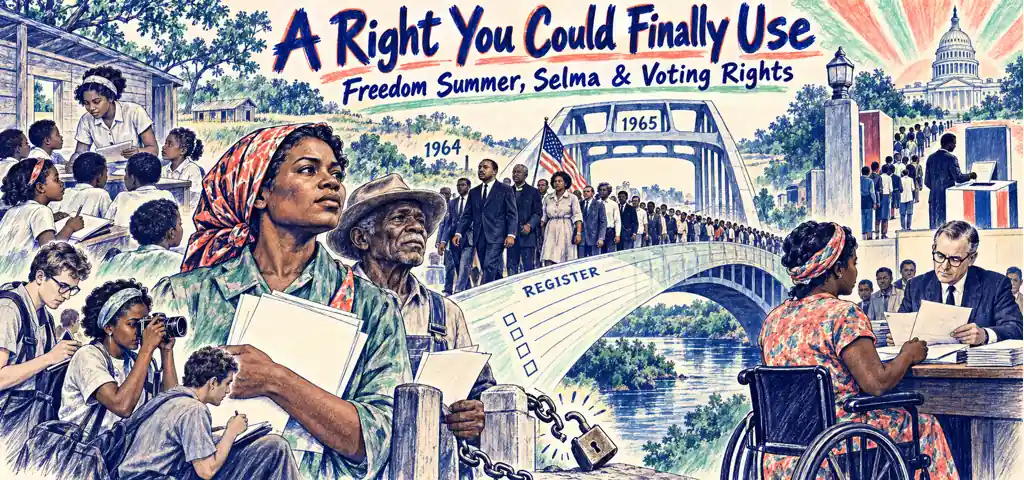
Chapter 13 of the CLEP History of the United States II study guide on Effortless Math covers Freedom Summer, Selma, and the Voting Rights Act of 1965: the key terms, the core ideas, and worked examples showing how this topic is tested on the exam.
CLEP History of the United States II, Chapter 13
Registration rules hid coercion behind local discretion
Mississippi registrars could open at irregular hours, interpret literacy tests selectively, demand difficult constitutional explanations, and share applicants' names with employers or sheriffs. Violence and economic retaliation reinforced the paperwork. The Fifteenth Amendment already barred racial denial of the vote, yet a right without accessible registration and enforcement remained fragile. The movement therefore gathered affidavits, registration figures, arrest records, and testimony that could show how local discretion operated.
Freedom Summer tried to make exclusion visible and build local capacity
In 1964 SNCC, CORE, and allied groups brought volunteers to Mississippi for registration work, Freedom Schools, and community organizing. James Chaney, Andrew Goodman, and Michael Schwerner disappeared in June and were found murdered weeks later. National attention increased partly because two victims were white northerners, a disparity that Black organizers noticed. The project produced schools, records, and relationships, but it did not by itself register most eligible Black Mississippians.
The MFDP challenged representation inside the national party
Because Mississippi's regular Democratic Party excluded Black citizens, activists created the Mississippi Freedom Democratic Party. At the 1964 Democratic convention, Fannie Lou Hamer described violence and retaliation faced by registration applicants. Party leaders offered two at-large seats rather than replacing the regular delegation. The MFDP rejected the compromise. The outcome revealed a conflict between movement claims to democratic representation and party leaders' fear of losing white southern support.
Selma concentrated pressure on voting legislation
The Selma campaign targeted registration in Dallas County, Alabama, where Sheriff Jim Clark's repression made the denial visible. On March 7, 1965, state troopers attacked marchers crossing the Edmund Pettus Bridge on their way to Montgomery. Television images of Bloody Sunday widened support. A later march proceeded under federal protection. Selma did not create voting inequality, but it focused national attention on a remedy Congress could enact.
The Voting Rights Act changed enforcement machinery
The 1965 act suspended literacy tests in covered jurisdictions, authorized federal examiners to register voters, and required certain jurisdictions to obtain federal preclearance before changing voting rules. Coverage originally turned on a formula linked to tests and low participation. The point was preventive as well as corrective. Instead of challenging every discriminatory rule only after an election, federal review could stop a covered change before it took effect.
The Twenty-fourth Amendment had a narrower reach
Ratified in 1964, the Twenty-fourth Amendment prohibited poll taxes in federal elections. It did not by itself abolish poll taxes in state elections. The Supreme Court later held in Harper v. Virginia Board of Elections that a state poll tax violated equal protection. Distinguishing amendment from case prevents a common timeline error. Congress and the Court used different constitutional routes to dismantle related barriers.
Federal protection did not end local danger
In parts of Louisiana and Mississippi, the Deacons for Defense and Justice guarded organizers and communities against white-supremacist violence. Their armed self-defense differed from the public nonviolence associated with SCLC marches. The two strategies could coexist in the same wider movement. The distinction concerns roles: disciplined demonstrators created public pressure, while local residents sometimes protected homes and meeting places when law enforcement refused.
Lowndes County organizers built an independent party
SNCC workers and local residents formed the Lowndes County Freedom Organization in Alabama in 1965. Because many voters had limited literacy, state law allowed parties to use emblems. The organization chose a black panther. It nominated local candidates independently of the white-controlled Democratic organization. The party did not win immediate county control, but it converted registration into an attempt to hold office and gave later Black Power politics a durable symbol.
Voting gains changed officeholding over time
Federal examiners, registration drives, and the act's deterrent effect sharply increased Black registration in many covered counties. Electoral change came on different schedules. Black mayors won in major cities during the late 1960s and 1970s as voting strength, migration, district boundaries, coalitions, and candidate organization shifted. A registration increase is a necessary part of that story, but it does not guarantee an immediate victory or identify the coalition behind one.
Shelby County altered preclearance without erasing the whole act
In Shelby County v. Holder (2013), the Supreme Court invalidated the coverage formula used to decide which jurisdictions needed preclearance. The Court did not strike every section of the Voting Rights Act. Section 2's nationwide ban on racially discriminatory voting practices remained, though litigation under it occurs after or in anticipation of a challenged rule. The decision weakened the act's preventive machinery by leaving the preclearance trigger inoperative unless Congress adopted a new formula.
separate a right, a barrier, and a remedy
A county has few registered Black voters even though the Fifteenth Amendment has existed for decades.
Federal examiners changed who controlled access to the ballot
The Voting Rights Act suspended literacy tests in covered jurisdictions and allowed federal officials to register voters where local systems had excluded them. It also required certain jurisdictions to obtain preclearance before changing voting rules. These devices addressed different stages: registration opened the electorate, while preclearance tried to prevent a county or state from replacing one barrier with another. Registration gains varied because intimidation, employment pressure, candidate access, and local administration did not disappear at once. The act's effect is therefore best measured through both legal authority and county-level participation over time.
Television made repression visible but did not create the movement
News images of police attacks at Selma influenced national opinion and increased pressure on federal officials. Cameras mattered because organizers had already built a campaign, marchers accepted risk, local authorities chose force, and viewers interpreted the evidence within an existing debate. Media attention could amplify violence in one location while ignoring organizing elsewhere. The correct causal chain joins local strategy, official response, national institutions, and public communication. Saying that television "caused" civil rights erases years of work; saying it had no effect ignores how images changed the political cost of inaction.
Watch the history in motion
This short lesson adds voices, images, and chronology to the ideas you just studied.
Video: The CIVIL RIGHTS Movement in the 1960s [APUSH Review], Heimler's History.
Try four CLEP-style questions
- What made preclearance different from an ordinary lawsuit filed after a voting rule took effect?
- It transferred state election administration to appointed federal registrars.
- It required covered jurisdictions to obtain approval before enforcing a change.
- It imposed one registration form and district map on covered states.
- It awarded office to candidates supported by newly registered voters.
- It applied when a poll tax altered participation in a federal contest.
- Why did the MFDP challenge matter at the 1964 Democratic convention?
- It exposed the gap between an exclusionary state delegation and democratic representation.
- It proposed ending primary elections throughout the Deep South.
- It asked the convention to replace SNCC with a national party committee.
- It demanded that Mississippi's electoral votes be assigned to an independent candidate.
- It sought federal examiners for county registration offices through a party rule.
- Which comparison of the Twenty-fourth Amendment and Harper is accurate?
- The amendment suspended state literacy tests, while Harper extended the same rule to local registration.
- The amendment created preclearance for covered counties, while Harper authorized federal voting examiners.
- Both measures addressed unequal legislative districts rather than financial qualifications for voting.
- The amendment covered state elections, while Harper limited the poll-tax ban to federal contests.
- The amendment covered federal poll taxes, while Harper struck a state poll tax under equal protection.
- Select the correct voting-rights chronology, earliest to latest.
- Freedom Summer, Twenty-fourth Amendment, Voting Rights Act, MFDP challenge
- MFDP challenge, Freedom Summer, Bloody Sunday, Twenty-fourth Amendment
- Bloody Sunday, Twenty-fourth Amendment, MFDP challenge, Voting Rights Act
- Twenty-fourth Amendment, Freedom Summer, MFDP challenge, Bloody Sunday
- Voting Rights Act, MFDP challenge, Freedom Summer, Bloody Sunday
Check your answers and reasoning
Independent preparation. CLEP is a registered trademark of the College Board, which does not endorse this lesson.

Related to This Article
More math articles
- How to do well on the PSAT test?
- How to Multiply and Divide Monomials? (+FREE Worksheet!)
- The Best Grade 8 Math Book for Wyoming Students
- The Ultimate 6th Grade TNReady Math Course (+FREE Worksheets)
- Ratification of the U.S. Constitution
- 2nd Grade Mathematics Worksheets: FREE & Printable
- Number Properties Puzzle – Challenge 14
- Dividing with Remainders for 4th Grade
- Escalation, Search and Destroy, and the Credibility Gap
- Understanding Decimals (Tenths and Hundredths) for 4th Grade










What people say about "Freedom Summer, Selma, and Voting Rights"?
No one replied yet.