Free Printable Grade 2 Math Worksheets for South Dakota
TL;DR: Free printable Grade 2 math worksheets for South Dakota families and teachers – place value, two- and three-digit addition and subtraction, time, money, measurement, and word problems aligned with the South Dakota Content Standards for math.
Key takeaways:
- South Dakota’s Smarter Balanced math test starts in grade 3, so grade 2 is the foundation year.
- Worksheets cover place value to \(1{,}000\), addition and subtraction within 1000, time, money, measurement, and word problems.
- All worksheets are free PDFs – print as many copies as you need for home or class.
- Aligned with the South Dakota Content Standards for Mathematics at grade 2.
- Short daily practice (10-15 minutes) builds the fluency Smarter Balanced expects in grade 3.
A friendly, complete set of practice pages for the year math really clicks.
A second grader counting by fives is a small wonder to watch. “Five, ten, fifteen, twenty..” they go, tapping the table or ticking off fingers, and somewhere in that steady rhythm a real mathematical pattern is taking root. Skip counting feels like a game. It’s actually the groundwork for telling time, counting money, and, a year or two from now, multiplication.
Second grade is full of moments like that, where everyday counting turns into genuine math understanding. If you’re a parent or teacher in South Dakota looking to give your second grader more of those moments, you’ve landed in the right place.
We’ve assembled a complete set of free, printable Grade 2 math worksheets covering every major topic of the school year. Each page is a clean PDF you can print at home, in the classroom, or wherever there’s a printer handy. Each set comes with an answer key, and there’s no signup, no email, and no paywall. Just pick a worksheet and print.
These pages follow the Grade 2 math standards South Dakota has adopted, so the practice here matches your child’s classroom learning. They’re great for reinforcing a tricky concept, reviewing before moving on, or keeping math skills warm during a break.
What’s in the Collection
Everything is sorted into eight chapters. Each one covers a major area of second-grade math, and within each chapter the worksheets build gradually, easier ideas first, harder ones later.
The eight chapters:
- Place Value and Number Sense, the meaning behind the digits
- Addition and Subtraction, fluency from quick facts to three-digit numbers
- Word Problems and Equations, math applied to real situations
- Odd, Even, and Arrays, patterns pointing toward multiplication
- Measurement and Length, measuring, estimating, comparing
- Time and Money, clocks and coins from daily life
- Data and Graphs, reading and creating simple charts
- Geometry, shapes, partitions, and equal shares
You can start anywhere. Match the chapter to what your child is studying now, or to whatever’s been giving them trouble. Every worksheet opens with a short Key Ideas box, shows a worked example, gives practice problems, and ends with an answer key.
The Worksheets
Place Value and Number Sense
- Understanding Place Value, Helping kids grasp that a digit’s position controls its value.
- Reading and Writing Numbers to 1,000, Going between number words and numerals all the way to 1,000.
- Expanded Form, Breaking a number open into hundreds, tens, and ones.
- Skip Counting, Counting in steps of 2, 5, 10, and 100 until the pattern is automatic.
- Comparing and Ordering 3-Digit Numbers, Comparing numbers and lining them up from smallest to largest.
Addition and Subtraction
- Addition Facts Within 20, Practice that builds quick recall of sums under 20.
- Subtraction Facts Within 20, Fast, accurate take-away facts to go with the addition pages.
- Adding Within 100, Two-digit addition that includes regrouping.
- Subtracting Within 100, Two-digit subtraction with borrowing, one clear step at a time.
- Adding Within 1,000, Pushing addition up into three-digit numbers.
- Subtracting Within 1,000, Larger subtraction problems that build careful habits.
- Mentally Adding and Subtracting 10 and 100, Jumping by tens and hundreds in your head.
Word Problems and Equations
- One-Step Word Problems, Story problems solved with one well-chosen step.
- Two-Step Word Problems, Two-part problems that teach kids to plan ahead.
- Finding the Unknown Number, Solving for the missing piece of an equation.
Odd, Even, and Arrays
- Odd and Even Numbers, Pairing objects up to see which numbers are even.
- Even Numbers as Equal Addends, Showing that an even number splits into two equal groups.
- Rectangular Arrays, Arranging objects in rows and columns to count them faster.
- Repeated Addition with Arrays, Adding equal rows to find a total, a preview of multiplication.
Measurement and Length
- Measuring Length with Tools, Using rulers and tape measures correctly.
- Estimating Lengths, Making a sensible guess, then measuring to see how close it was.
- Comparing Lengths, Figuring out how much longer one thing is than another.
- Adding and Subtracting Lengths, Combining measurements in length word problems.
- Length on a Number Line, Showing length and distance using a number line.
Time and Money
- Telling Time to the Nearest Five Minutes, Reading clock hands down to every five-minute mark.
- A.M. And P.M., Knowing whether a time means morning or evening.
- Counting Coins, Adding pennies, nickels, dimes, and quarters into a total.
- Money Word Problems, Real-world questions about spending and making change.
Data and Graphs
- Line Plots, Marking measurement data above a number line.
- Picture Graphs, Reading graphs that use pictures to stand for amounts.
- Bar Graphs, Drawing and reading bars to compare groups at a glance.
Geometry
- Recognizing and Drawing Shapes, Identifying shapes by their sides and corners, then sketching them.
- Partitioning Rectangles into Rows and Columns, Splitting a rectangle into equal squares and counting them.
- Equal Shares: Halves, Thirds, and Fourths, Dividing shapes into fair pieces, the first taste of fractions.
Tips for Using These Worksheets
A worksheet helps most when it’s part of a calm, repeatable routine. Here’s an approach that fits how second graders learn:
- One page per session. Don’t print a whole stack. A single worksheet finished well teaches more than five pages done in a rush.
- Begin with the Key Ideas box. It’s short on purpose. Reading it together prepares your child before the first problem appears.
- Talk through the worked example. Say the steps out loud. Hearing the reasoning gives your child a pattern to follow.
- Check answers together. A wrong answer is a starting point for a conversation. Let your child hunt down the slip and fix it.
- Revisit weak skills later. Print the same worksheet again about a week on. That gap between practice sessions is where lasting memory forms.
A Note on Smarter Balanced in South Dakota
South Dakota uses the Smarter Balanced assessment for statewide testing. If you have a second grader, here’s something good to know: the Smarter Balanced math test starts in third grade. Your child won’t take it in second grade.
That makes second grade the foundation year, and a relaxed one. With no state test in the picture, there’s room to build real understanding rather than rehearse for a test day.
The skills these worksheets cover are exactly the ones Smarter Balanced will eventually draw on. Place value, fluent addition and subtraction, measuring length, telling time, reading graphs, solving word problems. Those are the building blocks a third grader needs going into the test. Set them firmly in place this year, and everything that follows gets easier.
Frequently Asked Questions
Do these worksheets cost anything? No. They’re completely free to download and print, with no account or email required.
Are answer keys provided? Yes. Each worksheet set has an answer key, so you can check work together and find where your child needs another look.
Can I print these for a whole class? Absolutely. Teachers are welcome to print class sets, use them in math centers, or send them home for extra practice.
My second grader already knows this material. What then? Use the worksheets for quick review, then move into harder chapters or peek ahead. Pick the level that fits your child, not the grade label.
How does this connect to Smarter Balanced? The test starts in third grade, so it doesn’t touch your second grader directly. But strong second-grade math is the best preparation there is for it.
One Last Thought
Second grade is when math stops living only in the textbook and starts turning up everywhere, in counting coins, in checking the clock, in sharing a snack into equal parts. These free worksheets are here to support that, one page at a time. Print a set, sit beside your South Dakota second grader, and enjoy the steady progress. The work you do now builds confidence that lasts.
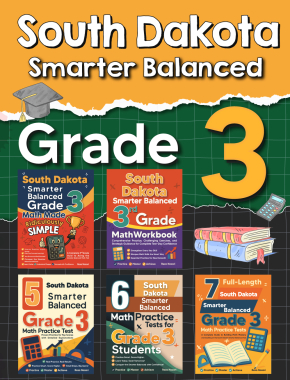
Ready for Grade 3 Math? The South Dakota Grade 3 Math Bundle
Second grade is the build-up year, and when your child is ready for what comes next, this bundle makes the jump to Grade 3 math feel easy. It packs full practice-test books, complete answer keys, and step-by-step explanations for the Grade 3 math skills just ahead.
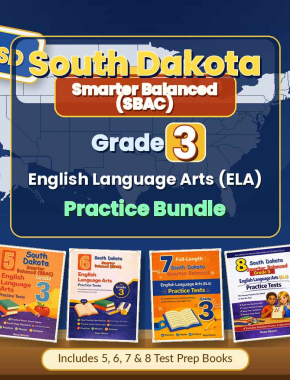
Getting Ready for Grade 3 English, Too? The South Dakota Grade 3 English Bundle
Reading and writing grow right alongside math. If your second grader could use a head start in English as well, this South Dakota Grade 3 English bundle covers it — practice tests, answer keys, and friendly explanations in one download.
Recommended EffortlessMath Books
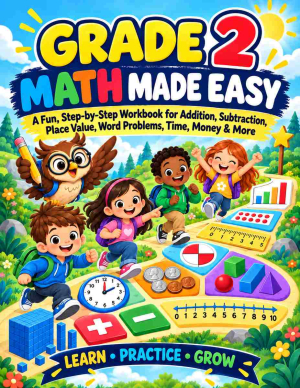
For a workbook that pairs neatly with these printable practice pages, Mastering Grade 2 Math walks your child through every second-grade topic with clear examples and lots of try-it-yourself problems. For extra word-problem practice (the part many second graders find hardest), see Mastering Grade 2 Math Word Problems.
Related EffortlessMath Lessons
If a topic on this page feels rusty, these short lessons go deeper:
- How to add and subtract two-digit numbers
- Place value to the hundreds
- How to tell time to the nearest five minutes
- How to count coins and dollar bills
- How to solve word problems

Related to This Article
More math articles
- Supply Distribution Systems Basics
- Free Grade 8 English Worksheets for Louisiana Students
- Chapter 26: Political Parties
- Georgia Milestones Grade 8 Math Free Worksheets: Free Printable PDFs Covering Every Grade 8 Standard
- ISEE Middle-Level Math Worksheets: FREE & Printable
- The Best Grade 5 Math Book for Kansas Students
- Free Energy and ATP Coupling
- Body Directions, Planes, and Cavities
- Using Context Clues
- Group Types, Boundaries, Dyads, and Triads







What people say about "Grade 2 Math Worksheets for South Dakota"?
No one replied yet.