Basic Blackjack Strategy: How Decisions Move the House Edge
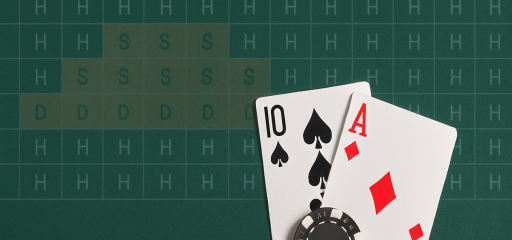
Blackjack is one of the only casino games where your decisions actually change the math at the table. Slots don’t care what you click. Roulette doesn’t care which color you pick. But blackjack hands you a menu, hit, stand, double, split, surrender, and every choice shifts expected value by a measurable amount. Most players hand back about 2% of every bet just by guessing. Learn the right moves and that number drops to around half a percent. Same dealer, same shoe, same shuffle, the difference is entirely in the seat.
What “House Edge” Actually Means at a Blackjack Table
House edge is the casino’s long-run cut of every dollar wagered. In blackjack it’s unusually sensitive to player behavior because the player acts first and can bust before the dealer is forced to act at all. That’s the structural advantage the house leans on. Everything else, the 3:2 payout on naturals, the soft-17 rule, doubling, splitting, pushes the edge up or down from that baseline.
Under standard Vegas Strip rules (six decks, dealer stands on soft 17, double after split allowed, late surrender on offer), the house edge against a player using flawless basic strategy lands near 0.5%. A casual player who hits, stands, and splits “by feel” typically gives up somewhere between 2.0% and 3.0%. That gap, call it 1.5 to 2.5 percentage points, is pure decision tax. It’s the cost of intuition.
Where the Edge Comes From, Decision by Decision
The basic strategy chart isn’t folklore. Every cell of it comes from running expected-value calculations across every possible remaining-deck composition for every player hand against every dealer upcard, then picking the move with the highest EV. The Wizard of Odds basic strategy calculator will spit out the matrix for any rule set you feed it. The numbers below assume six decks, dealer stands on soft 17, and DAS allowed.
Five families of decisions move the edge:
- Hit vs. Stand on hard totals 12 to 16 against dealer strong upcards (7, A). This is where casual players bleed the most. They stand on stiff totals because hitting feels like asking to bust.
- Doubling down on 9, 10, 11, and select soft totals. You’re putting more money on the table when the math says you’ll win the bigger bet more often than not.
- Splitting pairs. Two 8s is the textbook example, one ugly hand becomes two starting points.
- Surrender on the truly hopeless hands (where the table allows it). You pay half a bet to dodge a worse expected loss.
- Insurance and even-money offers. These are side bets dressed up as protection. Decline them. The math is bad and it doesn’t get better the more confident the dealer looks.
A Slice of the Decision Matrix
Here’s a small sample of the chart, enough to show how the moves shift across dealer upcards. H = hit, S = stand, D = double (hit if not allowed), P = split, Rh = surrender, else hit.
| Player Hand | 2 | 3 | 4 | 5 | 6 | 7 | 8 | 9 | 10 | A |
|---|---|---|---|---|---|---|---|---|---|---|
| Hard 9 | H | D | D | D | D | H | H | H | H | H |
| Hard 10 | D | D | D | D | D | D | D | D | H | H |
| Hard 11 | D | D | D | D | D | D | D | D | D | H |
| Hard 12 | H | H | S | S | S | H | H | H | H | H |
| Hard 15 | S | S | S | S | S | H | H | H | Rh | H |
| Hard 16 | S | S | S | S | S | H | H | Rh | Rh | Rh |
| Soft 18 (A,7) | S | D | D | D | D | S | S | H | H | H |
| Pair 8s | P | P | P | P | P | P | P | P | P | P |
| Pair 10s | S | S | S | S | S | S | S | S | S | S |
If you stare at one row long enough you can usually see the logic. Hard 11 doubles against everything except an Ace. You’ve got a great shot at 21 and the dealer doesn’t have a natural locked in. Pair 8s splits universally because a hard 16 is the worst total in the game; two new hands have to be better on average than the one you’re stuck with.
The Worked Example Everyone Argues About: 16 vs. 10
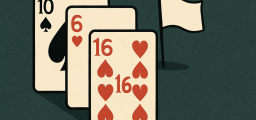
This is the hand that loses the most money in blackjack, and it’s where intuition fails hardest. You’re holding 16. The dealer shows a 10. Hitting feels like jumping off a roof, any card 6 or higher busts you, and there are a lot of those left in the shoe.
Run the EV with the standard six-deck assumption and you get this:
- Stand EV ≈ −0.5404 (you lose about 54 cents per dollar in the long run)
- Hit EV ≈ −0.5358 (you lose about 53.6 cents per dollar)
- Late surrender EV = −0.5000 (flat half-bet loss, available at some tables)
So hitting is barely less bad than standing, about 0.46% better, and surrender, if your table offers it, is better still. The hand is a loser no matter what; the question is only how much you lose. Most players stand here because standing feels safe. The math doesn’t care how it feels. It cares about the average outcome over thousands of trials, and on average hitting saves you a fraction of a percent on every 16-vs-10 you play. That fraction adds up across a session.
I’ll be honest. I still flinch on this hand. Drawing a face card into a stiff total has a particular kind of sting. But flinching costs money.
Splitting: Where Pairs Become Two Problems or Two Opportunities
Splitting is the move that confuses people most because it’s the only one where you’re putting a second bet down on a hand that hasn’t been improved yet. The trick is to compare the EV of playing one ugly hand against the EV of playing two new starting hands.
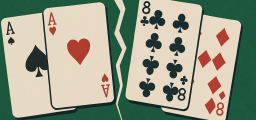
The classic case is two 8s. As a single hand, you’re sitting on 16, the worst total in blackjack. Split them and each new hand starts at 8, which is a perfectly workable launching point. A few patterns worth memorizing:
- Always split 8s and Aces. Two 8s vs. Dealer 10 is a small loss split, but a big loss unsplit.
- Never split 10s. You’re trading a guaranteed-strong 20 for two unknowns. Don’t get cute.
- Never split 5s. A pair of 5s is hard 10, exactly the total you want to double down on. Splitting destroys a doubling opportunity.
- Never split 4s (except vs. 5 or 6 when DAS is allowed). Two 4s makes a hard 8 you can play normally.
- Split 9s against 2 to 6, 8, and 9. Stand against 7, 10, and Ace. The 7 exception trips people up, a dealer 7 is more likely to make 17, and your 18 already beats that.
Doubling Down: When the Math Wants You Bolder
Doubling is a constrained bet on a small set of strong starting positions. The rule of thumb that gets you 90% of the way there: double when the dealer is weak and you have an immediate path to a strong total.
The headline cases under Vegas Strip rules:
- Hard 11 vs. 2 to 10: double. (Hit vs. Ace because dealer naturals are too costly to risk the extra bet.)
- Hard 10 vs. 2 to 9: double. Stop at 10 and Ace.
- Hard 9 vs. 3 to 6: double. Otherwise hit.
- Soft 18 (A,7) vs. 3 to 6: double. This is the one that feels wrong, you’re “ruining” an 18, but the dealer’s bust card and your ability to draw without busting makes it the highest-EV move.
- Soft 17 (A,6) vs. 3 to 6: double. A soft 17 is hilariously weak on its own; doubling salvages it.
The opinionated aside: dealers and pit staff occasionally make small noises when you double a soft hand. Ignore them. Their commentary is not part of the EV calculation.
Surrender: Paying Half to Avoid Worse
Late surrender lets you fold after the dealer checks for blackjack, giving up half your bet instead of playing the hand. Lots of casinos quietly offer it without advertising. Ask. The two surrender spots that matter most:
- Hard 16 vs. 9, 10, or Ace, your EV playing the hand is around −0.54, surrender is −0.50, so you pocket about 4% of the bet by folding.
- Hard 15 vs. 10, similar story, slightly smaller margin.
Surrendering looks weak. It plays smart. If your table doesn’t offer it, you’re paying a small premium on those bad-hand totals, figure into your edge calculation that “no surrender” rules add roughly 0.08% to the house’s cut.
Soft Hands: The Hidden Skill Check
Soft totals, hands with an Ace counted as 11, are where casual players give up another quiet chunk of edge. The Ace’s dual value means you literally cannot bust on the next card from most soft totals, which changes the calculus completely. Yet most people play soft 17 like it’s hard 17, standing pat and praying. Hard 17 is a “stand and pray” total. Soft 17 is “you have a free card coming.”
A few soft-hand patterns that pay for themselves quickly:
- Soft 13 to 15: hit against most dealer cards, double only vs. 5 or 6.
- Soft 16 to 17: hit against 7+, double vs. 3 to 6 (or 4 to 6 for soft 16).
- Soft 18: stand vs. 2, 7, 8; double vs. 3 to 6; hit vs. 9, 10, A. That last bit shocks people, you’re hitting an 18, but a soft 18 against a dealer 9 is a loser if you stand on it.
- Soft 19, 20: stand. Always. The one exception in some rule sets is doubling soft 19 vs. Dealer 6, which is a thin edge play.
Soft 18 vs. 9 leaks money for so many players because it looks like a winning hand. It isn’t, the dealer makes 19 or better often enough from a 9 upcard that standing is a long-run loss.
How Much Does All This Actually Save?
Numbers people can sanity-check at home. Say you’re at $25 a hand on a six-deck Strip game, putting in 80 hands an hour over a four-hour session. That’s $8,000 in total action.
- Gut-feel play at a 2.5% edge: expected loss ≈ $200 per session.
- Basic strategy at a 0.5% edge: expected loss ≈ $40 per session.
That’s $160 of avoidable damage per four-hour session, not from getting luckier, not from counting cards, just from making the move the chart says to make. I’ve watched players insist for hours that “the cards are running cold tonight” while standing on 12 vs. A dealer 3. The shoe wasn’t cold. The decisions were.
If you want a deeper dive into how expected value works across casino games, not just blackjack, there’s a good primer over at Effortless Math that walks through the underlying probability math at a non-intimidating pace.
FAQ
Do I need to memorize the whole chart? Eventually, yes. Start with hard totals 12 to 17, then learn the doubling rows, then pairs, then soft totals. The chart isn’t that big once you see the patterns.
Can I bring a printed chart to the table? At most casinos, yes. They’ll let you reference one as long as you’re not slowing the game down. Online, there’s no rule against it. Some players keep one open on their phone.
Does basic strategy “work” in the short run? No. Basic strategy minimizes long-run loss. Any individual hand or session can swing wildly. What it guarantees is that you’re not adding decision tax on top of the structural edge.
What if the rules are different, single deck, hits soft 17, no DAS? The chart shifts at the margins. Re-pull it from the Wizard of Odds calculator with your exact rule set. The big moves (split 8s, double 11, never split 10s) stay the same.
Is counting cards just basic strategy plus extra? Sort of. Counting layers a bet-sizing and play-deviation system on top of basic strategy. Without basic strategy as the foundation, counting gains nothing.
Closing Thought
Blackjack rewards discipline more than cleverness. There’s no secret move, no magic seat, no dealer who “runs hot.” There’s a chart, and there’s whether you follow it. Players who follow it lose slowly. Players who don’t lose quickly and tell themselves stories about why. If you’re going to sit down at the table anyway, at least make the math earn its half a percent honestly, don’t gift it the other one and a half.

Related to This Article
More math articles
- How to Get Out of a Knowledge Check on ALEKS
- Rational-basis review
- Grade 8 Vocabulary and Word Study: Roots, Context Clues, and Academic Language That Sticks
- A Comprehensive Collection of FREE SAT Math Practice Tests
- What Kind of Math Is on the TABE Test?
- Full-Length ISEE Middle Level Math Practice Test-Answers and Explanations
- The Ultimate 7th Grade OST Math Course (+FREE Worksheets)
- Rotation, Torque, and Balance
- 3rd Grade MCA Math Worksheets: FREE & Printable
- 7th Grade FSA Math Worksheets: FREE & Printable



What people say about "Basic Blackjack Strategy: How Decisions Move the House Edge - Effortless Math"?
No one replied yet.