Fibonacci Betting: Pretty Sequence, Same House Edge

The fibonacci betting system dresses up the oldest gambling trick around, chase your losses with bigger bets, in the prettiest math costume on the rack. People love it because the sequence shows up in sunflower spirals and Renaissance paintings, so surely it must hide some cosmic edge over the casino. It doesn’t. I’ve watched smart players talk themselves into this one for years, and the sequence’s elegance is doing all the heavy lifting; the underlying expected value never budges. Let’s walk through what the system actually does, where its modest virtue lives, and where it quietly hands your bankroll to the house.
What the Fibonacci sequence is
Leonardo of Pisa wrote about it in 1202 while modeling rabbit populations, and the rule couldn’t be simpler: every term is the sum of the two before it. Start with 1, 1, and you get 1, 1, 2, 3, 5, 8, 13, 21, 34, 55, 89, 144, onward forever. The ratio between consecutive terms creeps toward the golden ratio φ ≈ 1.618, which is why the sequence shows up everywhere from pinecones to algorithm textbooks.
That’s a beautiful piece of mathematics, and it has absolutely nothing to do with what a roulette wheel does next. The wheel doesn’t read books. But somewhere along the line, a gambler noticed the sequence has a tidy recovery property when you treat each term as a bet size, and a “system” was born.
How the system applies to even-money bets
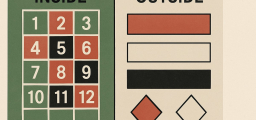
You play the Fibonacci on bets that pay 1:1, red/black or odd/even on roulette, the pass/banker areas in baccarat, the outside wagers in sic bo. Pick a unit size, say $5, and that’s your “1.” Your bet ladder becomes $5, $5, $10, $15, $25, $40, $65, $105, $170, $275, and so on.

You start at the first rung. Win the opening bet and you pocket your unit; nothing fancy required. Lose, and the system kicks in.
The “step forward after a loss, step back two after a win” rule
Here’s the mechanism in one breath: every loss moves you one position to the right on the ladder, and every win moves you two positions to the left. If you fall off the left end (back below position 1), you’re done with this betting cycle, book the profit and start over.
Why two steps back? Because of the sequence’s defining identity. The term at position n equals the sum of the terms at positions n−1 and n−2. So one win at position n pays out exactly what you lost on the previous two bets combined. It’s a self-healing ladder, assuming you can keep climbing it.
Why one win recovers preceding losses (sort of)
Let’s run a small example. You bet 1 and lose. Bet 1 again, lose. Bet 2, lose. Bet 3 and win. You’re up 3 on that round, but you’d lost 1+1+2 = 4 earlier, so you’re net −1 across those four spins. Then per the rule you step back two positions, down to bet size 1, and the cycle continues.
That’s the catch nobody mentions in the YouTube videos, the recovery isn’t full. A win on bet n covers losses on bets n−1 and n−2, but you’ve usually also lost on bets further back, and those losses stay on the books until later wins peel them off. It’s progressive bookkeeping, not magic.
I’ve coached players through this on paper and the moment they trace a real losing streak, the romance dies. The ladder works fine when wins and losses alternate politely. Real shoes don’t alternate politely.
The math: every bet still faces the same house edge
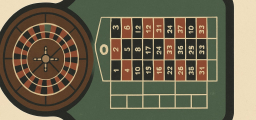
This is the part the system’s fans want to argue with, and they’re wrong every time. Each spin of European roulette has an expected value of −1/37 ≈ −0.0270 per unit wagered, no matter what came before. The wheel doesn’t remember your last result, your bet size, or which Italian mathematician you’re channeling.
Expected value is linear. If you wager amounts \(w_1, w_2, w_3, \ldots, w_N\) across N spins, your total expected loss is:
E[loss] = 0.0270 × (w_1 + w_2 +.. + w_N)
The Fibonacci system doesn’t shrink that sum. It grows it, because losing streaks force you to bet bigger. So progressive systems actually increase total expected loss in dollar terms, even though the percentage edge stays fixed. That’s a tradeoff worth saying out loud: you’re paying more action in exchange for variance reshaping. American roulette is worse at −5.26%, and baccarat’s banker is gentler at −1.06%, but the structural point holds across every game where each round is independent.
Bankroll risk during long losing streaks
Now the unpleasant numbers. Here’s the cumulative exposure if your first ten bets all lose:

| Step | Bet (units) | Cumulative units risked | Cumulative ($5 unit) |
|---|---|---|---|
| 1 | 1 | 1 | $5 |
| 2 | 1 | 2 | $10 |
| 3 | 2 | 4 | $20 |
| 4 | 3 | 7 | $35 |
| 5 | 5 | 12 | $60 |
| 6 | 8 | 20 | $100 |
| 7 | 13 | 33 | $165 |
| 8 | 21 | 54 | $270 |
| 9 | 34 | 88 | $440 |
| 10 | 55 | 143 | $715 |
After ten consecutive losses you’ve put 143 units through the felt and the next bet up the ladder is 89, which would push cumulative exposure to 232 units before you even see step eleven resolve. On a $5 unit that’s $1,160 of action chasing what started as a $5 wager. The numbers don’t politely flatten. They grow at roughly the golden ratio per step, which means every two losses roughly triples the running tab.
How likely is a 10-loss streak? On a fair coin it’s 1 in 2^10 = 1,024 sequences. On European roulette red/black the per-spin loss probability is 19/37, so a 10-loss run is (19/37)^10 ≈ 1 in 1,100. That’s not astronomical, at 60 spins an hour, you’ll see streaks like that in a single session more often than people expect. A small but cruel asymmetry: one bad streak erases dozens of profitable cycles.
Comparison to Martingale
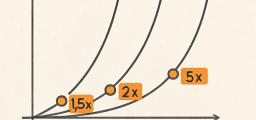
The Martingale doubles after every loss: 1, 2, 4, 8, 16, 32, 64, 128, 256, 512. Cumulative after ten losses is 1,023 units, and a win at any step recovers everything plus one unit of profit. The Fibonacci grows slower, only ~1.618× per step versus 2×, so its bankroll requirement after a long streak is gentler, and table limits bite later.
- Growth rate: Martingale doubles per step; Fibonacci multiplies by φ ≈ 1.618 per step.
- Cumulative after 10 losses: Martingale 1,023 units; Fibonacci 143 units.
- Win recovery: Martingale recovers all prior losses plus one unit; Fibonacci recovers only the last two losses, leaving earlier ones on the books.
- Bankroll-to-table-limit ratio: Fibonacci lets you survive longer streaks before hitting a posted max bet.
- House edge per spin: identical to flat betting. Both systems leave it untouched.
- Total dollars wagered: both inflate it during streaks, which inflates total expected loss in raw dollars.
So the Fibonacci is the more conservative cousin. It trades faster recovery for longer survival. That’s a real choice, not a fake one. But survival isn’t profit.
A worked session: what the books look like
Let me walk through a realistic 12-spin sequence on European roulette red, betting one unit at the start. Spins: L, W, L, L, L, W, L, L, W, L, W, W. After spin 1 (loss) you’re at −1 and move to step 2. Spin 2 wins at step 2 betting 1 unit, so you’re at 0 and step back two, but you’d only moved forward once, so you reset to step 1. Spin 3 loses (−1, step 2). Spin 4 loses at bet size 1 (−2, step 3). Spin 5 loses at bet size 2 (−4, step 4). Spin 6 wins at bet size 3, putting you at −1 net, and you step back to step 2. Spin 7 loses 1 (−2). Spin 8 loses 1 (−3, step 4). Spin 9 wins 3 (net 0, step 2). Spin 10 loses 1 (−1). Spin 11 wins 1 (net 0, back to step 1). Spin 12 wins 1 (net +1).
So you wagered 14 units of action across twelve spins to net one unit of profit, and that result depended on the wins landing where they did. Shift two of those wins into the middle of a streak and you’re at −10 units with the ladder demanding bet sizes you didn’t budget for.
What changes (variance), what doesn’t (EV)
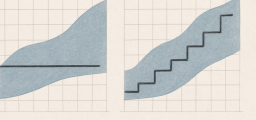
Progressive systems are variance-shaping tools, full stop. The Fibonacci front-loads small wins and back-loads catastrophic losses. You’ll have a lot of sessions where you grind out a few units and leave smiling. That’s the kind of result that builds true believers. Then occasionally you’ll have the session where streaks 8, 9, and 10 land back to back and you donate a month’s grocery budget to the felt.
Average those sessions together, weighted by probability, and you land exactly on the flat-betting expected value: −2.70% of total action on European roulette, −1.06% on baccarat banker, and so on. There’s no parameter to tune that changes this. None. The wheel is memoryless, the cards are shuffled, and your bet sequence is just a stream of independent draws no matter how you arrange the stakes.
For the record, I find variance-shaping perfectly legitimate when players know that’s what they’re buying. If you’d rather have many small wins and rare painful losses than steady tiny losses, the Fibonacci delivers that profile honestly. The dishonesty creeps in when someone tells you the sequence “beats” the casino. It doesn’t, and the casino’s accountants would happily mail you a thank-you card.
FAQ
Q: Does the fibonacci betting system work better on baccarat than roulette?
A: Better in the sense that baccarat’s banker bet has a smaller house edge (~1.06% vs 2.70%), so your raw dollar bleed is slower. The system itself doesn’t perform differently. It’s still neutral to EV on either game.
Q: Can I combine Fibonacci with card counting or pattern reading?
A: Card counting works in blackjack because the deck composition genuinely shifts the edge. Roulette and baccarat scoreboards don’t carry that kind of information, no shoe-tracking gimmick changes the next outcome’s probability on a fresh shuffle.
Q: What’s a safe stop-loss for a Fibonacci run?
A: Most disciplined players cap the ladder at step 7 or 8, accept the loss, and reset. Going further means betting amounts that dwarf your initial unit and risking a bankroll wipe for a single unit of theoretical profit.
Q: Will table limits stop me before my bankroll does?
A: Often yes. A $5 minimum table with a $500 maximum caps you at step 12 (144 units = $720, already over limit). The Fibonacci stretches further than Martingale before hitting the wall, but the wall’s still there.
Q: Is there any betting system that beats the house edge on independent-trial games?
A: No, and that’s a theorem, not an opinion. Any betting strategy on a negative-EV game with independent trials has negative expected value. The proof is one line of linearity of expectation, and it’s been settled math since the 1700s. For more on this, the Wizard of Odds breakdown of betting systems walks through the simulations rigorously.
Final word
The Fibonacci sequence is gorgeous mathematics with a gentle growth rate and a tidy two-step recovery rule, and that’s exactly why it seduces people. It’s a kinder cousin to the Martingale, sure, but kinder doesn’t mean profitable. Use it because you enjoy the rhythm, or because you prefer rare big losses to steady small ones, but not because you’ve cracked anything. If you want genuine math that pays off, study probability and number theory at EffortlessMath.com. That knowledge compounds in ways no betting system ever will.
Gambling outcomes are uncertain; no strategy guarantees profit.

Related to This Article
More math articles
- ASTB Math-Test Day Tips
- How to Find Experimental Probability?
- Classifying 2D Shapes for 5th Grade: Polygons and Properties
- 6th Grade PARCC Math Practice Test Questions
- The Best Grade 4 ELA Practice Tests for Iowa Students
- Other Punctuation Marks
- Political knowledge
- Tangent Line Calculator (Free, with Graph)
- Heat, Temperature, and Pressure
- The Illinois IAR Grade 5 Math Worksheet Pack — 49 Free Printable Pages with Solutions








What people say about "Fibonacci Betting: Pretty Sequence, Same House Edge - Effortless Math"?
No one replied yet.