La Partage and En Prison: The Two French Rules That Halve the Edge
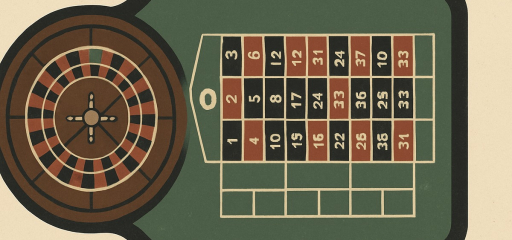
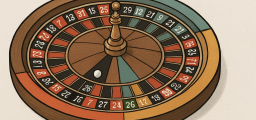
Walk up to a French roulette table in Monte Carlo and you are playing the same wheel a tourist plays in Berlin or Vegas, with the same single zero and the same 37 pockets. But two small rules on that French table quietly cut the house edge in half on red, black, odd, even, high, and low. Those rules are la partage and en prison, and once you see the math, you understand why serious even-money bettors hunt them out.
The Standard European Edge on Even-Money Bets
A European wheel has 37 pockets: 1 through 36, plus a single 0. Bet $1 on red. There are 18 red numbers, 18 black, and one green zero. You win 18 times out of 37 and lose 19 times out of 37. The expected value works out to:
EV = (18/37)(+1) + (19/37)(−1) = −1/37 ≈ −0.0270.
That is the famous 2.70% house edge. Every even-money proposition on a normal European wheel, red/black, odd/even, 1 to 18/19 to 36, sits at exactly that number. The zero is the entire reason. Without it, the bet would be a coin flip.
What Happens When Zero Hits Without These Rules
On a plain European table, the rule is brutal and simple. The ball lands on 0, the croupier sweeps every outside even-money bet into the rack along with the inside losers. Your $100 on black is gone. The wheel doesn’t care that 0 is neither red nor black; from the table’s point of view, you didn’t win, so you lose the whole stake.
This is the single sentence that defines the 2.70% edge. Change what happens on that one pocket, and you change the entire economics of even-money play.
La Partage: Half Back When the Zero Strikes
La partage is French for “the division,” and the rule is exactly that. When the ball lands on 0, the croupier splits your even-money bet in half. Half goes to the house. Half comes back to you. You are not out the full unit. You are out half of it.
Put $100 on red. The ball lands on 0. Without la partage you walk away $100 lighter. With la partage you get $50 back and lose $50. Same bet, same wheel, very different outcome on that one pocket.
The math shifts accordingly. Loss on zero becomes 0.5 units instead of 1:
EV = (18/37)(+1) + (18/37)(−1) + (1/37)(−0.5) = −0.5/37 ≈ −0.0135.
That’s 1.35%. The edge is literally cut in half because the worst outcome, the zero, now costs you half as much.
En Prison: The Bet Goes to Jail
En prison gets at the same destination by a different road. When 0 hits, your even-money bet doesn’t lose. It doesn’t win either. It is “imprisoned”, left on the layout for one more spin. If the next spin wins, you get the full bet back (no profit, just the stake). If it loses, the bet is gone. Some houses also count a second zero as a full loss; others release the bet on any non-zero in your favor. The Monte Carlo version is the strictest and the most common reference.
Run the numbers. Your $100 on black sits on the felt after a 0. On the next spin there’s an 18/37 chance black hits and you get the $100 back, an 18/37 chance red hits and you lose, and a 1/37 chance of 0 again (treated as a loss under the standard rule). So conditional on the zero, you keep your bet with probability 18/37 and lose it with probability 19/37. Expected loss given a zero:
(19/37)(1) + (18/37)(0) = 19/37 ≈ 0.5135 of a unit.
Plug that back into the full EV:
EV ≈ (18/37)(+1) + (18/37)(−1) + (1/37)(−19/37) ≈ −0.0139.
Close enough to 1.35% that for practical purposes the two rules are mathematically equivalent. The casino industry quotes both as a 1.35% edge and moves on. Players sometimes prefer la partage because it’s instant and cleaner; en prison gives the small drama of one more spin, which some tables prefer.
The Resulting House Edge: 1.35%
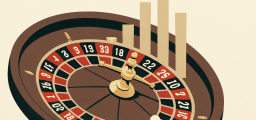
The headline number is the only one most players need to remember. With either French rule applied, the even-money house edge drops from 2.70% to 1.35%. Cut in half. Per dollar wagered, that’s a meaningful change. Over a $5,000 night of $25 red/black spins, expected loss falls from about $135 to about $67.50.
The wheel itself didn’t change. The pockets didn’t move. The payouts didn’t shift. The only thing that changed was the rule on a single pocket, and it cut the long-run cost of play in half.
| Game / Rule | Pockets | House Edge on Even-Money | Expected Loss per $100 |
|---|---|---|---|
| American roulette (0 and 00) | 38 | 5.26% | $5.26 |
| European roulette (no French rules) | 37 | 2.70% | $2.70 |
| French roulette with la partage | 37 | 1.35% | $1.35 |
| French roulette with en prison | 37 | ≈1.35% | ≈$1.39 |
Only Even-Money Bets, Inside Bets Still Pay Full Freight
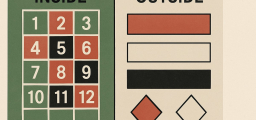
This is the part that trips people up. La partage and en prison apply only to even-money outside bets. If you put $100 straight up on number 17 and the ball lands on 0, you don’t get half back. You don’t get to imprison the chip. The bet just loses, and your inside-bet house edge stays at 2.70%, same as any European wheel.
- Covered by French rules: red/black, odd/even, 1 to 18/19 to 36.
- Not covered: straight-up numbers, splits, streets, corners, six-lines, columns, and dozens.
Columns and dozens are 2-to-1 outside bets, not even money, so they pay 2.70% too. Some casinos extend partial refunds to those, but it’s house-specific and not standard. Assume the French rules are an even-money perk unless the table placard says otherwise.
Where to Actually Find French Roulette
French roulette in its full form is less common than European or American outside of Europe. Where you can find it:
- Monte Carlo and the French Riviera. The classic home. La partage is standard on most French tables there.
- Parts of mainland Europe. Many French, Belgian, and German casinos run at least one French table.
- High-limit rooms in Las Vegas. A handful of properties offer single-zero roulette with la partage at higher minimums. Bellagio, Wynn, and a few others have featured it at various times. Check the placard, not the marketing.
- Online live-dealer rooms. Several operators run French roulette with la partage clearly labeled. Read the rules tab before you sit down.
If a table just says “French Roulette” but doesn’t mention either rule, ask the dealer. The wheel and layout look the same as European; the rule that matters is invisible until 0 hits.
Worked $100 Bet Examples
Concrete numbers help. Put $100 on red on three different wheels and play one spin:
- American (0 and 00): 18 reds out of 38. EV = (18/38)(+100) + (20/38)(−100) = −$5.26.
- European (no French rules): 18 reds out of 37. EV = (18/37)(+100) + (19/37)(−100) = −$2.70.
- French with la partage: 18 reds win $100, 18 blacks lose $100, the zero loses $50. EV = (18/37)(+100) + (18/37)(−100) + (1/37)(−50) = −$1.35.
Now zoom out. Say you grind 200 spins of $100 on red in one session. Expected loss:
- American: about $1,052.
- European: about $540.
- French with la partage: about $270.
You won’t hit those numbers exactly, variance is huge over 200 spins, but the long-run expectation is what determines whether your bankroll survives a thousand sessions or a thousand thousand. Cutting the edge in half is the same as doubling the expected lifespan of your bankroll at the table, all else equal. That’s not a small thing for a player who actually plans to come back tomorrow.
One more comparison worth pinning down: a $25 even-money bettor doing roughly 50 spins an hour on a French table is wagering $1,250 per hour. Expected loss is $1,250 × 0.0135 ≈ $16.88 per hour. On a plain European wheel that same hour costs about $33.75 in expectation. On American, $65.75. The wheel barely changed. The cost did.
It’s also worth thinking about what la partage does to variance, not just expectation. On a standard European wheel, every spin of an even-money bet is a +1 or −1 outcome. With la partage, one pocket out of 37 returns a −0.5 instead. That tiny third outcome shifts the distribution just slightly toward the middle. The standard deviation per spin drops from roughly 1.000 to about 0.998, barely measurable, but it’s there. The real benefit is still the EV, not the variance. People who claim French rules “smooth out the swings” are overselling. The swings are essentially identical. What’s different is the long-run grind.
Two final practical notes. First, table minimums on French roulette tend to run higher than on plain European tables, sometimes meaningfully so. A $5 European table and a $25 French table is a common pairing in casinos that offer both. If a higher minimum forces you to bet more than your bankroll wants, the lower edge can be a false economy: you’ll end up wagering more total dollars per session. Second, side bets and progressive add-ons that some French tables now offer are almost always priced at much worse edges than the base game. Stick to flat red/black or odd/even if you came for the 1.35% number.
FAQ
Q: Is en prison better than la partage?
A: They produce nearly identical house edges. La partage is settled immediately; en prison forces you to wait one more spin. If you’d rather just collect half and move on, la partage feels cleaner. The math is essentially a wash.
Q: Can I use la partage on a column or dozen bet?
A: Generally no. The French rules are an even-money privilege. Columns and dozens pay 2-to-1 and stay at the 2.70% European edge unless a specific house posts otherwise.
Q: Does la partage make roulette a winning game?
A: No. It cuts the house edge to 1.35%, which is still negative. You’re losing slower, not winning. Anyone who tells you otherwise is selling something.
Q: Why don’t all casinos offer it if the house still wins?
A: Because doubling the cost of the game for the player doubles the revenue for the house. Markets where players will accept a 2.70% or 5.26% edge have no business reason to give back half of it.
Q: What happens if 0 hits while my bet is already in prison?
A: House rule. The Monte Carlo tradition treats a second 0 as a loss. Some tables “double imprison”, the bet stays for yet another spin. Always check the placard so you know which version you’re sitting at.
If you like reading through the actual rule mechanics, the Wizard of Odds roulette pages walk through every variant in detail, and the Britannica entry on roulette gives the historical context for how the French rules came about. For more accessible math write-ups of probability and expected value, Effortless Math is a useful starting point.
Gambling outcomes are uncertain; no strategy guarantees profit.

Related to This Article
More math articles
- Why Prejudice and Conflict Develop
- The Best Grade 8 ELA Practice Tests for Montana Students
- Grade 3 Math: Fractions on a Number Line
- Cleaning Tools, Chemicals, Dilution, and IFUs
- Free Grade 4 English Worksheets for Georgia Students
- The Best Grade 8 Math Book for Maine Students
- Administrative Discretion and Rulemaking: Limits and Examples
- New Immigration, Ellis Island, and Angel Island
- Binomial Probability Calculator — P(X = k) & Cumulative (Free)
- How to Find the GCF and LCM (With Quick Tricks)




What people say about "La Partage and En Prison: The Two French Rules That Halve the Edge - Effortless Math"?
No one replied yet.