D’Alembert: The Pseudo-Conservative Betting Trap
The d’alembert system is the betting strategy people reach for when the Martingale scares them but flat betting feels boring. You raise your bet by one unit after a loss and drop it by one unit after a win. It looks measured. It looks responsible. It looks like math. And that is precisely why it fools so many otherwise careful players into believing they have found a middle path between safety and profit. They have not. The middle path the d’alembert system actually occupies is between two well-known dead ends, and the destination is the same.
How the D’Alembert System Actually Works
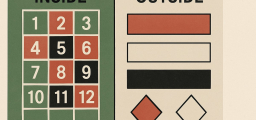
The rules fit on a napkin. Pick a base unit, say $1. Bet one unit on an even-money proposition such as red on a European roulette wheel. After a loss, increase the next bet by one unit. After a win, decrease the next bet by one unit, but never below the base. That is the whole system. There is no progression table to memorize, no “after three losses double up” twist, no recovery target hidden in a footnote.
The intuition behind it, attributed loosely to the 18th-century mathematician Jean le Rond d’Alembert, is that wins and losses on a 50/50 wager should “even out” over time, so raising stakes after losses lets you cash in when the balance corrects itself. That intuition is wrong in a specific, well-documented way, and the rest of this article is about exactly how wrong it is.
The False Intuition: Wins and Losses “Balance Out”
If you flip a fair coin 100 times, you expect roughly 50 heads and 50 tails. The phrase “expect” hides the problem. The expected proportion of heads converges to 0.5 as the number of flips grows. The expected difference between heads and tails does not converge to zero. It grows, on average, like the square root of the number of flips. After 10,000 flips the typical gap between heads and tails is around 100, not zero.

The d’alembert system is built on the unstated assumption that the gap shrinks. It does not. A losing streak is not “owed” a corresponding winning streak. Each spin of a roulette wheel is independent of every spin before it. The wheel does not remember. The dealer does not remember. The chip rack does not remember. Only the player remembers, and the player’s memory is the source of the problem, not the solution.
Why the Gambler’s Fallacy Underlies the Appeal
The belief that a string of losses makes a win more likely has a name in the literature: the gambler’s fallacy. It is one of the most studied cognitive biases in decision-making research, and it is the engine that makes the d’alembert system feel sensible. When you have lost four red bets in a row and your next bet is five units instead of one, the reasoning your brain quietly supplies is “red is due.” Red is not due. Red has the same probability on the fifth spin that it had on the first, and on the five-hundredth.
What the d’alembert system does is translate this fallacy into a betting schedule. The schedule looks numerical and disciplined, which gives the fallacy a kind of borrowed credibility. The numbers are real. The discipline is real. The premise underneath them is still false.
What Really Happens During a Losing Streak
Say you lose ten bets in a row starting from a one-unit base. Your bet sizes are 1, 2, 3, 4, 5, 6, 7, 8, 9, 10. Total wagered: 55 units. Total lost: 55 units. After a Martingale doubling sequence of the same length you would be down 1023 units, so the d’alembert system is genuinely less aggressive. But “less aggressive than Martingale” is a low bar. A 10-loss streak still costs you 55 base units, and the bet you are about to place is 11 units, more than ten times your starting stake.
The growth is linear in the streak length, not exponential. That is the kernel of truth in the system’s reputation for being “safer.” Linear is bounded in a way exponential is not. But linear growth multiplied by an exposure that lasts thousands of spins still produces drawdowns large enough to wipe out small bankrolls, and the table maximum on a 1-unit base is essentially irrelevant because no realistic player reaches it through d’alembert progression alone.
| Bet # | Stake | Result | P/L this bet | Running total |
|---|---|---|---|---|
| 1 | $1 | Loss | -$1 | -$1 |
| 2 | $2 | Loss | -$2 | -$3 |
| 3 | $3 | Win | +$3 | $0 |
| 4 | $2 | Loss | -$2 | -$2 |
| 5 | $3 | Loss | -$3 | -$5 |
| 6 | $4 | Loss | -$4 | -$9 |
| 7 | $5 | Win | +$5 | -$4 |
| 8 | $4 | Win | +$4 | $0 |
| 9 | $3 | Loss | -$3 | -$3 |
| 10 | $4 | Win | +$4 | +$1 |
| 11 | $3 | Loss | -$3 | -$2 |
| 12 | $4 | Loss | -$4 | -$6 |
That sequence has six wins and six losses, an exact 50/50 split, and the player still ends down six units. This isn’t a coincidence and it isn’t a rigged example. It’s a direct consequence of the fact that the wins and losses happened in a particular order, and the d’alembert system is sensitive to order in a way flat betting is not.
Same Expected Value as Flat Betting
Here is the result that ends the discussion mathematically. On European roulette, every even-money bet has the same expected value per unit wagered: -1/37, or approximately -2.70%. The d’alembert system does not change which bets you make; it only changes how many units you put on each one. Expected value is linear, which means the expected value of a sequence of bets is the sum of the expected values of the individual bets.
Multiply -2.70% by the total amount you wager and you have your expected loss. The d’alembert system rearranges when you wager more or less, but it does not change the total expected loss per unit wagered. Over any large number of spins, the d’alembert system has exactly the same expected outcome as betting flat: a loss of about 2.70% of total turnover. The American wheel with its double zero pushes that to about -5.26%.
Variance: Between Martingale and Flat
If expected value is identical to flat betting, why does the d’alembert system feel different at the table? The answer is variance. Variance is how much your actual results swing around the expected value, and it depends heavily on bet sizing.
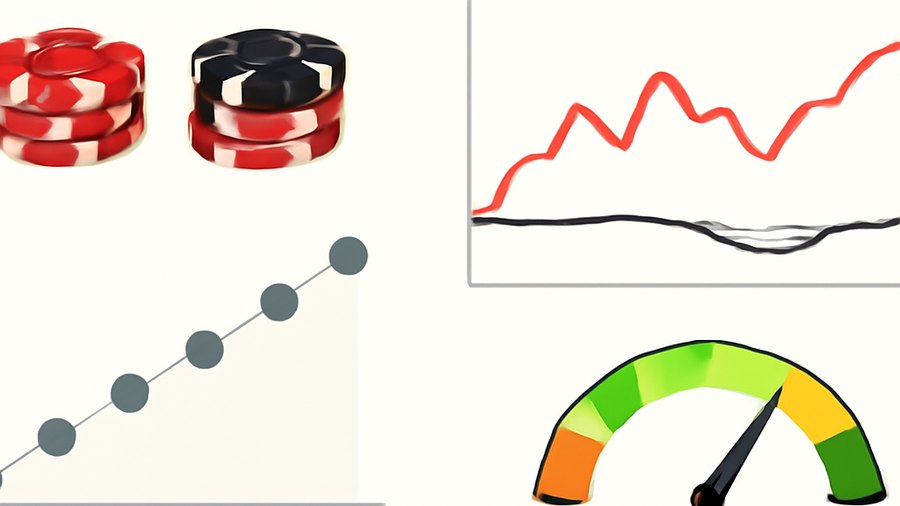
- Flat betting has the lowest variance: every bet is the same size, so the swings are as small as they can be for a given total turnover.
- The Martingale has extreme variance: small frequent wins punctuated by rare catastrophic losses when a streak finally exceeds your bankroll or the table limit.
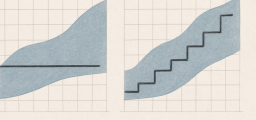
- The d’alembert system lives between them. Bet sizes drift up during cold runs and back down during hot runs, so your losses on bad runs are larger than flat-bet losses, and your wins on good runs are larger too, but neither extreme is as severe as Martingale.
- Because the bet schedule responds to recent results, short-term sessions feel more “active” than flat betting without the cliff-edge risk of doubling.
- That intermediate variance is the entire psychological appeal, and it is also why the system gets credited with safety it does not actually deliver.
For an external treatment of why no progression system changes house edge, the analysis at Wizard of Odds on betting systems walks through the same conclusion from a different angle, with simulations across multiple progression families.
A 1000-Spin Simulation Summary
Run a Monte Carlo of 1000 d’alembert spins on European red, base unit $1, repeated tens of thousands of times, and the distribution comes out roughly like this. Mean result per 1000 spins lands close to -27 units, which matches the -2.70% expected value times an average turnover near 1000 units. The median is in the same neighborhood. The standard deviation of session outcomes is noticeably larger than for flat 1-unit betting over the same 1000 spins, because individual bet sizes range up into double digits during streaks.
The proportion of sessions ending in profit hovers in the mid-40s percent, lower than the headline 48.6% single-spin red probability suggests, because the larger bets during losing streaks pull average outcomes down. Some sessions finish hundreds of units underwater after multiple compounded cold runs. Almost none finish hundreds of units up, because winning streaks ratchet the bet size down, capping the upside. That asymmetry, capped upside, real downside, is the d’alembert signature.
If you want to push further into the probability behind streak distributions and expected value computations, the explainers at Effortless Math are a useful starting point for the underlying tools.
One more numerical detail worth pulling out of the simulation: the modal outcome, the most common single result, is a small loss, not a small win. People who play d’alembert in short sessions and report “it usually works” are reporting accurately within those short sessions. The system does produce more winning sessions than losing ones when sessions are short, because it tends to ratchet down to small bets after wins and cash out near the base unit. The losing sessions, when they come, are bigger than the winning ones by enough to swamp the win frequency. This is the same shape that lottery players see in reverse, and it is the same shape that progressive jackpot slots produce: frequency of one outcome and magnitude of the other arranged so the average is negative even when the count looks positive. The d’alembert system inherits that shape from the underlying negative-edge bet and dresses it up in a progression that feels disciplined.
FAQ
Q: Is the d’alembert system safer than the Martingale?
A: Safer in the narrow sense that bet sizes grow linearly with losing-streak length instead of doubling each time. The maximum drawdown during any given streak is much smaller. That is a real difference and worth acknowledging. It is not the same as being profitable, because the expected loss per unit wagered is identical to flat betting.
Q: Does the system work better on a single-zero wheel?
A: It works less badly. European roulette has a house edge of about 2.70% on even-money bets versus 5.26% on American double-zero. The d’alembert system loses money at both rates; it just bleeds slower on the European wheel.
Q: What about a “reverse d’alembert”, raise after wins, lower after losses?
A: The reverse, sometimes called the Contre-d’Alembert, has the same expected value per unit wagered. It changes the variance profile (bigger swings on hot runs, smaller on cold ones) but it does not change the long-run outcome. Same math, different scenery.
Q: Can the d’alembert system beat a small house edge if combined with comps or rebates?
A: Only the comps or rebates can beat the house edge; the betting system cannot. If a rebate program returns more than 2.70% of total turnover on European roulette, you have an edge regardless of how you size your bets. The d’alembert system in that scenario neither helps nor hurts the edge. It only changes session variance.
Q: How big a bankroll do I need to survive a long losing streak?
A: A streak of n losses costs you n(n+1)/2 base units. A 20-loss streak, entirely plausible in thousands of spins, costs 210 units, and the next bet is 21 units. Build the bankroll for the streak you actually expect to encounter, not the one you hope to avoid.
Gambling outcomes are uncertain; no strategy guarantees profit.

Related to This Article
More math articles
- Math Tutor Online: Practice Guide
- The Sociological Imagination and the Origins of Sociology
- How to Ace the GED Math Formulas
- What Kind of Math Is on the Computer Science?
- Free Grade 6 English Worksheets for New York Students
- How to Write Linear Equations From Y-Intercept and A Slope
- Top 10 5th Grade MAP Math Practice Questions
- The Best Grade 7 ELA Practice Tests for Maryland Students
- Summer Math Slide: How to Prevent It (and Reverse It Fast)
- From Equations To Innovation: Math Careers That Quietly Run The World








What people say about "D’Alembert: The Pseudo-Conservative Betting Trap - Effortless Math"?
No one replied yet.