Dragon Bonus, Lucky 6, Tiger: A Math Tour of Baccarat Side Bets
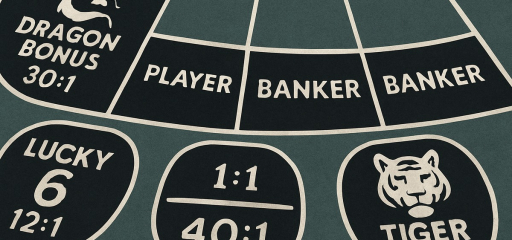
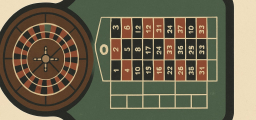
Walk up to a modern baccarat table and the felt looks busier than it used to. Next to the familiar Player, Banker, and Tie spots, you will see a constellation of smaller circles with names like Dragon Bonus, Lucky 6, Tiger, Panda 8, and Dragon 7. Those are baccarat side bets, and they are the reason the game has stayed profitable for casinos even as players have learned that the main game has one of the lowest house edges on the floor. The payouts look generous, the names sound exotic, and the math underneath is unforgiving.
Why side bets exist in the first place
The main baccarat bets are remarkably player-friendly. Banker comes in around a 1.06% house edge after the 5% commission, Player sits at roughly 1.24%, and Tie is the obvious trap at about 14.4%. A casino that only offered those three spots would still grind out a profit, but a slow one. Side bets exist to add variance and a much larger margin without changing the base game.
The pitch to the player is excitement. You can keep flat-betting Banker for hours, or you can drop a chip on Dragon Bonus and chase a 30:1 payout. The pitch to the casino is simpler: every side bet on the layout carries an edge that is several times what Banker pays them. Players think they are buying a lottery ticket. The house knows it is selling one.
Dragon Bonus: the natural-and-margin bet
Dragon Bonus pays based on how decisively your side wins. A “natural” win, where your two-card total of 8 or 9 beats the other hand, pays 1:1. A non-natural win pays based on the margin of victory: 4 points pays 1:1, then the schedule climbs to 30:1 for a 9-point win. Ties push and naturals that tie also push.
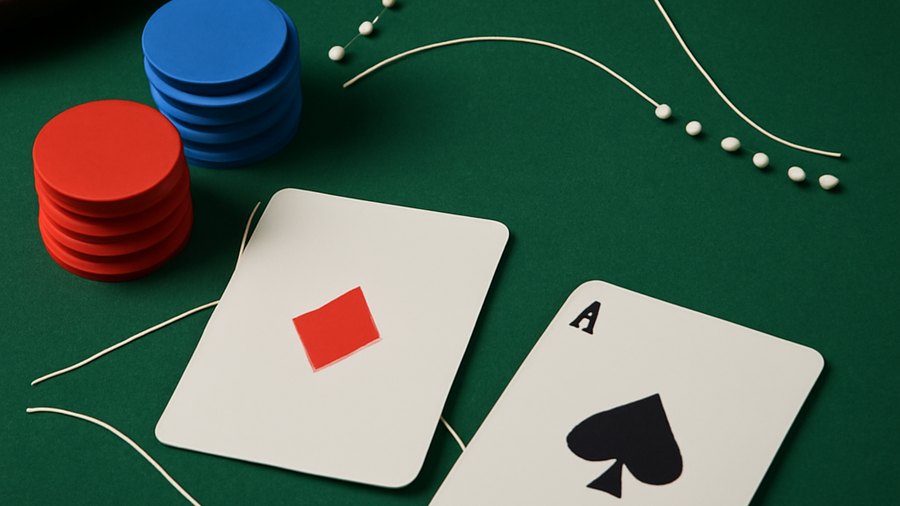
The structure sounds friendly, but the math does not cooperate. On the Banker side, Dragon Bonus carries a house edge of about 9.37%. On the Player side it drops to roughly 2.65%. The gap exists because the Player hand draws under a more predictable rule set, which makes large-margin wins slightly more reachable for the Player side. Even the “better” of the two is still more than double the edge of flat Banker.
The payouts on the schedule create the illusion of a real shot at a big hit. A 9-point win at 30:1 sounds reachable when you have just watched a hand finish 9-to-0. In practice, that exact 9-point margin happens on a tiny fraction of resolved hands. The smaller margin payouts (4, 5, and 6 points) anchor most of your wins at 1:1 to 4:1, and ties on naturals cancel some of the very hands you needed to break even. The schedule is built so the average win is much smaller than the eye-catching top line.
Lucky 6: a single hand pays the bills
Lucky 6 is offered on EZ Baccarat and on many commission-free tables. The bet wins when the Banker hand wins with a total of 6. The payout depends on whether the 6 came from two cards or three. The common schedule pays 12:1 for a 3-card 6 and 20:1 for a 2-card 6.
The Banker total of 6 is not rare, but it is not common either. Combined across two-card and three-card outcomes, the probability is enough to land the house edge in the neighborhood of 5.27% under the 12:1/20:1 schedule. Some casinos offer a flat 12:1 on any winning 6, which pushes the edge into the 10% range. Always check the payout printed on the felt before you decide whether the bet is “the same” Lucky 6 you played last weekend.
The Tiger family: Tiger, Big Tiger, Small Tiger, and Tiger Pair
The Tiger side bets are a newer family built around Banker wins with a total of 6, similar in spirit to Lucky 6 but sliced into more flavors. Tiger pays on any Banker 6 win, with a higher rate for a 3-card 6. Big Tiger pays only on a 3-card Banker 6, and Small Tiger pays only on a 2-card Banker 6. Tiger Pair pays when either of the first two hands contains a pair.
Because each Tiger variant targets a thinner slice of outcomes, the payouts look juicier (Big Tiger commonly pays 50:1, Small Tiger 22:1) but the house edge stays firmly in the high single digits. The whole family typically lives between 6% and 12% depending on the schedule a property uses. They are fun, they hit just often enough to feel reachable, and they quietly fund the dealer’s paycheck.
One thing worth noting: the Tiger bets are correlated with Lucky 6, because both pay on the same underlying event (Banker wins with 6). Stacking Lucky 6 and a Tiger variant on the same hand does not diversify your risk. You are buying two tickets that win or lose together, with both edges working against you simultaneously. Players who like the “every-bet-active” feel often end up paying a combined edge north of 10% on those chips.
Panda 8 and Dragon 7: the EZ Baccarat twins
EZ Baccarat removes the 5% Banker commission and replaces it with a rule that pushes Banker wins on a 3-card total of 7. To make up for the missing commission, the game offers two signature side bets.
Dragon 7 pays 40:1 when Banker wins with a 3-card total of 7 (the same outcome that pushes the main bet). The probability of that exact result is small enough that even a 40:1 payout leaves a house edge of roughly 7.61%. Panda 8 pays 25:1 when Player wins with a 3-card total of 8. Player 3-card 8 wins are rarer than the Dragon 7 case, and the 25:1 payout is not generous enough to compensate, so Panda 8 ends up at around a 10.19% house edge.
The two bets are the cleanest example of how a side bet can be “balanced” against the main game and still be a bad deal. The push rule that helps the player on the main bet is the same rule that makes Dragon 7 expensive.
Perfect Pair and other pair bets
Perfect Pair pays when either the Player or Banker is dealt two cards of the same rank and the same suit on the initial deal. A typical schedule pays 25:1 for a perfect pair and 5:1 for a regular pair on the chosen side. The exact edge depends on the schedule and the number of decks, but most offered versions live in the 11% to 17% range.

Pair bets feel like they should hit constantly because pairs feel common. They are not. In an 8-deck shoe, the probability that the first two cards on a chosen side form any pair is about 7.5%, and a suited pair is a small fraction of that. A 25:1 payout is real money, but you will wait through a lot of hands to see one.
Comparison: the main bets vs the side bets
The simplest way to see what side bets cost is to put them next to the base game.
| Bet | Typical payout | House edge |
|---|---|---|
| Banker (main, 5% commission) | 0.95: 1 | ~1.06% |
| Player (main) | 1: 1 | ~1.24% |
| Tie (main, 8:1) | 8: 1 | ~14.4% |
| Dragon Bonus, Player side | up to 30: 1 | ~2.65% |
| Dragon Bonus, Banker side | up to 30: 1 | ~9.37% |
| Lucky 6 (12:1 / 20:1) | 12: 1 or 20: 1 | ~5.27% |
| Big Tiger (3-card Banker 6) | 50: 1 | ~7 to 9% |
| Small Tiger (2-card Banker 6) | 22: 1 | ~5 to 8% |
| Panda 8 (EZ Baccarat) | 25: 1 | ~10.19% |
| Dragon 7 (EZ Baccarat) | 40: 1 | ~7.61% |
| Perfect Pair | 25: 1 | ~11 to 17% |
The pattern is hard to miss. The main game is one of the cheapest seats in the casino. The side bets sitting next to it cost anywhere from two to fifteen times as much per dollar wagered.
Why side bets are the profit center
It helps to translate house edge into something concrete. If you bet $25 a hand and play 70 hands per hour:
- $25 on Banker at 1.06% edge costs about $18.55 per hour in expectation.
- $25 on Dragon Bonus Banker at 9.37% edge costs about $164 per hour in expectation.
- $25 on Panda 8 at 10.19% edge costs about $178 per hour in expectation.
- $5 on Perfect Pair at 15% edge costs about $52.50 per hour in expectation, on a $5 bet.
The Banker bet pays the lights. The side bets pay the renovation. Which is why dealers are trained to ask “Any side bets?” before every deal, and why new layouts keep appearing.
None of this means side bets are evil or that you should never place one. A $5 Dragon 7 punt for entertainment is the price of a coffee. The danger is treating side bets like they belong in the same category as flat Banker. They do not. If your bankroll math assumed a 1% edge, switching half your action to side bets can quietly multiply your expected loss by ten. For a refresher on how house edge translates into expected loss over time, the worked examples at EffortlessMath are a clean place to start, and the side bet reference tables maintained by Wizard of Odds list payout-by-payout edges for nearly every variant you will see on a live floor.
FAQ
Q: Is there a side bet that beats the main game?
A: Not under standard payouts. The closest is Dragon Bonus on the Player side at about 2.65%, which is still roughly double Banker’s edge. Everything else is several times worse.
Q: Can card counting beat baccarat side bets?
A: Some side bets (notably Dragon 7 and Panda 8) are theoretically beatable with deep-shoe counting, but the edges gained are small and casinos shuffle and watch closely. Treat counting baccarat side bets as a research project, not a paycheck.
Q: Why does Banker-side Dragon Bonus have a much bigger edge than Player-side?
A: The drawing rules for the Banker hand depend on the Player’s third card, which makes large-margin Banker wins relatively less frequent. Fewer big wins means the 30:1 top payout hits less often, which pushes the edge up.
Q: Are commission-free baccarat tables a better deal?
A: The main bets end up close to the commission version because the push rule on a 3-card Banker 7 replaces the 5% commission. The difference shows up in the side bets, especially Dragon 7 and Panda 8, which only exist on EZ Baccarat layouts.
Q: How much should I budget for side bets?
A: A common rule among players who still want to place them: cap side-bet action at 10% to 20% of your main wager, and treat that money as entertainment spend rather than part of your “real” bankroll. The math is not your friend on these spots, and pretending otherwise is how short sessions become expensive ones.
Gambling outcomes are uncertain; no strategy guarantees profit.

Related to This Article
More math articles
- Calculating Water Potential: Formula and Worked Examples
- Order of Operations (Introduction) for 4th Grade
- Top 10 OAR Math Practice Questions
- Grade 3 Math: Word Problems: Multiplication
- Sense Organs
- How to Pass TSI Test: Top Tips and Key Tactics
- How Political Parties Change and Realign
- How to Apply for College: Complete Guide
- Multiplication Facts Review for 4th Grade
- Advanced Vocabulary Words: Strident to Theorize




What people say about "Dragon Bonus, Lucky 6, Tiger: A Math Tour of Baccarat Side Bets - Effortless Math"?
No one replied yet.