Free Grade 6 English Worksheets for Arizona Students
When Arizona released its most recent AASA results, the biggest shift was at Grade 6. Reading scores told the familiar story, passages got longer, the questions got harder, and the proportion of students hitting proficiency dropped against the lower grades. That is not an Arizona-specific story. It is a sixth-grade story. The middle of middle school is where reading stops being a thing kids practice and starts being a thing they have to do, with sources they did not choose, in subjects they did not pick.
What changes the outcome is not panic. It is small, regular practice on the standards Arizona kids are already being taught, citing evidence, finding central ideas, analyzing how authors build arguments, writing in clear paragraphs with reasons and proof.
That is what this page is for. Forty-six free worksheets, each one tied to a Grade 6 standard from the Arizona English Language Arts Standards. No signup, no fluff, no ads in the middle. Print and go.
What’s on this page
Each worksheet is a one-skill PDF: a short Quick Review on page one, practice items in the middle, and a thorough answer key at the end. The answer keys explain reasoning, not just letters, which is the part most kids skip and most parents wish they would not.
The pages are grouped by what the worksheet does, not by which standard number it belongs to. If you want to drill one area for a week, work down the section. If you want a quick warm-up before a test, pull one from anywhere.
Reading: Literature
- Citing Textual Evidence and Drawing Inferences, [RL.6.1] make the inference, then defend it with a line from the text
- Theme and Objective Summary, [RL.6.2] what the whole story is teaching, written as a real sentence
- Plot, Episodes, and Character Change, [RL.6.3] how each episode pushes the character a little further
- Figurative Language, Connotation, and Tone, [RL.6.4] the feeling words carry on top of their definition
- Structure: How a Scene or Stanza Builds the Whole, [RL.6.5] every section has a job; learn to name it
- Developing the Narrator’s Point of View, [RL.6.6] whose eyes the story is using
- Reading vs. Watching: Comparing Versions, [RL.6.7] what print does that film cannot
- Comparing Stories Across Forms and Genres, [RL.6.9] same idea in two different forms
Reading: Informational Text
- Citing Evidence and Drawing Inferences in Nonfiction, [RI.6.1] careful conclusions backed by a specific sentence
- Central Idea and Objective Summary in Nonfiction, [RI.6.2] the whole article’s main point, separated from a single detail
- How Ideas and Events Are Developed, [RI.6.3] introduce, elaborate, illustrate, compare
- Word Meaning in Nonfiction: Figurative, Connotative, Technical, [RI.6.4] three jobs a word can be doing at once
- Text Structure: How Sections Fit Together, [RI.6.5] problem, cause, effect, solution
- Author’s Point of View and Purpose, [RI.6.6] angle and motive
- Integrating Information from Text, Visuals, and Data, [RI.6.7] words plus chart plus photo as one combined message
- Evaluating Arguments and Claims, [RI.6.8] claim, support, and whether the support is strong enough
- Comparing Two Authors on the Same Topic, [RI.6.9] different facts, different angles, same subject
Writing
- Argument Writing: Claim, Reasons, Evidence, [W.6.1] defend a debatable position with reasons and quotes
- Informative and Explanatory Writing, [W.6.2] teach a reader using facts, transitions, and clear order
- Narrative Writing, [W.6.3] hook, develop, resolve
- Clear Writing for Task, Purpose, and Audience, [W.6.4] match the writing to who is reading
- Planning, Revising, and Editing, [W.6.5] drafts get better in passes
- Short Research Projects, [W.6.7] a focused question, multiple sources, a clean write-up
- Gathering, Evaluating, and Citing Sources, [W.6.8] which sources to use and how to credit them
Speaking & Listening
- Collaborative Discussions, [SL.6.1] show up ready, listen, build
- Interpreting Diverse Media, [SL.6.2] strengths and limits of each format
- Analyzing a Speaker’s Argument, [SL.6.3] claim, reasons, gaps
- Presenting Claims and Findings, [SL.6.4] open with the point, walk the evidence, close
- Adapting Speech to Context, [SL.6.6] different registers for different rooms
Grammar
- Pronoun Case: Subjective, Objective, and Possessive, [L.6.1a] I, me, my, and when each one fits
- Intensive Pronouns, [L.6.1b] adding emphasis without changing meaning
- Avoiding Shifts in Pronoun Number and Person, [L.6.1c] stay in one person and number through the paragraph
- Vague Pronouns and Unclear Antecedents, [L.6.1d] every pronoun needs a clear noun to point at
- Recognizing and Improving Non-Standard English, [L.6.1e] switching into school English on demand
Conventions: Punctuation, Spelling
- Punctuation: Commas, Parentheses, and Dashes, [L.6.2a] three ways to slip in extra information
- Spelling Grade-Appropriate Words, [L.6.2b] homophones and the words sixth graders miss most
Knowledge of Language and Style
- Varying Sentence Patterns for Style, [L.6.3a] combine, expand, rearrange to keep prose alive
- Consistency in Style and Tone, [L.6.3b] choose a register and stay there
Vocabulary and Word Study
- Using Context Clues, [L.6.4a] slow down at the strange word and read what is next to it
- Greek and Latin Roots and Affixes, [L.6.4b] port, dict, photo, tele
- Using Dictionaries and Thesauruses Effectively, [L.6.4c] match the tool to the question
- Verifying Word Meaning, [L.6.4d] check the guess, don’t trust it
- Figurative Language: Personification and More, [L.6.5a] personification, hyperbole, idiom
- Word Relationships: Cause-Effect, Part-Whole, Category, [L.6.5b] predictable patterns that connect words
- Connotation: Shades of Meaning, [L.6.5c] slender vs. Skinny, curious vs. Nosy
- Academic and Domain-Specific Vocabulary, [L.6.6] words that move across subjects and the specialist words for each one
How to use these worksheets at home
The pattern that works for most Arizona families is small, frequent, and quiet. Three twelve-minute sessions a week will produce more durable learning than one sixty-minute Saturday push. A sixth grader’s attention is a renewable resource, but only if it is renewed.
Start with the worksheet your kid is least enthusiastic about. The skill they roll their eyes at is usually the one with the most room to grow. Sit close enough to overhear them working but not so close that they feel like you are grading them. When they finish, swap roles. They read the answer key explanations out loud while you listen.
Once a week, pull one worksheet from a different section than the last time. Cross-pollination matters. A kid who has spent four sessions on inference but never on word relationships will plateau; rotating sections keeps each skill warm and prevents the boredom that ends practice routines.
If summer is the practice season for your family, and given Arizona summer afternoons, the indoor hours are real, these worksheets work as well in July as in February. The skills do not expire.
A note about AASA ELA
AASA, Arizona’s Academic Standards Assessment, is the spring Grade 6 ELA test that measures the Arizona English Language Arts Standards. The reading sections give students mixed passages and ask them to find central ideas, analyze how texts are structured, work out the meaning of words in context, and pull evidence to support each answer. The writing tasks expect organized responses with claims supported by text-based evidence.
None of the worksheets here are advertised as AASA prep, and they are not designed as cram material. They are designed for the standards Arizona teachers are already teaching, which is also what AASA measures. The overlap is not a coincidence. It is the point. Steady year-long practice on the standards is, in plain terms, the best preparation for any test built on those same standards.
Want everything in one bundle?
Some families prefer a single organized resource over a long page of standalone worksheets. The Grade 6 ELA Preparation Bundle is built for that case. It includes full-length practice assessments so a sixth grader can practice not just the individual skills but the experience of working across a complete test.
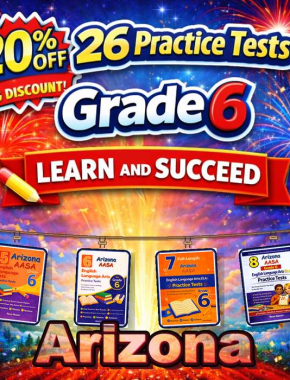
Arizona Grade 6 ELA Preparation Bundle, four practice-test books, 26 unique full-length tests, complete answer keys with explanations.
Common questions Arizona parents ask
Is this aligned to the Arizona ELA standards? Yes. Every worksheet targets a specific Grade 6 standard from the Arizona English Language Arts Standards. The skills your child is learning at school are the same skills these pages drill.
My child reads well above grade level, should I still use these? Yes, especially the writing, evaluation, and connotation pages. Strong readers often have weak spots in pronoun shifts, vague antecedents, and argument analysis that the harder reading hides until the writing makes them obvious.
My child is behind, where do I start? Start with Context Clues, Greek and Latin Roots, and Central Idea. Those three unlock more of the rest of the catalog than any other combination.
Are these usable for homeschool? Yes. Many Arizona homeschool families use single-skill worksheets as the practice piece after a longer lesson, or as a five-day rotation through the four big skill areas, reading, writing, language, and vocabulary.
A short closing
There is no trick to sixth-grade reading practice. There is only the worksheet you actually print, the conversation you actually have, and the answer key you actually read together. Come back any time you need the next one.
Best Bundle to Ace the Arizona AASA Grade 6 ELA
Looking for the best resource to help your kid ace the Arizona AASA? Try this bundle, four full practice-test books (5 + 6 + 7 + 8 tests) covering the same Grade 6 reading, writing, and language skills your child is already learning. Instant PDF download, answer keys included.

Related to This Article
More math articles
- How to Use Area Models to Divide Three-digit Numbers By One-digit Numbers
- How to Understand Cost of Credit and Loans? (+FREE Worksheet!)
- The Ultimate AFOQT Math Course (+FREE Worksheets & Tests)
- Use the market graph before the firm graph
- Advanced Vocabulary Words: Ostracize to Potable
- Free Grade 4 English Worksheets for Connecticut Students
- Agency capture
- Free Grade 4 English Worksheets for Wyoming Students
- Fitting a Line to Data: Complete Guide with Video and Examples
- Internment, the Bracero Program, and Minority Wartime Experiences






What people say about "Free Grade 6 English Worksheets for Arizona"?
No one replied yet.