How to Multiply Fractions: A Visual Guide for Beginners
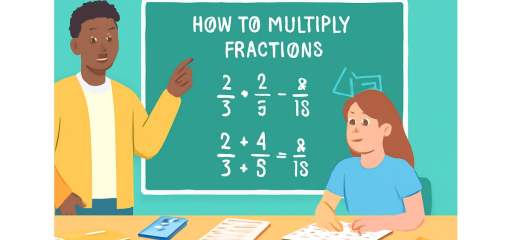
TL;DR: Multiplying fractions is the easiest of all four fraction operations, no common denominator needed, no hunting for the LCD. Just multiply the tops together to get your new numerator, multiply the bottoms together to get your new denominator, and simplify if you can. Two-thirds times four-fifths is 8 over 15, done. After all the work fractions have given you with adding and subtracting, multiplication finally feels like a break, straight across and you are out.
Key takeaways:
- Multiply numerator by numerator and denominator by denominator. That’s it.
- No common denominator is needed (unlike addition and subtraction).
- Convert mixed numbers to improper fractions before multiplying.
- Treat whole numbers as fractions over 1 (\(6 = \tfrac{6}{1}\)).
- Cross-cancel before multiplying to keep numbers small.
Multiplying fractions is one of the only math operations that gets easier than working with whole numbers. No common denominators. No crossing out. Just a quick three-step routine, and you’re done. Let me show you.
By the end of this guide, you’ll multiply any pair of fractions, proper, improper, or mixed, without breaking a sweat. We’ll also walk through a picture-based explanation so the rule actually makes sense (instead of feeling like another mystery from your textbook).
The three-step routine
- Multiply the tops (the numerators).
- Multiply the bottoms (the denominators).
- Simplify if you can.
Example: \(\tfrac{2}{3} \times \tfrac{4}{5}\)
- Tops: \(2 \times 4 = 8\).
- Bottoms: \(3 \times 5 = 15\).
- Answer: \(\tfrac{8}{15}\) (already simplified).
Multiplying by a whole number
A whole number is the same as that number over 1.
\(6 \times \tfrac{2}{3} = \tfrac{6}{1} \times \tfrac{2}{3} = \tfrac{12}{3} = 4\).
Another example. \(\tfrac{3}{8} \times 12 = \tfrac{3}{8} \times \tfrac{12}{1} = \tfrac{36}{8} = \tfrac{9}{2} = 4\tfrac{1}{2}\).
Multiplying mixed numbers
First convert mixed numbers to improper fractions, then follow the three steps.
\(2\tfrac{1}{2} \times 1\tfrac{1}{3} = \tfrac{5}{2} \times \tfrac{4}{3} = \tfrac{20}{6} = \tfrac{10}{3} = 3\tfrac{1}{3}\).
Conversion reminder. To convert \(a\tfrac{b}{c}\) to an improper fraction: multiply \(a \cdot c\), add \(b\), put it over \(c\). Example: \(3\tfrac{2}{5} = \tfrac{3 \cdot 5 + 2}{5} = \tfrac{17}{5}\).
The “cross-cancel” shortcut
If a numerator and a different fraction’s denominator share a common factor, you can divide them out before multiplying. It keeps the numbers small.
\(\tfrac{3}{8} \times \tfrac{4}{9}\) → cancel 4 and 8 (both ÷4) → \(\tfrac{3}{2} \times \tfrac{1}{9}\) → cancel 3 and 9 (both ÷3) → \(\tfrac{1}{2} \times \tfrac{1}{3} = \tfrac{1}{6}\).
Cross-cancelling is optional, your final answer will still be correct without it, but it’s a huge time-saver when the numbers are big.
A picture that makes it stick
Multiplying \(\tfrac{1}{2} \times \tfrac{1}{3}\) means “half of a third.” Imagine a chocolate bar split into 3 equal pieces; take 1 piece. Now split that one piece in half. You have \(\tfrac{1}{6}\) of the whole bar. That’s why multiplying two fractions usually gives a smaller number.
This mental image, “of” means “multiply”, is the most important idea behind fraction multiplication. Whenever you read “half of a cup” or “three-quarters of an hour,” the word of literally means multiplication.
Real-world word problem
A recipe calls for \(\tfrac{2}{3}\) cup of flour per batch. You want to make \(\tfrac{3}{4}\) of a batch. How much flour?
\(\tfrac{2}{3} \times \tfrac{3}{4}\) → cross-cancel the 3s → \(\tfrac{2}{1} \times \tfrac{1}{4} = \tfrac{2}{4} = \tfrac{1}{2}\) cup.
So you need half a cup of flour. Notice how the language gave it away: “\(\tfrac{3}{4}\) of a batch.”
Common mistakes
- Trying to find a common denominator (that’s for adding, not multiplying).
- Forgetting to simplify the answer.
- Skipping the “convert mixed numbers first” step.
- Multiplying only the numerators, leaving the denominator alone.
- Confusing the result direction: you should usually get a smaller fraction when both factors are less than 1.
Quick practice
- \(\tfrac{5}{6} \times \tfrac{3}{10}\). Answer: \(\tfrac{1}{4}\).
- \(\tfrac{7}{8} \times \tfrac{4}{14}\). Answer: \(\tfrac{1}{4}\).
- \(2\tfrac{1}{4} \times 1\tfrac{2}{3}\). Answer: \(\tfrac{9}{4} \times \tfrac{5}{3} = \tfrac{45}{12} = \tfrac{15}{4} = 3\tfrac{3}{4}\).
- \(\tfrac{4}{9}\) of 27. Answer: 12.
- A piece of land is \(\tfrac{3}{5}\) mile long and \(\tfrac{2}{3}\) mile wide. What is its area? Answer: \(\tfrac{2}{5}\) square mile.
- \(\tfrac{6}{11} \times \tfrac{22}{18}\). Answer: \(\tfrac{2}{3}\).
- A car uses \(\tfrac{1}{8}\) gallon per mile. How many gallons for a 36-mile drive? Answer: \(36 \times \tfrac{1}{8} = \tfrac{9}{2} = 4.5\) gallons.
- \(1\tfrac{1}{2} \times 2\tfrac{2}{3}\). Answer: \(\tfrac{3}{2} \times \tfrac{8}{3} = 4\).
Multiplying three or more fractions
The rule scales up perfectly. To multiply \(\tfrac{2}{3} \times \tfrac{5}{6} \times \tfrac{9}{10}\):
- Multiply all the numerators: \(2 \times 5 \times 9 = 90\).
- Multiply all the denominators: \(3 \times 6 \times 10 = 180\).
- Simplify: \(\tfrac{90}{180} = \tfrac{1}{2}\).
Pro tip: cross-cancel across all three fractions before multiplying. In the example above, 2 and 6 share a factor of 2, 5 and 10 share a factor of 5, 9 and 3 share a factor of 3. After cancelling: \(\tfrac{1}{1} \times \tfrac{1}{2} \times \tfrac{3}{2} \times \tfrac{1}{1} = \tfrac{3}{4}\). Wait, let’s redo: \(\tfrac{2}{3} \to \tfrac{1}{1}\) (cancel with 6); \(\tfrac{5}{6} \to \tfrac{1}{1}\) after both prior cancellations; \(\tfrac{9}{10} \to \tfrac{3}{2}\). Always finish by FOIL-ing or re-multiplying to verify.
Fraction multiplication in geometry
Area, scale factor, and similarity problems all reduce to fraction multiplication.
- A photo \(\tfrac{2}{3}\) ft tall and \(\tfrac{5}{6}\) ft wide has area \(\tfrac{5}{9}\) sq ft.
- If you scale a triangle by \(\tfrac{1}{2}\), the new area is \(\left(\tfrac{1}{2}\right)^2 = \tfrac{1}{4}\) of the original.
- A map at scale \(1:\tfrac{1}{50000}\) means 1 cm represents 50,000 cm of real distance.
Fluency with multiplying fractions makes geometry feel half as hard.
Multiplying negative fractions
The same three-step routine works, just track the sign. Negative × negative = positive. Negative × positive = negative.
- \(\tfrac{-3}{4} \times \tfrac{2}{5} = -\tfrac{6}{20} = -\tfrac{3}{10}\).
- \(-\tfrac{1}{2} \times -\tfrac{4}{7} = \tfrac{4}{14} = \tfrac{2}{7}\).
Connecting to division and ratios
Multiplying by \(\tfrac{1}{n}\) is the same as dividing by \(n\). So \(\tfrac{3}{4} \times \tfrac{1}{2} = \tfrac{3}{4} \div 2 = \tfrac{3}{8}\). This connection becomes important when you study fraction division (see our companion guide on Keep-Change-Flip).
FAQ
Do I need a common denominator to multiply fractions?
No. That’s only for adding and subtracting.
How do I multiply a fraction by a whole number?
Write the whole number as itself over 1, then multiply.
Why is the product sometimes smaller than the original fractions?
Because you’re taking a fraction of a fraction, which is less than either original.
Should I simplify before or after multiplying?
Either works. Simplifying first (cross-cancelling) keeps the numbers smaller and easier to manage.
How is multiplying fractions different from adding them?
For adding, you must match denominators first. For multiplying, you just multiply straight across.
What does “of” mean in fraction word problems?
“Of” means multiplication. “Half of 12” means \(\tfrac{1}{2} \times 12\).
How do I multiply three or more fractions at once?
Multiply all the numerators, multiply all the denominators, then simplify.
Can I multiply a fraction by a negative number?
Yes. The rules for signs are the same as for whole numbers, negative times positive = negative.
What happens when I multiply two fractions less than one?
The product is smaller than either factor. This trips up a lot of students who assume “multiplying makes things bigger.” \(\tfrac{1}{2} \times \tfrac{1}{3} = \tfrac{1}{6}\), which is less than both \(\tfrac{1}{2}\) and \(\tfrac{1}{3}\).
When is the product of two fractions a whole number?
When the denominators cancel completely with the numerators. \(\tfrac{4}{3} \times \tfrac{9}{2} = \tfrac{36}{6} = 6\).
How do I multiply a fraction by a whole number?
Write the whole number as itself over 1, then multiply normally. \(5 \times \tfrac{2}{3} = \tfrac{5}{1} \times \tfrac{2}{3} = \tfrac{10}{3} = 3\tfrac{1}{3}\).
How do I multiply mixed numbers?
Convert each mixed number to an improper fraction first. Then multiply the usual way. Don’t try to multiply the whole parts and fractional parts separately. That gives the wrong answer.
Is there a fastest way to multiply by a unit fraction?
Yes. Multiplying by \(\tfrac{1}{n}\) is identical to dividing by \(n\). So \(\tfrac{1}{3} \times 24 = 24 \div 3 = 8\). Use whichever feels easier on a given problem.
Worked walkthrough: “three-quarters of two-thirds”
In English, “of” almost always means multiply. So “three-quarters of two-thirds” is \(\tfrac{3}{4} \times \tfrac{2}{3}\). Cross-cancel the 3s, leaving \(\tfrac{1}{4} \times \tfrac{2}{1} = \tfrac{2}{4} = \tfrac{1}{2}\).
Picture it. Imagine a chocolate bar. Cut it into thirds and take 2 of them. Now of those two thirds, take 3 of every 4 little chunks. You’d end up with half the original chocolate bar, which is exactly \(\tfrac{1}{2}\).
This is why fraction multiplication works the way it does. You’re nesting one fraction inside another.
Common test-day question patterns
- Recipe scaling. “A recipe calls for \(\tfrac{2}{3}\) cup of flour. To make \(\tfrac{1}{2}\) a recipe, how much flour?” → \(\tfrac{2}{3} \times \tfrac{1}{2} = \tfrac{1}{3}\).
- Map distance. “\(\tfrac{1}{4}\) inch represents \(\tfrac{3}{8}\) mile. How many miles in \(\tfrac{3}{2}\) inches?” → scale up.
- Probability of independent events. “P(heads then heads) = \(\tfrac{1}{2} \times \tfrac{1}{2} = \tfrac{1}{4}\).”
- Area of a fractional rectangle. “Length \(\tfrac{5}{6}\) ft, width \(\tfrac{3}{10}\) ft. Area?” → cross-cancel and multiply.
Each of these patterns shows up on the SAT, ACT, GED, TEAS, and almost every state K, 12 assessment. Master one and you’ve mastered them all, same underlying skill.
One last reminder
Progress in math compounds. A 1% improvement every day for 100 days yields nearly a 3x improvement overall, because each new concept builds on the last. The students who pull ahead aren’t the ones who study the longest. They’re the ones who study consistently, review their mistakes, and refuse to skip the foundations. Show up tomorrow. Then show up the day after. The results take care of themselves.
If you found something useful here, save this article and revisit it after your next practice session. You’ll catch nuances on the second read that you missed on the first, because by then you’ll have the experience to recognize them. Happy practicing.
Practice helps, try our free 4th- and 5th-grade math worksheets, or go big with the Middle School Math Bundle.
Recommended EffortlessMath Books
For grade-by-grade practice with fractions and every other elementary topic, the Grade 5 Math for Beginners covers all four fraction operations with worked examples. For students moving toward middle school, the Pre-Algebra for Beginners reviews fractions before launching into algebra basics.
Frequently Asked Questions
How do I multiply two fractions?
Multiply the numerators together to get the new top, then multiply the denominators together to get the new bottom. Example: \(\tfrac{2}{3} \times \tfrac{4}{5} = \tfrac{2 \times 4}{3 \times 5} = \tfrac{8}{15}\). Simplify the result if possible.
Do I need a common denominator to multiply fractions?
No. That’s the rule for addition and subtraction. For multiplication, the denominators don’t need to match, just multiply them. This is what makes multiplication the easiest of the four fraction operations.
How do I multiply a whole number by a fraction?
Write the whole number over 1, then multiply normally. Example: \(6 \times \tfrac{2}{3} = \tfrac{6}{1} \times \tfrac{2}{3} = \tfrac{12}{3} = 4\). Or just multiply the whole number by the numerator and keep the original denominator: \(6 \times 2 = 12\), keep the 3, so \(\tfrac{12}{3} = 4\).
How do I multiply mixed numbers?
Convert each mixed number to an improper fraction first, then multiply. Example: \(2\tfrac{1}{2} \times 1\tfrac{1}{3} = \tfrac{5}{2} \times \tfrac{4}{3} = \tfrac{20}{6} = \tfrac{10}{3} = 3\tfrac{1}{3}\). Don’t try to multiply the whole parts and fractional parts separately. That gives the wrong answer.
What’s cross-cancellation and when do I use it?
Before multiplying, check if any numerator shares a factor with any denominator (even from the other fraction). Cancel them out. In \(\tfrac{3}{4} \times \tfrac{8}{9}\), the 3 and 9 share a factor of 3, and the 4 and 8 share a factor of 4. Cancel to get \(\tfrac{1}{1} \times \tfrac{2}{3} = \tfrac{2}{3}\). Much easier than multiplying \(\tfrac{24}{36}\) and simplifying.
Why does multiplying fractions sometimes give a smaller number?
Because you’re taking a fraction OF a fraction. \(\tfrac{1}{2} \times \tfrac{1}{2} = \tfrac{1}{4}\), half of a half is a quarter. Multiplying by a fraction less than 1 always shrinks the value. Multiplying by a fraction greater than 1 (an improper fraction) grows it.
What’s a common mistake when multiplying fractions?
Trying to find a common denominator first. That’s the addition rule, not the multiplication rule. Another common slip: with mixed numbers, multiplying the wholes separately from the fractions. Convert to improper form first, every time.
How do I show fraction multiplication with a picture?
Draw a rectangle. Divide it horizontally into the first denominator’s parts and vertically into the second denominator’s parts. Shade rows for the first numerator and columns for the second. The overlap shows the answer. For \(\tfrac{1}{2} \times \tfrac{1}{3}\): 1 of 2 rows shaded and 1 of 3 columns shaded creates 1 overlap out of 6 boxes, \(\tfrac{1}{6}\).
Can I cross-cancel with mixed numbers?
Only after converting them to improper fractions. Never cross-cancel parts of a mixed number, the math doesn’t work because the whole and fractional parts aren’t actually multiplied separately.
Where can I get more fraction multiplication practice?
EffortlessMath has free worksheets on multiplying fractions. The Grade 5 Math for Beginners book covers all four fraction operations with step-by-step examples, and the Pre-Algebra for Beginners workbook reviews fractions Before algebra.
Related EffortlessMath Lessons
If a topic on this page feels rusty, these short lessons go deeper:
- How to divide fractions
- How to simplify fractions
- How to add fractions
- How to convert mixed numbers to improper fractions
- How to find equivalent fractions

Related to This Article
More math articles
- Top 10 3rd Grade FSA Math Practice Questions
- In-Depth Analysis of Vector Function Derivatives: Theory and Practical Applications
- How to Get Better at Math: 7 Comprehensive Tips for Parents with Kids Struggling
- The Best Algebra 1 Book for Missouri Students
- Rhode Island RICAS Grade 7 Math Worksheets: 95 Free Printable Skill PDFs with Keys
- Research Ethics and Participant Protection
- Weight Limits and Distribution
- The Ultimate ASTB Math Course (+FREE Worksheets & Tests)
- Motion: Speed, Velocity, and Acceleration
- Driving Electric Is Cheaper: Let’s Do the Math




















What people say about "How to Multiply Fractions: A Visual Guide"?
No one replied yet.