FREE 7th Grade SBAC Math Practice Test

TL;DR: Want a clean honest preview of 7th grade SBAC Math? Try this free practice test with 20 real-style questions. SBAC is computer-adaptive and used in California, Washington, Oregon, Hawaii, and several other states, with a calculator allowed on most items. Treat this set as a dress rehearsal for your student, talk through the reasoning behind any misses, and you will know exactly which topics still need a little more time.
Key takeaways:
- This practice set has 20 questions modeled on the real SBAC Grade 7 math test.
- SBAC is computer-adaptive (CAT): question difficulty adjusts to your child’s answers.
- An on-screen calculator is available on calculator-allowed items in grade 7.
- The real test has a CAT portion (~25 items) plus a Performance Task (1-2 extended problems).
- 4 achievement levels: Below Standard, Near Standard, At Standard, Above Standard.
The Absolute Best Book to Ace the 7th Grade SBAC Math Test
Common Core Math Exercise Book for Grade 7 Student Workbook and Two Realistic Common Core Math Tests
10 Sample 7th Grade SBAC Math Practice Questions
1- What is the slope of a line that is perpendicular to the line \(4x-2y=12\)?
A. \(-2\)
B. 2
C. 4
D. 12
2- Simplify: \(5(x-2y)+(2-x)^2 = (5x-10y)+(4-4x+x^2) = x -10y +4 +x^2\)
When \(x=3\) and \(y=-2\),therefore:
\(x -10y +4 +x^2 =3+20+4+9 =36\)
A. \(-4\)
B. 20
C. 36
D. 50
3- The mean of 50 test scores was calculated as 88. But, it turned out that one of the scores was misread as 94 but it was 69. What is the mean?
A. 85
B. 87
C. 87.5
D. 88.5
4- The width of a box is one-third of its length. The height of the box is one-third of its width. If the length of the box is 27 cm, what is the volume of the box?
A. 81 cm\(^3\)
B. 162 cm\(^3\)
C. 243 cm\(^3\)
D. 729 cm\(^3\)
5- In five successive hours, a car travels 40 km, 45 km, 50 km, 35 km and 55 km. In the next five hours, it travels with an average speed of 50 km per hour. Find the total distance the car traveled in 10 hours.
A. 425 km
B. 450 km
C. 475 km
D. 500 km
6- The ratio of boys to girls in a school is 2:3. If there are 600 students in a school, how many boys are in the school.____________
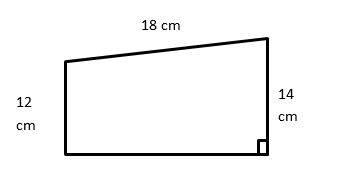
7- The perimeter of the trapezoid below is 54 cm. What is its area? _________
8- In 1999, the average worker’s income increased $2,000 per year starting from $24,000 annual salary. Which equation represents income greater than average? (\(I =\) income, \(x = \)Number of years after 1999)
A. \(I > 2000 x + 24000\)
B. \(I > -2000 x + 24000\)
C. \(I < -2000 x + 24000\)
D. \(I < 2000 x – 24000\)
9- Which of the following graphs represents the compound inequality?
A. Graph 1

B. Graph 2

C. Graph 3

D. Graph 4

10- A football team had $20,000 to spend on supplies. The team spent $14,000 on new balls. New sport shoes cost $120 each. Which of the following inequalities represent how many new shoes the team can purchase.
A. \( 120x+14,000 ≤20,000 \)
B. \(120x+14,000 ≥20,000\)
C. \(14,000x+12,0 ≤20,000 \)
D. \( 14,000x+12,0 ≥20,000 \)
11- Two dice are thrown simultaneously, what is the probability of getting a sum of 6 or 9?
A. \(\frac{1}{3}\)
B. \(\frac{1}{4}\)
C. \(\frac{1}{6}\)
D. \(\frac{11}{36}\)
12- A swimming pool holds 2,000 cubic feet of water. The swimming pool is 25 feet long and 10 feet wide. How deep is the swimming pool? __________
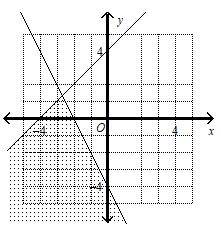
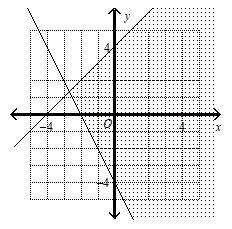
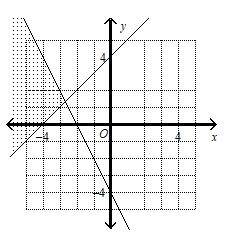
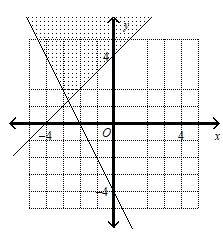
13- Which graph corresponds to the following inequalities?
\(y≤ x + 4\)
\(2x + y ≤ – 4\)
A.
B.
C.
D.
14- A bank is offering \(4.5\%\) simple interest on a savings account. If you deposit $8,000, how much interest will you earn in five years?
A. $360
B. $720
C. $1800
D. $3600
15- A card is drawn at random from a standard 52, card deck, what is the probability that the card is of Hearts? (The deck includes 13 of each suit clubs, diamonds, hearts, and spades)
A. \(\frac{1}{3}\)
B. \(\frac{1}{4}\)
C. \(\frac{1}{6}\)
D. \(\frac{1}{52}\)
16- How long does a 420, miles trip take moving at 50 miles per hour (mph)?
A. 4 hours
B. 6 hours and 24 minutes
C. 8 hours and 24 minutes
D. 8 hours and 30 minutes
17- 11 yards 6 feet and 4 inches equals to how many inches?
A. 388
B. 468
C. 472
D. 476
18- A shirt costing $200 is discounted \(15\%\). After a month, the shirt is discounted another \(15\%\). Which of the following expressions can be used to find the selling price of the shirt?
A. \((200) (0.70)\)
B. \((200) – 200 (0.30)\)
C. \((200) (0.15) – (200) (0.15)\)
D. \((200) (0.85) (0.85)\)
19- Which of the following points lies on the line \(2x + 4y = 10\)
A. \((2, 1)\)
B. \((–1, 3)\)
C. \((–2, 2)\)
D. \((2, 2)\)
20- \(5 + 8 × (–2) – [4 + 22 ×5] ÷ 6 = \)?
A. \(-30\)
B. \(-20\)
C. \(-10\)
D. 0
Best 7th Grade SBAC Math Workbook Resource for 2026
Answers:
1- A
The equation of a line in slope intercept form is: \(y = mx + b\)
Solve for \(y\).
\(4x-2y=12 ⇒ -2y=12-4x ⇒ y=(12-4x)÷(-2) ⇒ y=2x-6\)
The slope of this line is 2.
The product of the slopes of two perpendicular lines is\( -1\).
Therefore, the slope of a line that is perpendicular to this line is:
\(m_1 × m_2 = -1 ⇒ 2 × (m_2) = -1 ⇒ (m_2) = -\frac{1}{2}\)
2- C
Simplify: \(5(x-2y)+(2-x)^2 = (5x-10y)+(4-4x+x^2) = x -10y +4 +x^2\)
When \(x=3\) and \(y=-2\),therefore:
\(x -10y +4 +x^2 =3+20+4+9 =36\)
3- C
\(average (mean) = \frac{sum \space of \space terms }{number \space of \space terms}⇒ 88 = \frac{sum \space of \space terms}{50}⇒ sum = 88 × 50 = 4400\)
The difference of 94 and 69 is 25. Therefore, 25 should be subtracted from the sum.
\(4400 – 25 = 4375\)
\(mean =\frac{sum \space of \space terms}{number \space of \space terms}⇒ mean = \frac{4375 }{50}= 87.5\)
4- D
If the length of the box is 27, then the width of the box is one third of it, 9, and the height of the box is 3 (one third of the width). The volume of the box is:
\(V = lwh = (27) (9) (3) = 729\)
5- C
Add the first 5 numbers. \(40 + 45 + 50 + 35 + 55 = 225\)
To find the distance traveled in the next 5 hours, multiply the average by number of hours.
\(Distance = Average × Rate = 50 × 5 = 250\)
Add both numbers.
\(250 + 225 = 475\)
6- 240
The ratio of boy to girls is 2:3. Therefore, there are 2 boys out of 5 students. To find the answer, first divide the total number of students by 5, then multiply the result by 2.
\(600 ÷ 5 = 120 ⇒ 120 × 2 = 240\)
7- 130
The perimeter of the trapezoid is 54 cm.
Therefore, the missing side (high) is \(= 54 – 18 – 12 – 14 = 10\)
Area of a trapezoid:
\( A = \frac{1}{2}h (b_1 + b_2) = \frac{1}{2}(10) (12 + 14) = 130\)
8- A
Let \(x\) be the number of years. Therefore, $2,000 per year equals 2000\(x\).
starting from $24,000 annual salary means you should add that amount to 2000\(x\).
Income more than that is:
\(I > 2000x + 24000\)
9- D
Solve for \(x\).
\(-2≤2x-4<8 \)⇒ (add 4 all sides)\( -2+4≤2x-4+4<8+4 \)
\(⇒ 2≤2x<12 \)
⇒ (divide all sides by 2)\( 1≤x<6\)
\(x\) is between 1 and 6.
10- A
Let \(x\) be the number of new shoes the team can purchase. Therefore, the team can purchase 120 \(x\).
The team had $20,000 and spent $14000. Now the team can spend on new shoes $6000 at most.
Now, write the inequality:
\(120x+14.000 ≤20.000\)
11- B
For Sum 6: (1 & 5) and (5 & 1), (2 & 4) and (4 & 2), (3 & 3), so we have 5 options.
For sum 9: (3 & 6) and (6 & 3), (4 & 5) and (5 & 4), we have 4 options.
To get a sum of 6 or 9 for two dice: \(5+4=9\)
Since we have \(6 × 6 = 36\) total options, the probability of getting a sum of 6 and 9 is 9 out of 36 or \(\frac{1}{4}\).
12- 8
Use formula of rectangle prism volume.
\(V = (length) (width) (height) ⇒ 2000 = (25) (10) (height)\)
\( ⇒ height = 2000 ÷ 250 = 8\)
13- A
For each option, choose a point in the solution part and check it on both inequalities.
A. Point \((–4, –4)\) is in the solution section. Let’s check the point in both inequalities.
\(-4 ≤ – 4 + 4, \space It \space works\)
\(2 (–4) + (–4) ≤ –4 ⇒ – 12 ≤ – 4\) it works (this point works in both)
B. Let’s choose this point \((0, 0)\)
\(0 ≤ 0 + 4, \space It \space works\)
\(2 (0) + (0) ≤ –4, \space \space That’s \space not \space true!\)
C. Let’s choose this point \((–5, 0)\)
\(0 ≤ -5 + 4, \space That’s \space not \space true!\)
D. Let’s choose this point \((0, 5)\)
\(5 ≤ 0 + 4, \space That’s \space not \space true!\)
14- C
Use simple interest formula:
I=prt
(I = interest, p = principal, r = rate, t = time)
\(I=(8000)(0.045)(5)=1800\)
15- B
The probability of choosing a Hearts is \(\frac{13}{52}=\frac{1}{4}\)
16- C
Use distance formula:
\(Distance = Rate × time ⇒ 420 = 50 × T\)
divide both sides by 50.
\(\frac{420}{50} = T ⇒ T = 8.4 \space hours\)
Change hours to minutes for the decimal part.
\(0.4 \space hours = 0.4 × 60 = 24 \space minutes\)
17- C
\(11 × 36 + 6 × 12 + 4 = 472\)
18- D
To find the discount, multiply the number by (\(100\% – \)Rate of discount).
Therefore, for the first discount we get:
\((200) (100\% – 15\%) = (200) (0.85) = 170\)
For the next \(15%\) discount: \((200) (0.85) (0.85)\)
19- B
Input \((-1, 3)\) in the \(2x + 4y = 10\) formula instead of \(x\) and y. So we have:
\( 2(-1) + 4(3) = 10\)
\(-2 + 12 = 10\)
20- A
Use PEMDAS (order of operation):
\(5 + 8 × (–2) – [4 + 22 ×5] ÷ 6 = 5 + 8 × (–2) – [4 + 110] ÷ 6 = 5 + 8 × (–2) – [114] ÷ 6 = 5 + (–16) – 19 = 5 + (–16) – 19 = –11 – 19 = –30\)
Looking for the best resource to help you succeed on the 7th Grade SBAC Math test?
The Best Books to Ace the 7th Grade SBAC Math Test
Recommended EffortlessMath Books
For more structured prep alongside this practice test, the Common Core Mathematics Workbook for Grade 7 walks through every SBAC topic with worked examples. For the kind of multi-step word problems that appear on the Performance Task, see the Mastering Grade 7 Math Word Problems.
Frequently Asked Questions
What grades take the SBAC test?
Students take the Smarter Balanced (SBAC) math and English tests in grades 3 through 8 and again in grade 11. So a 7th grader sits the test once each spring, usually in a window set by the state and district. The grade 7 math test has a computer-adaptive part plus a performance task, so practice with both short questions and longer multi-step problems.
What is a good SBAC score for 7th grade math?
A good score is one that reaches Level 3 (Standard Met) or Level 4 (Standard Exceeded). Level 3 means your 7th grader is on track with grade-level math; Level 2 (Standard Nearly Met) means some skills still need work. The scale-score cut points for each level are printed on the student score report and on the Smarter Balanced website, so compare your child’s number to those.
What is on the SBAC 7th grade math performance task?
The performance task is a set of related questions built around one real-world situation, such as planning a class trip or comparing prices. Students may calculate, explain their reasoning and show their work, and some parts are scored by trained readers. Practicing multi-step problems like finding a box’s volume when width is 1/3 of length helps, since the task rewards clear steps, not just answers.
Is the CAASPP 7th grade math test the same as SBAC?
Yes. In California, the grade 7 math test given under CAASPP is the Smarter Balanced Summative Assessment, so SBAC practice prepares students for it directly. The format, question types and achievement levels are the same. California families can find practice and training tests on the CAASPP website, and the 20 questions on this practice test cover the same grade 7 topics.
What math should a 7th grader know?
By the end of 7th grade, students should handle ratios, unit rates and percents, add, subtract, multiply and divide negative numbers, and solve two-step equations and inequalities. Geometry includes circle area and circumference, angle relationships, scale drawings, surface area and volume. Statistics covers sampling and simple probability. For example, a 7th grader should solve 3x − 5 = 16 and get x = 7.
Is 7th grade math algebra?
Seventh grade math is mostly pre-algebra: students write and solve linear equations, work with expressions and use variables in word problems, but a full Algebra 1 course usually comes in 8th or 9th grade. Some schools offer an accelerated track. SBAC questions such as simplifying 5(x − 2y) + (2 − x)² show how much algebra already appears at this level.
Related EffortlessMath Lessons
If a topic on this page feels rusty, these short lessons go deeper:
- Proportional ratios
- How to add and subtract integers
- How to solve one-step equations
- Percent of change (resource currently unavailable)
- How to find the volume of a prism

Related to This Article
More math articles
- Discover the Gateway: “CBEST Math for Beginners” Full Solution Handbook
- Twenty-Sixth Amendment
- The Ultimate Grade 3 Math Course (+FREE Worksheets)
- How to Graph Inequality: Using Number Lines to Graph Inequalities
- Kansas KAP Grade 6 Math Free Worksheets: 72 Free Printable Worksheets with Step-by-Step Keys
- Federalist No. 70 and executive power
- SHSAT Math Worksheets: FREE & Printable
- Free Grade 5 English Worksheets for Louisiana Students
- How to Use Area Models to Divide Three-digit Numbers By One-digit Numbers
- Tennessee TCAP Algebra 1 Free Worksheets: Free Printable TCAP-Ready Algebra 1 Practice with Answers







What people say about "Free 7th Grade SBAC Math Practice Test"?
No one replied yet.