Free Grade 7 English Worksheets for Delaware Students
A seventh grader in Lewes wakes up to salt air and a bus that ferries kids past corn fields and tomato stands on the way to school. A seventh grader in Wilmington wakes up to traffic on I-95 and the morning news from Philadelphia. Two very different mornings, one identical curriculum, because Delaware, despite its size, runs a coherent set of Grade 7 ELA standards from Sussex County to New Castle County and back. What ought to be true on the page in Selbyville should be just as true on the page in Hockessin.
The standards themselves take a real step up in seventh grade. Inference requires multiple pieces of evidence. Arguments require counterclaims. Vocabulary work introduces allusion. Grammar adds clause-counting and modifier placement. Most of these moves are brand new at this grade level, which is why so many families notice the load change around the holidays, the report cards come home and the writing scores have shifted, not because the student got worse but because the expectation got more specific.
This page collects forty-three free printable worksheets, every one aligned to a single Delaware ELA standard at Grade 7. They are designed for ten or fifteen minutes at a time, not for marathon sessions.
What’s on this page
Each worksheet follows the same shape. A Quick Review on the first page your seventh grader can read on their own. Practice items in the middle. A student-facing answer key on the last page that walks through why each wrong option was tempting and what the correct answer actually depends on.
No login. No email harvesting. No paywall on click two.
Reading: Literature
- Citing Several Pieces of Textual Evidence, [RL.7.1] gather two or three quotes that converge on one inference
- Theme and Its Development Over the Text, [RL.7.2] say the theme as a sentence and trace where it grows
- How Setting, Character, and Plot Interact, [RL.7.3] how setting shapes character and how character drives plot
- Word Choice, Figurative Language, and Tone, [RL.7.4] denotation, connotation, and the mood a single word can plant
- How Form Shapes Meaning in Drama and Poetry, [RL.7.5] line breaks, stanzas, and stage directions as carriers of meaning
- Developing and Contrasting Points of View, [RL.7.6] two perspectives put deliberately in tension
- Comparing a Story to Its Audio, Film, or Stage Version, [RL.7.7] what each medium can and cannot do
- Comparing Fictional and Historical Portrayals, [RL.7.9] separate the documented past from the writer’s invention
Reading: Informational Text
- Citing Several Pieces of Evidence in Nonfiction, [RI.7.1] back an inference with two or more lines from the article
- Two or More Central Ideas and Their Development, [RI.7.2] read articles that build more than one big idea at once
- How Individuals, Events, and Ideas Interact, [RI.7.3] how a person reshapes an idea and how an idea reshapes a person
- Word Meaning in Nonfiction: Figurative, Connotative, Technical, [RI.7.4] one word doing three jobs in nonfiction
- How Text Structure Develops the Author’s Ideas, [RI.7.5] see the writer’s organizational blueprint
- Author’s Point of View and How They Distinguish It, [RI.7.6] locate the writer’s stance and the moves that mark it
- Comparing a Text to Its Audio or Video Version, [RI.7.7] what each medium adds and what it leaves out
- Evaluating an Argument: Reasoning and Evidence, [RI.7.8] judge whether reasons and evidence support the claim
- How Two Authors Shape Their Presentation of the Same Topic, [RI.7.9] same subject, different choices, different effects
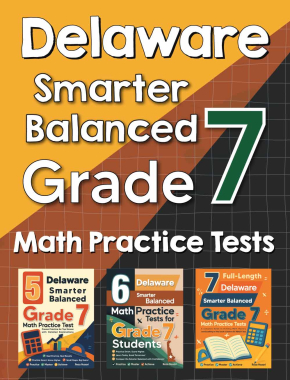
Working on Math Too? Try the Delaware Smarter Balanced Grade 7 Math Bundle
Many third graders are getting ready for the Smarter Balanced in both subjects. If your child also needs math practice that matches the same standards, this companion bundle is the shortest path, workbook, study guide, and full practice tests in one download.
Writing
- Argument Writing: Claims, Reasons, Evidence, and Counterclaims, [W.7.1] the new Grade 7 move: counterclaim, then refutation
- Informative and Explanatory Writing, [W.7.2] thesis, sections, transitions, real conclusion
- Narrative Writing, [W.7.3] pacing, dialogue, sensory detail, ending that lands
- Coherent Writing for Task, Purpose, and Audience, [W.7.4] adjust the same idea for three different readers
- Planning, Revising, and Editing, [W.7.5] when revising means scrapping the plan
- Short Research Projects: Question and Refocus, [W.7.7] let early findings sharpen the question
- Gathering, Evaluating, and Citing Sources, [W.7.8] author, date, publisher, citation done right
Speaking & Listening
- Collaborative Discussions, [SL.7.1] prepared, listening first, building on what others said
- Analyzing Information in Diverse Media, [SL.7.2] chart, clip, and photo as one combined message
- Evaluating a Speaker’s Argument, [SL.7.3] claim, reasons, evidence, soft spots
- Presenting Claims with Focus and Coherence, [SL.7.4] clean open, previewed structure, controlled close
- Adapting Speech to Context, [SL.7.6] match register to the room
Grammar
- Phrases and Clauses: Placement and Function, [L.7.1a] name what each chunk of a sentence is doing
- Sentence Structures: Simple, Compound, Complex, Compound-Complex, [L.7.1b] count clauses, then name the structure
- Avoiding Dangling and Misplaced Modifiers, [L.7.1c] the quiet error that makes a paragraph absurd
Conventions: Punctuation, Spelling
- Commas with Coordinate Adjectives, [L.7.2a] when two adjectives in a row need a comma between them
- Spelling Grade-Appropriate Words, [L.7.2b] homophones, doubled letters, frequent seventh-grade trip-ups
Knowledge of Language and Style
- Precise and Concise Language, [L.7.3a] cut filler, pick the exact word
Vocabulary and Word Study
- Using Context Clues, [L.7.4a] name the kind of clue, then use it deliberately
- Greek and Latin Roots and Affixes, [L.7.4b] break long words apart and open whole word families
- Using Reference Materials Effectively, [L.7.4c] pick the right tool for the actual question
- Verifying Word Meaning, [L.7.4d] confirm a guess before trusting it
- Allusions and Figures of Speech, [L.7.5a] the L.7.5a standard new to Grade 7, myth, Bible, and literary references
- Word Relationships: Synonyms, Antonyms, Analogies, [L.7.5b] name the relationship in plain words before answering
- Connotation and Denotation, [L.7.5c] same fact, different emotional weight
- Academic and Domain-Specific Vocabulary, [L.7.6] Tier 2 cross-subject words and Tier 3 field words
How to use these worksheets at home
Delaware seventh graders are spread across vastly different home situations, a beach town in summer is empty by Halloween, a Wilmington apartment buzzes with city noise on a Tuesday night, a Dover house may have one parent stationed at the base. The worksheets on this page were designed for whatever weeknight shows up.
Pick one PDF per session. Twelve focused minutes is the working unit. Have your seventh grader read the Quick Review out loud before starting, the rule has to be active in working memory. After the practice, hand over the answer key and let your child grade their own work. The self-grade is where the actual learning happens because the student has to face the gap between what they wrote and what was correct.
Cycle the worksheets. A PDF that gave your seventh grader trouble in November is exactly the one to pull out again in December. First attempts teach; second attempts confirm. Grade 7 reading and writing skills are slow-build skills, and spaced practice across the year is what makes them stick.
A note about Smarter Balanced ELA
Delaware administers the Smarter Balanced English Language Arts assessment in a spring window the Delaware Department of Education typically opens between early March and early June, with districts scheduling their own testing dates inside that window. The Grade 7 portion is aligned to the Delaware ELA Standards, which means the standards your child has been studying since the first week of school are the standards being assessed.
The computer-based test asks for literary and informational reading items requiring multiple pieces of textual evidence, vocabulary items that test connotative and figurative meaning, an extended writing prompt, and a performance task combining reading, research, and writing. The grammar items target the Grade 7 language standards, phrases and clauses, sentence structures, and modifier placement. Worksheets on this page line up with those exact expectations.
Want everything in one bundle?
For Delaware families who would rather work from a single resource than a long catalog of standalone PDFs, the Grade 7 ELA Preparation Bundle is built for exactly that. Full-length practice tests in the same computer-based shape as Smarter Balanced, answer keys with student-facing explanations, and a structured progression touching every Grade 7 standard.
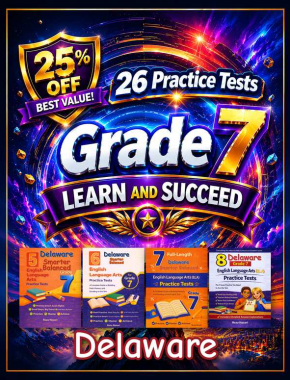
Delaware Grade 7 ELA Preparation Bundle, four practice-test books, 26 unique full-length tests, complete answer keys with explanations.
A short closing
Seventh grade in Delaware is long, August dismissal bells, December half-days, March spring break, May testing windows, and the reading work inside it ought to feel like a regular habit rather than a panic before the assessment opens. Bookmark this page, pull a PDF when there is a quiet quarter-hour at the kitchen table, and let one skill at a time accumulate across the months. That is how Smarter Balanced readiness actually arrives in Delaware: through small, regular sessions stacked across the whole school year.
Best Bundle to Ace the Delaware Smarter Balanced Grade 7 ELA
Looking for the best resource to help your kid ace the Delaware Smarter Balanced? Try this bundle, four full practice-test books (5 + 6 + 7 + 8 tests) covering the same Grade 7 reading, writing, and language skills your child is already learning. Instant PDF download, answer keys included.

Related to This Article
More math articles
- Digital SAT Harder Second Module: What It Means for Your Score (2027 Prep)
- The Best Grade 6 ELA Practice Tests for Pennsylvania Students
- Number Properties Puzzle -Critical Thinking 4
- Special Right Triangles Calculator — 45-45-90 & 30-60-90 (Free)
- Maryland MCAP Grade 3 Math Worksheets — 49 Free Printable Single-Skill PDFs
- CLEP U.S. History I 010: Plantation Regions, Family, Gender, and Authority
- Reading the Question Before the Passage
- A Comprehensive Collection of Free AFOQT Math Practice Tests
- Free Grade 6 English Worksheets for Alaska Students
- Full-Length GED Math Practice Test-Answers and Explanations





What people say about "Free Grade 7 English Worksheets for Delaware"?
No one replied yet.