Estimate Differences for 4th Grade
Estimate Differences for 4th Grade: this Effortless Math guide explains the topic in plain language, shows how it works through solved examples, and gives you free practice to try immediately, so the idea sticks instead of staying abstract.
Estimating differences helps students use rounding to make subtraction problems easier to think about and to check exact answers.
This lesson covers estimating sums and differences for fourth-grade math. Use the examples and practice below to build confidence and skill.
Key Ideas to Remember
- Round numbers to a friendly place value before doing the mental math.
- Estimate first and then use the estimate to check the exact answer later.
- Make sure the rounded numbers are close enough to the originals to be useful.
Detailed Explanation
Estimating means finding a number close to the exact answer. Round each number to the nearest ten, hundred, or thousand, then add or subtract the rounded numbers. Estimates help check if an exact answer is reasonable.
Worked Example
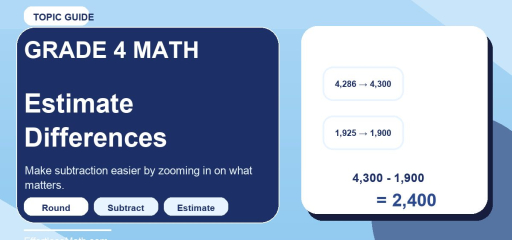
Problem: Estimate 4,286 – 1,925 by rounding to the nearest hundred.
- Round 4,286 to 4,300.
- Round 1,925 to 1,900.
- Subtract the rounded numbers: 4,300 – 1,900 = 2,400.
Answer: The estimated difference is 2,400.
Worked Example
Problem: Estimate 3,478 + 2,193 by rounding to the nearest hundred.
- Step 1: Apply the concept from the lesson above.
- Step 2: Carry out the operation or reasoning.
Answer: 3,478 ≈ 3,500; 2,193 ≈ 2,200. 3,500 + 2,200 = 5,700.
Common Mistakes
Students usually improve faster in estimate differences when they slow down and watch for a few repeated mistakes. These are the ones worth checking first:
- Rounding to different place values within the same problem.
- Treating an estimate like an exact answer.
- Using a rounded number that is too far from the original value.
Practice Strategy
A short but consistent review routine helps students build confidence with estimate differences without getting overwhelmed.
- Round to the same place value across several practice problems.
- Compare each estimate to an exact answer to see how close it is.
- Explain why the chosen rounded numbers make the mental math easier.
Watch Another Example
Use a second example video to hear the steps explained in a different way and reinforce the same skill from another angle.
Frequently Asked Questions
What should students focus on first in estimate differences problems?
Identify the rule, pattern, or place value that controls the problem before solving. That first step makes the rest of the work much clearer.
How can students practice estimate differences at home?
Short daily review works best. Solve a few simple problems, explain the thinking out loud, and then check the answers with estimation or a model.
What is a fast way to check the answer?
Use the opposite operation, estimate the result, or explain why the answer fits the question. A strong explanation usually exposes mistakes quickly.
Keep Practicing
After finishing this lesson on estimate differences, spend a few minutes on mixed review so the skill stays connected to the rest of Grade 4 math.
Need more Grade 4 review? Explore the Grade 4 Mathematics Worksheets hub for extra guided practice, review sets, and printable support.

Related to This Article
More math articles
- The Best Grade 6 ELA Practice Tests for Illinois Students
- How to Find x- and y-intercepts in the Standard Form of Equation?
- Simplifying Radicals Practice — Simplest Radical Form (Free)
- Is the ACCUPLACER Test hard?
- 10 Most Common 6th Grade PSSA Math Questions
- Multiple Meanings, Tone, and Connotation
- How to Apply for College: Complete Guide
- How to Prepare for the HSPT Math Test?
- Tennessee TCAP Algebra 1 Free Worksheets: Free Printable TCAP-Ready Algebra 1 Practice with Answers
- From Neutrality Acts to Pearl Harbor



















What people say about "Estimate Differences for 4th Grade"?
No one replied yet.