New York Algebra I Worksheets and Regents Review
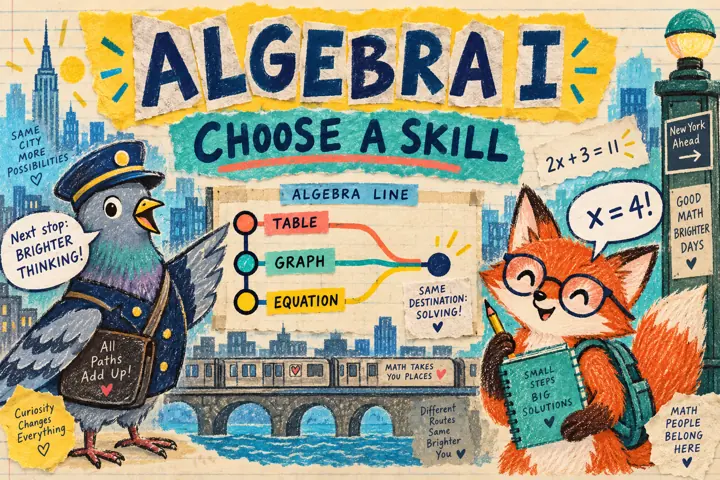
Choose an Algebra I topic below to open its existing worksheet directly. This New York collection has 64 topic links, organized from expressions and linear equations through functions, quadratics and data. Start with the skill your class is studying or the step that caused difficulty in recent work.
Quick answer: This page links 64 free Algebra I practice PDFs, sorted into 11 topics such as linear equations, functions, systems, factoring and quadratics, so you can practice Regents skills one topic at a time. For full past exams with answer keys, NYSED posts every recent Regents Examination in Algebra I with its scoring key and rating guide.
For example, review slope before writing linear equations, and review factoring before solving a quadratic by factoring. Use the topic titles to choose a starting point; your teacher’s course sequence and assignments help determine what to study next.
Use this directory for focused topic practice. For Regents preparation, connect that practice with the current NYSED guidance linked below.
Choose a worksheet topic
The 64 existing links are grouped by mathematical topic. Choose equations, inequalities, functions, systems, polynomials or data from the sections below. The collection includes broad algebra review; a topic’s presence here does not establish that it is tested on a particular Regents administration.
Use the resource that matches your learner’s current need. If a problem is difficult, identify whether the obstacle is the algebraic step, the representation or the wording, then return to the relevant lesson or prerequisite. Read the instructions in the selected resource and use any provided solutions or your teacher’s feedback to check your reasoning.
Algebra Foundations
- Variables, Expressions, and Properties, use letters for unknown values and the laws that govern them
- Order of Operations and Evaluating Expressions, PEMDAS in action, what to do first, second, and last
- Simplifying Algebraic Expressions, combine like terms and distribute to tidy any expression
- Introduction to Equations and Solutions, what it means for a value to ‘solve’ an equation
- Personal Financial Literacy, real-money algebra: interest, discount, markup, tax
Solving Linear Equations
- Solving One-Step Equations, undo one operation to isolate the variable
- Solving Two-Step Equations, two careful moves, in the right order
- Solving Multi-Step Equations, distribute, combine, then isolate, a full solve
- Equations with Variables on Both Sides, collect like terms on one side first
- Literal Equations and Formulas, solve a formula for a different letter
Inequalities and Absolute Value
- Solving One-Step Inequalities, one move, with one new rule for negatives
- Solving Multi-Step Inequalities, solve like an equation; reverse the inequality when multiplying or dividing by a negative
- Compound Inequalities, AND vs. OR, and how to graph each
- Absolute Value Equations and Inequalities, split into two cases and read ‘and’ vs ‘or’ correctly
Functions and Sequences
- Relations and Functions, every input gets exactly one output, and how to check
- Function Notation and Evaluating Functions, read \(f(x)\) and plug in to evaluate
- Domain and Range, the inputs you may use and the outputs you get back
- Graphing Functions and Transformations, shift, stretch, and flip a parent graph
- Arithmetic Sequences as Linear Functions, add the same step each time, a line in disguise
- Geometric Sequences, multiply by the same ratio each time
- Graphing Square Root, Cube Root, and Piecewise Functions, graph nonlinear parent functions and split rules
- Comparing Functions, compare functions given as equations, tables, and graphs
- Combining Functions, add, subtract, multiply, and divide functions
- Inverse Functions, swap input and output, then solve for \(y\)
Linear Functions and Graphs
- Slope and Rate of Change, rise over run, a real-world rate of change
- Slope-Intercept Form, \(y = mx + b\), read slope and intercept right off it
- Point-Slope Form, build a line from one point and a slope
- Standard Form of a Linear Equation, \(Ax + By = C\), and when it’s most useful
- Writing Linear Equations from Graphs and Tables, turn a graph or a table into an equation
- Parallel and Perpendicular Lines, compare slopes of nonvertical lines; vertical lines need separate treatment
- Direct and Inverse Variation, \(y = kx\) versus \(y = k/x\)
- Understanding Graphs as Solution Sets, every point on the line satisfies the equation
Systems of Equations and Inequalities
- Solving Systems by Graphing, two lines, one shared point
- Solving Systems by Substitution, solve one equation for a variable, then substitute
- Solving Systems by Elimination, add or subtract the equations to cancel a variable
- Applications of Systems of Equations, two unknowns, two equations, one word problem
- Systems of Linear Inequalities, shade two regions and find where they overlap
- Solving Linear-Quadratic Systems, find where a line crosses a parabola
Exponents and Polynomials
- Properties of Exponents, product, quotient, power, zero, and negative-exponent rules
- Adding and Subtracting Polynomials, combine like terms in higher-degree expressions
- Multiplying Polynomials, FOIL and the box method, when each one helps
- Special Products of Polynomials, perfect squares and difference-of-squares patterns
- Rational and Irrational Numbers, tell a fraction-able number from one whose decimal never repeats
Factoring Polynomials
- Greatest Common Factor and GCF Factoring, pull out the biggest common piece first
- Factoring Trinomials: \(x^2 + bx + c\), two numbers that multiply to \(c\) and add to \(b\)
- Factoring Trinomials: \(ax^2 + bx + c\), the AC method and trial-and-error, side by side
- Factoring Special Products, spot difference of squares and perfect-square trinomials
Quadratic Functions
- Graphing Quadratic Functions, the parabola, its vertex, and the axis of symmetry
- Characteristics of Quadratic Functions, zeros, vertex, max/min, and end behavior
- Solving Quadratics by Factoring, set the product to zero, then each factor
- Solving Quadratics by Completing the Square, rewrite as \((x-h)^2 = k\) and take square roots
- The Quadratic Formula and the Discriminant, the formula every Algebra 1 student remembers, plus what the discriminant tells you
- Solving Quadratics by Square Roots, isolate the square, then take both roots
- Quadratic Applications and Modeling, real-world parabolas: projectiles, area, profit
Statistics and Probability
- Measures of Center and Spread, mean, median, range, and the feel of standard deviation
- Displaying Data: Histograms and Box Plots, two ways to picture a distribution
- Scatter Plots and Correlation, read clustering, outliers, and the direction of a trend
- Lines of Best Fit and Predictions, draw a trend line and predict the next value
- Probability and Counting Principles, count outcomes by multiplying and combine events
- Two-Way Frequency Tables, organize categorical data and read relative frequencies
Exponential Functions and Models
- Graphing Exponential Functions, the shape of \(y = ab^x\), growth or decay
- Exponential Growth and Decay, real-world doubling, half-life, and interest
- Comparing Linear, Quadratic, and Exponential Models, which model fits the pattern, and how to tell
- Interpreting Functions and Parameters, what every letter in the model actually means
Plan a focused practice session
Choose a short sequence rather than working down the entire directory. A useful starting sequence is simplifying expressions, solving equations, slope, then writing equations. For quadratic review, begin with multiplication and factoring before choosing a method for solving.
Ask the learner to explain one step aloud or in writing. For an equation, check the result by substitution; for a graph, check a plotted point against the equation. Adjust the amount of practice to what the learner can explain accurately.
Keep track of the skill that needs another attempt. An arithmetic error may call for a quick calculation check; a repeated sign or distribution error may call for reviewing the rule before trying another problem. Use your teacher’s feedback when deciding what comes next.
Connect practice to current Regents guidance
Use NYSED’s current Algebra I resources for Regents preparation. Its public page separates Next Generation mathematics resources from the older 2011 standards resources. Choose the materials that match your course and administration instead of assuming that every archived resource or worksheet list represents the current exam.
Pair topic practice with the current official guidance and reference materials. Worksheet practice can help isolate a skill, while assessment preparation also involves reading questions carefully, connecting representations and explaining reasoning. This directory does not replace the official guidance or establish complete exam coverage.
Choose the next useful skill
After a practice session, record one skill you can now explain and one to revisit. Return to this directory for the next useful topic, and use the public Algebra I hub for related lessons and study resources.
Compare an optional study bundle
If you want an additional study-book option, compare the current public bundle listing and available preview with your course needs. Check the included titles and format before choosing; a paid book is optional for using the free worksheet links.
View the New York Regents Algebra I preparation bundle.
Related public study resources
Continue at the Algebra I study hub. For official preparation information, use NYSED’s Algebra I resources and its Next Generation Algebra I reference-sheet page.
Algebra I Regents Exam at a Glance
Since June 2024, the Regents Examination in Algebra I has been based on the New York State Next Generation Mathematics Learning Standards. Here is how the exam is built, according to the NYSED Algebra I Educator Guide.
| Part | Questions | Credits each | Total credits |
|---|---|---|---|
| Part I (multiple choice) | 24 | 2 | 48 |
| Part II (constructed response) | 6 | 2 | 12 |
| Part III (constructed response) | 4 | 4 | 16 |
| Part IV (constructed response) | 1 | 6 | 6 |
| Total | 35 | 82 |
- Time: 3 hours.
- Calculator: Every student must have a graphing calculator for the whole exam. Calculators that do symbolic algebra are not allowed.
- Reference sheet: A reference sheet comes at the end of the test booklet. Practice with the printable Next Generation Algebra I Reference Sheet from NYSED so you know what is on it.
How to Pair Topic Worksheets With Full Practice Exams
- Take one full past exam first. NYSED posts recent Algebra I Regents exams with scoring keys and rating guides. Time yourself for 3 hours and use your graphing calculator.
- Score it and list your misses by topic. For example, two missed factoring questions and one missed system of equations.
- Practice those topics here. Open the matching group above and work through it until the mistakes stop.
- Take another past exam. Compare your raw score using that exam’s conversion chart, then repeat the cycle.
Parts II to IV give partial credit, so always show your work, label graphs, and write the answer clearly.
Frequently Asked Questions
Where can I find free Algebra 1 Regents practice tests with answers?
NYSED’s Regents exam site posts recent Algebra I exams as free PDFs, each with a scoring key, a rating guide that shows how open-response questions are graded, model responses, and a conversion chart for turning raw credits into a scale score. Use them for full timed practice, and the topic PDFs on this page for targeted review.
How many questions are on the Algebra 1 Regents?
The Next Generation Algebra I Regents has 35 questions worth 82 credits. Part I has 24 multiple-choice questions worth 2 credits each. Parts II, III and IV have 6, 4 and 1 constructed-response questions worth 2, 4 and 6 credits each.
Do you need a graphing calculator for the Algebra 1 Regents?
Yes. NYSED requires every student to have a graphing calculator for the entire exam. Calculators that can manipulate symbols (computer algebra systems) are not allowed. Practice with the same calculator you will use on test day so graphing and regression feel routine.
Is there a reference sheet on the Algebra 1 Regents?
Yes. A reference sheet is printed at the end of the test booklet. It lists formulas and facts you need to apply but not memorize. NYSED also offers a printable copy of the Next Generation Algebra I Reference Sheet, so you can practice with it.
How long is the Algebra 1 Regents exam?
Students have three hours. You cannot leave before the official admission deadline, even if you finish early, so plan to use the extra time to check your Part II to IV answers and make sure your work is shown. Pace yourself through Part I.

Related to This Article
More math articles
- Free Grade 3 Math Worksheet Library for Georgia (Milestones): 49 Printable Skill Pages
- Surface Defects, Rust, and Finish Preparation
- The Slope of The Slope: Second Derivatives
- The Best Grade 5 ELA Practice Tests for Montana Students
- 6th Grade Georgia Milestones Assessment System Math FREE Sample Practice Questions
- All You Need To Know About Parametric Equations And How To Differentiate Them
- 4th Grade FSA Math FREE Sample Practice Questions
- Newton’s Method Calculator (Free, with Iteration Table)
- Equipment-Area Safety and Preparation
- Shop Troubleshooting: Stop, Inspect, Then Decide










What people say about "Algebra 1 Regents Practice PDFs by Topic (Free, NY)"?
No one replied yet.