Weight Measurement for 4th Grade
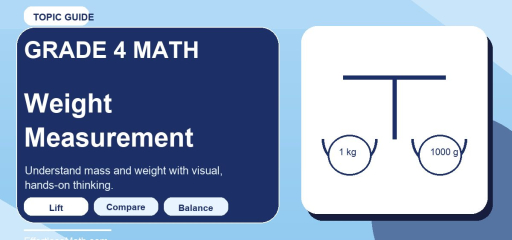
Weight Measurement for 4th Grade: this Effortless Math guide explains the topic in plain language, shows how it works through solved examples, and gives you free practice to try immediately, so the idea sticks instead of staying abstract.
Weight and mass problems help fourth graders compare everyday quantities and convert between common measurement units.
This lesson covers converting units of weight/mass for fourth-grade math. Use the examples and practice below to build confidence and skill.
Key Ideas to Remember
- Choose the correct unit before you start solving so the answer fits the situation.
- Convert measurements before comparing or combining them when the units do not match.
- Keep the unit label with the final answer to avoid confusion.
Detailed Explanation
Customary weight: ounces (oz), pounds (lb). 16 oz = 1 lb. Metric mass: grams (g), kilograms (kg). 1,000 g = 1 kg. Convert by multiplying or dividing.
Worked Example
Problem: How many ounces in 2 pounds?
- Step 1: Apply the concept from the lesson above.
- Step 2: Carry out the operation or reasoning.
Answer: 2 lb × 16 oz/lb = 32 oz.
Common Mistakes
Students usually improve faster in weight measurement when they slow down and watch for a few repeated mistakes. These are the ones worth checking first:
- Comparing measurements that are still written in different units.
- Choosing a unit that is too large or too small for the object being measured.
- Leaving the unit off the final answer.
Practice Strategy
A short but consistent review routine helps students build confidence with weight measurement without getting overwhelmed.
- Estimate the answer first, then measure or convert to check the estimate.
- Practice one comparison problem and one unit-conversion problem.
- Keep a short list of benchmark measurements to build intuition.
Watch Another Example
Use a second example video to hear the steps explained in a different way and reinforce the same skill from another angle.
Frequently Asked Questions
What is the first step in weight measurement problems?
Identify the unit and decide whether the object or quantity is best described with that unit. This prevents many avoidable mistakes.
Why do conversion problems feel tricky?
Students often understand the numbers but forget to convert to the same unit before comparing or combining them.
How can students check their answer?
Think about whether the final measurement is reasonable for the object and whether the unit label fits the situation.
Keep Practicing
After finishing this lesson on weight measurement, spend a few minutes on mixed review so the skill stays connected to the rest of Grade 4 math.
Need more Grade 4 review? Explore the Grade 4 Mathematics Worksheets hub for extra guided practice, review sets, and printable support.

Related to This Article
More math articles
- How the Supreme Court Chooses and Decides Cases
- Manual Cleaning: Disassembly, Sinks, and Aerosol Control
- Build a Word, Then Check It Against the Whole Word
- FREE CBEST Math Practice Test
- Plot, Conflict, and Resolution
- Using Context Clues
- SAT Math Subject Level 1 Calculator Tips and Hints
- Graphing Absolute Value Functions: Vertex, Points, and Intercepts
- Complete Guide to Understanding Deductive Reasoning: Principles and Applications
- Forces and Newton’s Laws




What people say about "Weight Measurement for 4th Grade"?
No one replied yet.