Stop-Loss and Stop-Win Rules: Math vs. Psychology
Walk through any casino floor on a Saturday night and you will hear the same advice traded between strangers: “Set a stop-loss. Quit when you are up.” It sounds like discipline borrowed from Wall Street, and in a way it is. But the math of a stop loss casino rule is not at all what most players think. It does not change your expected loss per spin, it does not give the house any less of an edge, and it does not turn a negative-expectation game into a positive one. What it actually does is reshape the distribution of how your sessions end, which is a real, useful thing, just not the thing most people are selling.
What a Stop-Loss and Stop-Win Actually Are
A stop-loss is a pre-committed quit point on the downside: a dollar amount that, once your bankroll drops to it, ends the session. A stop-win is the mirror image on the upside: a profit number that, once hit, ends the session. Both are session-level rules layered on top of whatever game you are playing. They do not change the bet, the odds, or the payout. They only change when you stand up and leave the table.
The framing matters. A stop-loss is not a “risk management strategy” in the trading sense, because a casino bet has no spread you can work and no edge you are protecting. It is a behavioral constraint, a contract you make with yourself before the dopamine and the cocktails get involved. That is its real job, and judged on those terms it can be very valuable. Judged as a math trick, it falls apart fast.
Why Expected Value Does Not Move
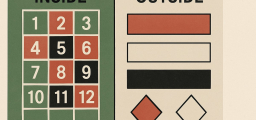
Here is the part that frustrates people the most. Take a $5 bet on red at a European roulette wheel. Red has 18 winning slots out of 37, so each spin you have an 18/37 chance of winning $5 and a 19/37 chance of losing $5. Your expected value per spin is:

EV = $5 × (18/37) − $5 × (19/37) = −$5/37 ≈ −$0.135.
Now suppose you announce a stop-loss at −$100 and a stop-win at +$50. Does spin number 37 in your session somehow know that you have a stop rule? Of course not. Conditional on you still being seated, every future spin still has the same −$0.135 expected value. The casino’s edge is a property of the wager, not of your psychology. Across 200 spins, your expected loss is 200 × $0.135 ≈ $27, whether or not you have ever heard the phrase “stop-loss.”
Stopping rules are what statisticians call optional stopping. For a fair game (martingale), no stopping rule can change the expected ending bankroll. That is the optional stopping theorem in plain English. For a negatively-biased game like roulette, stopping rules cannot fix the bias either; they can only choose which slices of the random walk you keep.
What Does Move: Variance and the Shape of Outcomes
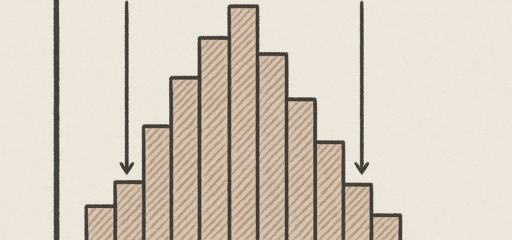
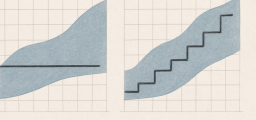
So if EV does not budge, what are stop rules actually doing? They are slicing the distribution of session outcomes. Without stops, your ending bankroll after a fixed number of spins is roughly bell-shaped around a slightly negative mean. With stops, you truncate that distribution: most sessions end at one of the two stop points, and the middle of the bell hollows out.
This is the part players feel and misinterpret. With a low stop-win and a high stop-loss, you end more sessions in the green. That feels like winning. It is also, mathematically, a setup for a long left tail: the rare losing sessions are much bigger than the typical winning ones. The casino is not lying when it lets you walk out with $50. It knows your next visit, or your other visits, are paying for it.
“Win Small, Lose Big”, The Asymmetric Tail You Create
Set a stop-win at +$50 and a stop-loss at −$100, betting $5 on red. The most common session outcomes are now: cash out +$50, or bust to −$100. With a near-even-money bet, the hitting probabilities are close to the ratio of the opposite distances. Because the game has a small house edge, the math leans slightly more toward hitting the loss first, but the win side is still common enough to feel routine.
Here is the asymmetry. You collect a stream of small +$50 wins and feel disciplined. Then once every few visits you eat a full −$100. Your bookkeeping reads: “I win a lot, but when I lose, I really lose.” That is not bad luck. That is the geometry of your own stop rule. You built a payoff that pays you a little, often, and punishes you a lot, occasionally. Casinos do not need to do anything to you; you did it to yourself with the rule.
- Stop rules do not change per-spin expected value. The house edge is in the bet, not the schedule.
- An asymmetric rule (small stop-win, big stop-loss) increases the frequency of winning sessions and the size of losing ones.
- The mirror rule (big stop-win, small stop-loss) decreases your winning-session rate but caps each loss tightly.
- Across many sessions, your total expected loss is roughly the per-spin EV times the total spins, regardless of the rule.
- The real value of a stop-loss is behavioral, not mathematical.
Stop-Loss as Time-on-Device Control
There is one mechanical thing a stop-loss reliably does: it bounds your exposure. If you cannot lose more than $100 in a sitting, then you cannot lose more than $100 in a sitting. That sounds tautological, but it is the entire game. Casino losses are roughly proportional to time and bet size, because the house edge grinds at a fixed rate per wager. A stop-loss is, more than anything else, a clock.
This is also why a stop-win can backfire if it is too tight. Cashing out at +$50 only to sit back down an hour later resets the clock without resetting the bankroll. You are still feeding the same negative-EV machine; you just took an intermission. If the goal is to limit lifetime damage, the variable that matters is total handle (total amount wagered), and the cleanest way to cap it is to cap total time and total bet size, not to chase profit targets.
The Real Enemy: Loss Chasing
Behavioral economics has been documenting one casino fact for half a century: people hate locking in losses. Daniel Kahneman and Amos Tversky’s prospect theory predicts it; every floor manager has watched it happen. When a player is down, the next bet feels less like a fresh wager and more like a chance to “get even.” Bet sizes creep up. Sessions stretch past closing time. A planned $40 night becomes a $400 night.

A pre-committed stop-loss is a defense against your future self, the one who will, in the moment, find a very persuasive reason to ignore it. The math isn’t the point, the point is that you took the decision out of the hands of the person who is about to be tilted, tired, and three drinks in. If you are going to gamble at all, that is the genuinely useful thing a stop-loss does. If you find yourself routinely “renegotiating” your stop-loss mid-session, that is a flag worth taking seriously. Resources like the National Council on Problem Gambling’s help and treatment directory exist for exactly this pattern.
A Concrete Session Simulation
Let’s make this numerical. A player sits down with a $200 bankroll, bets $5 per spin on red at European roulette, and plans for up to 200 spins. We simulate 10,000 such sessions in two regimes: no stop rules (just play 200 spins), and a stop-loss at −$100 with a stop-win at +$50. Per-spin EV is −$0.135, so the unrestricted regime expects to lose about $27 over 200 spins. Per 100 spins it works out to about a $13.50 average loss, the number quoted in the standard “house edge times handle” calculation.
The aggregate expected loss across all sessions is essentially identical between the two regimes (the stop sessions are a little shorter, so the total loss is a touch smaller, but it tracks total spins almost exactly). What differs is the shape.
| Session ending bankroll change | No stop rules (10,000 sessions, 200 spins each) | With stop-loss −$100, stop-win +$50 |
|---|---|---|
| −$100 or worse | 16.9% | 52.3% |
| −$99 to −$50 | 23.2% | 0.2% |
| −$49 to −$1 | 21.9% | 0.1% |
| Exactly $0 | 5.5% | 0.0% |
| +$1 to +$49 | 17.4% | 0.1% |
| +$50 to +$99 | 10.9% | 47.3% |
| +$100 or better | 4.2% | 0.0% |
| Average session result | −$27.15 | −$28.73 |
| Sessions ending in profit | 32.5% | 47.3% |
Stare at that table for a minute. The stop-rule player ends 47% of sessions a winner versus 33% for the no-rules player, a meaningful jump in win frequency. The average outcome, though, is essentially unchanged (a hair worse, in fact, because losing sessions tend to involve more spins before they bust). And the modal loss is now exactly −$100, occurring in over half of all sessions. The bell curve became a barbell.
This is the asymmetric tail in numbers. The “more wins” feeling is real; it is also paid for by the fact that when you lose, you lose the maximum allowed every time. Spread over many trips, the casino still collects roughly the same total, about $27 per 200-spin session on average, it just collects it in fewer, larger increments.
What Stop Rules Are Good For (and What They Are Not)
Stop rules are good at: (1) hard-bounding the damage of any single session; (2) giving your future self a rule to follow when willpower is depleted; (3) shortening exposure to grinding house-edge losses; (4) creating a natural break point that lets you assess whether you want to keep playing at all. None of these are math wins. They are behavioral wins, and behavioral wins are the only kind available at a negative-EV game.
Stop rules are not good at: changing the house edge, creating a long-run profit, or telling you that you “beat” anything. If a system promises that a particular combination of stop-loss and stop-win can flip a negative-EV game positive, walk away. The optional stopping theorem is older than any of us and is not going to lose to a YouTube video. For careful breakdowns of the actual edges in every common casino game, the reference tables at Wizard of Odds are the standard public resource.
FAQ
Q: Does a stop-win lock in profit?
It locks in that session’s profit. Across many sessions it does not produce a long-run profit, because future sessions still face the same house edge and you will, on average, spend at least some of that profit feeding them.
Q: Should my stop-loss be bigger than my stop-win, or smaller?
That is a choice about variance, not about expected value. A bigger stop-loss and smaller stop-win means more frequent winning sessions and rarer, larger losses. The reverse means fewer winning sessions but each loss is capped tightly. Neither beats the house; they just feel different.
Q: What is a reasonable stop-loss in dollars?
A reasonable rule: pick an amount you’d be okay losing for an evening’s entertainment, set before you sit down. A common rule of thumb is somewhere between half and all of a discretionary entertainment budget for the trip. If a number feels too painful to lose, that is the number to use as your stop-loss.
Q: If stops do not change EV, why do casinos seem fine with them?
Because they do not change EV. The house is paid by the edge times the total amount wagered. As long as you keep coming back, your total wagered grows, and the math reasserts itself. Sessions are a slicing convention; the casino is patient about how the slices add up.
Q: Are there any games where stop rules matter more?
High-variance games (slots, single-number roulette, big-multiplier video poker) produce skewed per-spin outcomes, so stop rules can interact with the natural distribution in less obvious ways. The core point still holds: no stop schedule on a negative-EV game produces positive EV. Even-money games like red/black just make the math easy to see. If you want to sharpen the underlying probability intuition, the explainers at Effortless Math are a good plain-language starting point.
Gambling outcomes are uncertain; no strategy guarantees profit.

Related to This Article
More math articles
- Grade 5 Math Flashcards (Free Online: Formulas, Terms & Concepts)
- Full-Length GED Math Practice Test
- 10 PSAT Math Practice Questions with Answers
- CLEP U.S. History I 050: Nationalism, the American System, and the Era of Good Feelings
- CPA REG Blueprint and Tax-Law Timing: Check Before You Study (2027 Prep)
- Government corporations
- 4th Grade PSSA Math Worksheets: FREE & Printable
- Rules of Exponents
- The Best Grade 6 ELA Practice Tests for Missouri Students
- CLEP U.S. History I 056: Roads, Canals, Steamboats, Railroads, and Telegraph






What people say about "Stop-Loss and Stop-Win Rules: Math vs. Psychology - Effortless Math"?
No one replied yet.