How to Decode the Mysteries: A Comprehensive Solution Guide for “FTCE Math for Beginners”
The FTCE General Knowledge Math solution manual works every practice question in the book step by step. Below: how the manual is organized, a three-phase study structure, how topics are ordered by how often they appear and how hard they are, and how to use it alongside the exercises.
This Solution Manual is a cornucopia of insightful solutions, offering thorough answers to all practice questions in the guide, complete with a comprehensive answer key and step-by-step explanations. These are designed to build your comprehension and boost your confidence. Let’s explore this indispensable tool, crafted to simplify your journey to FTCE Math mastery!
Begin Your FTCE Math Adventure!
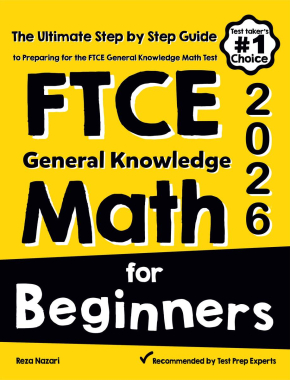
Feeling daunted by the FTCE Math test? Say goodbye to your anxieties! Our “FTCE Math for Beginners” book is crafted to streamline and enrich your study experience. More than just a textbook, it’s a detailed pathway to your FTCE Math triumph in 2026.
The Absolute Best Book to Ace the FTCE Math Test
Maximizing FTCE Math Preparation Through This Manual
The FTCE Mathematics subtest evaluates your mastery of high school mathematics content and your ability to explain concepts clearly, essential skills for teaching. This manual uniquely emphasizes both passing the examination and developing the pedagogical clarity required for effective classroom instruction. Every solution includes not just calculations but the underlying reasoning and explanation approaches that help students understand why a method works.
Three-Phase Study Structure for Success
Phase One covers Weeks 1-3 and focuses on topic-by-topic review. Begin by taking a diagnostic practice test to identify your weakest content areas. Rather than studying every topic equally, concentrate effort on identified weaknesses. For each topic: read the full concept explanation, study 2-3 completely worked examples, solve 5 practice problems, check your solutions against the manual’s explanations, and journal any errors or conceptual gaps. This focused approach maximizes your preparation efficiency.
Phase Two encompasses Weeks 4-5 and emphasizes integrated problem-solving. The FTCE frequently combines multiple topics within single questions. Percent problems might require setting up equations. Geometry questions might involve solving systems of equations. Statistics problems might require probability calculations. Study mixed-topic problem sets that reflect test structure. This integration phase reveals how concepts interconnect and prepares you for realistic test conditions.
Phase Three spans the final week and includes examination simulation. Take 2-3 full-length practice tests under timed conditions matching actual test parameters. After each test, thoroughly review every question, both correct and incorrect answers. Understanding why a correct answer works reinforces your knowledge. Understanding why an incorrect approach fails prevents future mistakes.
Content Organization by Frequency and Difficulty
Algebra appears most frequently, covering linear equations and systems (15% of exam), quadratic equations (12%), and functions (14%). Allocate substantial study time to these areas. Geometry accounts for approximately 18% of the exam, covering area, volume, angle relationships, similarity, and geometric proofs. Statistics and probability comprise 13%, focusing on distributions, hypothesis testing, and probability rules. Precalculus topics including trigonometry, logarithms, and sequences account for remaining questions. Allocate your limited study time proportionally to these frequencies for maximum point gain.
The Philosophy Behind Solution Explanations
Every solution in this manual demonstrates not just the mathematical steps but the reasoning underlying each step. When solving 2x – 3 = 7, we explain that we add 3 to both sides because we need to isolate the term containing x, and we specifically add 3 because negative three’s additive inverse is positive three. This level of explanation serves dual purposes: it demonstrates the logical thinking required to pass the examination and models the clear explanations you’ll need when teaching high school students. Your success requires understanding not just how to get the right answer, but why each step is necessary.
Recommended Study Strategies
The Solution Backwards method has you work backward from the given answer to the original problem. This reverse engineering reveals problem structure and reinforces understanding. The Teaching Yourself method requires you to explain each concept aloud as if instructing a high school class. If you cannot explain it clearly, you don’t fully understand it. The Error Analysis method identifies exactly where your reasoning diverged from correct solutions. Did you misread the problem? Make a computational error? Misapply a procedure? Different error types require different remediation. The Real-World Connection method links mathematical concepts to teaching contexts and everyday applications, strengthening both understanding and retention.
Use our ultimate FTCE math formula cheat sheet alongside this manual for quick formula reference and verification during practice and review sessions.
Maximizing FTCE Math Preparation Through This Manual
The FTCE Mathematics subtest evaluates your mastery of high school mathematics content and your ability to explain concepts clearly, essential skills for teaching. This manual uniquely emphasizes both passing the examination and developing the pedagogical clarity required for effective classroom instruction. Every solution includes not just calculations but the underlying reasoning and explanation approaches that help students understand why a method works.
Three-Phase Study Structure for Success
Phase One covers Weeks 1-3 and focuses on topic-by-topic review. Begin by taking a diagnostic practice test to identify your weakest content areas. Rather than studying every topic equally, concentrate effort on identified weaknesses. For each topic: read the full concept explanation, study 2-3 completely worked examples, solve 5 practice problems, check your solutions against the manual’s explanations, and journal any errors or conceptual gaps. This focused approach maximizes your preparation efficiency.
Phase Two encompasses Weeks 4-5 and emphasizes integrated problem-solving. The FTCE frequently combines multiple topics within single questions. Percent problems might require setting up equations. Geometry questions might involve solving systems of equations. Statistics problems might require probability calculations. Study mixed-topic problem sets that reflect test structure. This integration phase reveals how concepts interconnect and prepares you for realistic test conditions.
Phase Three spans the final week and includes examination simulation. Take 2-3 full-length practice tests under timed conditions matching actual test parameters. After each test, thoroughly review every question, both correct and incorrect answers. Understanding why a correct answer works reinforces your knowledge. Understanding why an incorrect approach fails prevents future mistakes.
Content Organization by Frequency and Difficulty
Algebra appears most frequently, covering linear equations and systems (15% of exam), quadratic equations (12%), and functions (14%). Allocate substantial study time to these areas. Geometry accounts for approximately 18% of the exam, covering area, volume, angle relationships, similarity, and geometric proofs. Statistics and probability comprise 13%, focusing on distributions, hypothesis testing, and probability rules. Precalculus topics including trigonometry, logarithms, and sequences account for remaining questions. Allocate your limited study time proportionally to these frequencies for maximum point gain.
The Philosophy Behind Solution Explanations
Every solution in this manual demonstrates not just the mathematical steps but the reasoning underlying each step. When solving 2x – 3 = 7, we explain that we add 3 to both sides because we need to isolate the term containing x, and we specifically add 3 because negative three’s additive inverse is positive three. This level of explanation serves dual purposes: it demonstrates the logical thinking required to pass the examination and models the clear explanations you’ll need when teaching high school students. Your success requires understanding not just how to get the right answer, but why each step is necessary.
Recommended Study Strategies
The Solution Backwards method has you work backward from the given answer to the original problem. This reverse engineering reveals problem structure and reinforces understanding. The Teaching Yourself method requires you to explain each concept aloud as if instructing a high school class. If you cannot explain it clearly, you don’t fully understand it. The Error Analysis method identifies exactly where your reasoning diverged from correct solutions. Did you misread the problem? Make a computational error? Misapply a procedure? Different error types require different remediation. The Real-World Connection method links mathematical concepts to teaching contexts and everyday applications, strengthening both understanding and retention.
Use our ultimate FTCE math formula cheat sheet alongside this manual for quick formula reference and verification during practice and review sessions.

Related to This Article
More math articles
- Consistency: Avoiding Shifts in Person, Number, Tense, Voice, and Mood
- Top 10 CBEST Prep Books (Our 2026 Favorite Picks)
- Chapter 38: Political Participation
- Free Grade 5 English Worksheets for Utah Students
- North Dakota NDSA Grade 4 Math Free Worksheets: Free Printable Grade 4 Math PDFs, No Signup
- How to Modeling Real-World Situations Using Functions
- Seeing Society Sociologically
- The Normal Distribution and the 68-95-99.7 Rule: 2026 Guide
- The Sociological Imagination and the Origins of Sociology
- Number Properties Puzzle – Challenge 10









What people say about "FTCE Math for Beginners: Solution Guide"?
No one replied yet.