Gold Coins vs. Sweeps Coins: The Dual-Currency EV Worked Out
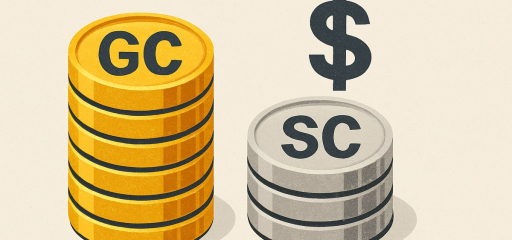
Sweepstakes casinos look strange on first contact. You pay for a stack of Gold Coins that cannot be cashed out, and the site hands you a separate pile of Sweeps Coins that supposedly can be. The marketing copy leans hard on the word “free,” and the legal copy leans hard on the words “no purchase necessary.” Somewhere between those two phrases sits the actual expected value of what you are buying. The trick is to stop treating the Gold Coins and the Sweeps Coins as one bundle and start treating them as two very different things glued together by a price tag.
How the Dual-Currency Model Actually Works
Every sweepstakes casino I have looked at runs on the same skeleton. There is one currency you can buy and play with but never redeem, and a second currency you cannot buy directly but can, in principle, redeem for cash or prizes. The first is usually branded Gold Coins (GC), and the second is usually branded Sweeps Coins (SC), though some sites use different names like Sweepstakes Cash or Promotional Entries. When you click a $9.99 button on the storefront, you are not buying SC. You are buying GC. The SC arrives in the same transaction, but it is presented as a bonus attached to the purchase, not as the thing you paid for.
That distinction isn’t cosmetic. It’s the entire load-bearing wall of the business model. The GC has no redemption value, so it cannot be a wager in the legal sense most state gambling statutes use. The SC has redemption value, but you did not pay for it, so it is not consideration in the legal sense those same statutes use. Each coin solves a different problem, and the dual-currency setup is what lets the operator offer real-money-feeling play in jurisdictions that have not greenlit online casinos.
The Legal Logic Behind the Split
Most sweepstakes promotions in the United States have to satisfy a fairly old framework: a promotion is generally treated as a lottery, and therefore restricted, if it involves prize, chance, and consideration all at once. Knock out any one of those three and you usually escape the lottery bucket. Sweepstakes casinos try to knock out consideration. The Gold Coins you buy are framed as the product. The Sweeps Coins are framed as a free promotional entry that happens to ride along.

You can read the general background on this framework in the Cornell Law overview of sweepstakes law. The short version is that operators want SC to look like a sweepstakes entry, not a casino chip, and they want GC to look like a product, not a wager. Whether a particular state attorney general agrees is a different question, and several have pushed back. But that is the structure the dual-currency model is trying to build.
The AMOE Path: Why “No Purchase Necessary” Has to Be Real
Because the legal cover depends on SC being a free promotional entry, the operator has to offer an alternative method of entry, usually shortened to AMOE. The most common one is a mail-in request. You write a postcard, follow the exact instructions in the terms, send it to the listed address, and receive a small allotment of SC in return. Some sites also offer social media giveaways, daily login drops, or short web forms as additional free paths.
The AMOE path is the reason any of the EV math below even makes sense. If the only way to get SC were to buy a GC pack, the SC would not be a free entry, and the sweepstakes framing would collapse. The mail-in path has to exist, has to be honored, and in practice has to be usable without absurd friction. It is rarely as convenient as the storefront. It is also rarely as generous per unit of effort. But it is the thing that keeps the dual-currency model standing.
A $9.99 Gold Coin Package, Step by Step
Take the classic intro offer: $9.99 for 50,000 GC plus 25 SC. You pay ten dollars, you get a large stack of play-money coins, and you get 25 SC on the side. At most sites, SC redeems at roughly 1 SC to 1 dollar in cash or prize value, subject to minimums and verification. So the 25 SC has a face value of about $25.
It is tempting to stop there and call this a $15 free lunch. It is not. There are at least three layers between that 25 SC and your bank account. First, you usually have to play through the SC at least once before it is redeemable; that is the playthrough or wagering requirement. Second, the games you play with SC have their own house edge, so the post-playthrough balance is almost never the full $25. Third, the redemption itself has minimums (often $50 or $100) and identity verification before any payout goes out.
The Real EV After One Playthrough
Assume the simplest case: a 1x wagering requirement and an SC-eligible slot running at a 96% return-to-player. You start with 25 SC. You wager it once. The expected remaining balance after that single cycle is roughly 25 multiplied by 0.96, which is 24 SC. That is your expected redeemable balance, ignoring variance.
Now compare to what you paid. You spent $9.99 on the package. If the SC bonus genuinely cost you nothing extra (because the same SC is available for free through the AMOE path), then the GC pack is the product and the SC is a side bonus that improves the deal. The math then looks like: expected SC redeemable value $24, minus the $9.99 you spent, gives an apparent net of about $14.01 in your favor. That number isn’t a guarantee. It’s the expected value of the redeemable side, treating the GC as a separately priced product you wanted anyway.
The catch is that this clean number depends on a 1x playthrough and one round of play. Real terms are usually stricter, and most players do not stop at one wager. Each additional wager of the same SC chips another 4% off the expected balance, on average. Push the same 25 SC through five rounds of play at 96% RTP and the expected balance drops to about 25 multiplied by 0.96 to the fifth power, which is roughly 20.4 SC, not 24.
Full Math on Common GC Promo Packages
To make the comparison concrete, here are several representative GC packages and their implied SC value at a 1:1 redemption rate. The exact numbers vary by site and by promotion week, but the pattern is consistent.

| Package Price | Gold Coins | Bonus SC | Face SC Value | Expected SC after 1x at 96% RTP | Apparent Net vs Price |
|---|---|---|---|---|---|
| $4.99 | 20,000 | 10 | $10.00 | $9.60 | +$4.61 |
| $9.99 | 50,000 | 25 | $25.00 | $24.00 | +$14.01 |
| $19.99 | 120,000 | 60 | $60.00 | $57.60 | +$37.61 |
| $49.99 | 350,000 | 150 | $150.00 | $144.00 | +$94.01 |
| $99.99 | 800,000 | 320 | $320.00 | $307.20 | +$207.21 |
Two things to notice. First, larger packages usually offer a slightly higher SC-to-dollar ratio, which is the operator nudging you toward bigger boxes. Second, every “apparent net” in that table assumes you stop wagering the SC after meeting the playthrough. If you keep playing, the house edge keeps grinding against the balance.
What Erodes the EV in Practice
The clean numbers above hide the things that actually pull EV down for most players. The short list:
- Playthrough multipliers above 1x. Some promotions require 2x, 3x, or even higher SC wagering before redemption.
- Game-by-game RTP differences. Not every game on the site is 96%. Some sit closer to 92%.
- SC-ineligible games. A handful of titles only accept GC, narrowing where the SC can actually clear playthrough.
- Redemption minimums. A $50 floor means small SC balances cannot be cashed out until you accumulate more.
- Verification delays. First redemption usually requires ID checks that can take several days.
- Behavioral overrun. Most players keep wagering past the minimum playthrough, which compounds the house edge.
- Promotional drift. Bonus SC amounts on the same dollar package can change week to week.
The Role of Recurring Purchase Deals
Almost every sweepstakes site front-loads its best ratio on the first purchase. After that, recurring promos take over: daily login SC, refill specials, weekend boosters, leaderboards that pay in SC, and tiered loyalty programs. The ratios on these are tighter than the welcome offer, but they keep the dual-currency math attractive enough that a steady player can keep their SC balance moving.
The thing to watch with recurring deals is that they shift the framing. The welcome bundle reads as “buy GC, get a generous SC bonus.” Recurring deals often read as “buy GC, get a normal SC bonus, plus a chance at extra GC.” That extra GC is play money. It feels valuable, but it does not redeem. When you evaluate a recurring offer, mentally strip the GC down to zero value and ask whether the SC alone makes the deal worth it. If you want a refresher on framing problems like this, there is a longer write-up at Effortless Math that walks through how to read mixed-incentive offers without getting pulled around by the headline numbers.
There is also a quieter math problem inside recurring offers: the SC-to-dollar ratio tends to fall right as your tolerance for the site rises. The first purchase might give you roughly 2.5 SC per dollar spent on the $9.99 tier. The third or fourth refill, after the welcome window closes, can quietly drop to closer to 1 SC per dollar on comparable packages. Nothing about the storefront flags this. The dollar buttons look the same, the GC counts look generous, and the SC line is a smaller number printed in a smaller font. If you are tracking actual EV across a month of play, the ratio is the variable that matters, not the GC headline.
One last practical point. The dual-currency model is not stable across jurisdictions. Some states have already restricted or banned sweepstakes casinos, and the list changes. Before you treat any of the EV math above as actionable, confirm that the operator still serves your state, that the SC redemption path is still active in your account, and that the current promo page matches the ratios you used in your calculation. The math is only as good as the terms it sits on top of, and those terms are rewritten more often than the marketing pages let on.
Frequently Asked Questions
Are Gold Coins worth anything? Not in cash terms. Gold Coins are play-money chips that can only be used inside the site for entertainment play. They have no redemption value, by design, which is part of why the model exists in the first place.
Why does the site give me Sweeps Coins when I buy Gold Coins? Because the dual-currency model treats the GC as the product you bought and the SC as a separate, free promotional entry that happens to be delivered at the same time. The SC has to be available without purchase to keep the sweepstakes framing intact.
What is the actual expected value of a $9.99 package with 25 SC? Under a 1x playthrough at 96% RTP, the expected redeemable balance from the SC side is about $24. Compared to the $9.99 spent, that looks like a positive expected return on the bonus side, but it depends on actually stopping at the playthrough and clearing redemption requirements.
Can I really get Sweeps Coins for free by mail? Yes, that is what the AMOE path exists for. The amount per request is small, and the instructions are usually strict about format and frequency, but it is a working path. Sites that fail to honor it risk their entire sweepstakes framing.
Why does the EV shrink when I keep playing? Each additional wager runs against the house edge again. A 4% edge applied once leaves about 96% of the balance on average; applied five times in a row it leaves roughly 82%. The longer you play the same SC, the more the expected balance drifts down.
Gambling outcomes are uncertain; no strategy guarantees profit.

Related to This Article
More math articles
- Short run is not long run
- Top 10 PERT Math Prep Books (Our 2023 Favorite Picks)
- Vermont Algebra 1 Free Worksheets: Free Printable Algebra 1 PDF Worksheets with Worked Solutions
- Effective Strategies for Learning and Memorizing Math Formulas
- Praxis Core Math Worksheets: Free Printable PDFs
- How to Become a Better Math Problem Solver & Still Have Steady Nerves?
- Advanced Vocabulary Words: Strident to Theorize
- CLEP U.S. History I 087: Antebellum Urban Growth and Public Health
- Free Grade 6 English Worksheets for Virginia Students
- Limits: What Happens When a Function Approaches Infinity









What people say about "Gold Coins vs. Sweeps Coins: The Dual-Currency EV Worked Out - Effortless Math"?
No one replied yet.