Hyphens, Dashes, and Parentheses
Punctuation questions love the small marks. Most students can spot a missing period from across the room, but the first time a question asks whether a compound needs a hyphen—or whether a dash belongs where a comma sits—many freeze. The marks look similar, and few of us ever got a full lesson on them.
Here is the encouraging part: hyphens, dashes, and parentheses each have one main job. Once you can name the job, you can answer these questions in seconds.
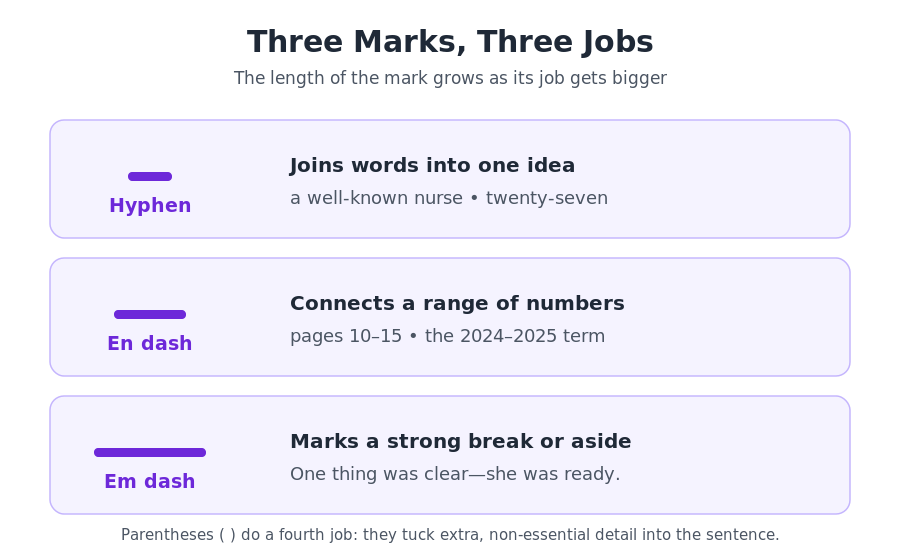
A hyphen (-) joins words so they work as a single idea, as in well-known or twenty-seven. A dash (—) is a longer mark that signals a strong break or sets off an aside. Parentheses ( ) enclose extra, non-essential information the sentence could live without. In short: hyphens connect, dashes interrupt, parentheses whisper.
What Does a Hyphen Do?
The hyphen’s specialty is the compound modifier: two or more words teaming up to describe a noun. When the team comes before the noun, hyphenate it: The clinic hired a well-organized assistant who keeps up-to-date records. When the same words follow the noun, the hyphen usually disappears: The records are up to date.
Hyphens also appear in spelled-out numbers from twenty-one through ninety-nine (thirty-four, sixty-two), in written-out fractions (two-thirds of the class), in family words such as mother-in-law, and after certain prefixes: self-esteem, ex-manager, mid-July.
Worked example. Wrong: It was a long term project. A reader stumbles for a moment—was the term long? Corrected: It was a long-term project. The hyphen shows that long and term describe the project together, as one idea.
When Should I Use a Dash Instead of a Hyphen?
Dashes come in two sizes, and neither one joins words.
The em dash (—) is the long one. Use a single em dash for a strong break, a punchline, or an afterthought: She checked the chart twice—then called the doctor anyway. Use a pair of em dashes to set off an interruption that deserves more attention than commas would give it: The medication—taken twice daily—reduced the swelling.
The en dash (–) is the medium-length one, and its everyday job is ranges: pages 12–20, the 2024–2025 school year, a 7–10 day recovery.
Worked example. Wrong: Read chapters 3-5 tonight uses a hyphen where a range belongs. Corrected: Read chapters 3–5 tonight. A reliable habit: joining is hyphen work; interrupting and ranging are dash work.
When Do Parentheses Make Sense?
Parentheses tuck in bonus material: a definition, a date, an abbreviation, or a quiet side comment. The patient’s blood pressure (BP) was normal. Florence Nightingale (1820–1910) reshaped modern nursing.
Two tests keep parentheses honest. First, the sentence must still read as complete when you lift the parenthetical out. Second, if the material inside feels essential, it does not belong in parentheses—promote it to the main sentence. One more detail: when a parenthetical sits inside a sentence, the period stays outside the closing mark. She passed the exam (on her first try).
Hyphen, Dash, or Parentheses: Which One Do I Need?
| Mark | Main job | Example |
|---|---|---|
| Hyphen (-) | Joins words into one idea | a well-known nurse; twenty-seven |
| En dash (–) | Connects a range of numbers or dates | pages 10–15; the 2024–2025 term |
| Em dash (—) | Marks a strong break or an aside | One thing was clear—she was ready. |
| Parentheses ( ) | Add non-essential extras | Her pulse (72 beats per minute) was steady. |
Watch: A Short Video Lesson
Khan Academy’s punctuation series has a short, friendly lesson on telling hyphens and dashes apart. It pairs well with the reading above:
A Quick Routine for Choosing the Right Mark
- Name what the mark is doing: joining words, showing a range, interrupting the sentence, or adding an extra.
- Joining two or more words to describe a noun? Use a hyphen—and check whether the compound comes before the noun.
- Connecting numbers or dates? Use an en dash.
- Breaking into the sentence for emphasis? Use an em dash: one for a break, a pair for an aside.
- Adding a detail the sentence can survive without? Use parentheses, then reread the sentence with the extra removed to be sure it still stands.
Practice
- Add the missing hyphens: “The hospital opened a state of the art lab.”
- Which mark completes the range: “Study pages 88 to 96” written with numerals only?
- Punctuate the strong break: “He knew the answer he had studied all week.”
- Fix this sentence: “My sister in law is a twenty seven year old nurse.”
- Rewrite with parentheses: “Her temperature 98.6 degrees was normal.”
- Is this correct? “The clinic (which opened in March) accepts walk-ins.”
Answers
- “The hospital opened a state-of-the-art lab.” The whole phrase describes the lab, so it hyphenates as one unit.
- An en dash: pages 88–96.
- “He knew the answer—he had studied all week.”
- “My sister-in-law is a twenty-seven-year-old nurse.”
- “Her temperature (98.6 degrees) was normal.” A pair of em dashes would also work for more emphasis.
- Yes. Remove the parenthetical and the sentence still reads as complete: “The clinic accepts walk-ins.”
Where This Fits in Your Prep
Hyphens and dashes are the last stop on the punctuation tour. To see the whole picture, review the comma rules that matter most, then semicolons, colons, and quotation marks, and how apostrophes show possession. It also helps to finish sentences strong with the capitalization rules. Every grammar and language topic is collected on our English and Language Usage practice hub.
Recommended Prep Books
These study guides and practice tests help you keep building momentum as you get ready:

Related to This Article
More math articles
- Mississippi MAAP Algebra 1 Free Worksheets: 72 Free Skill-by-Skill Algebra 1 PDFs with Answer Keys
- The Best Grade 5 Math Book for Minnesota Students
- Sentence Fragments
- Informal Work and Development Beyond Economic Growth
- FTCE General Knowledge Math Flashcards
- Intermediate scrutiny
- How to Graph the Cosecant Function?
- Heron’s Formula Calculator — Area from 3 Sides
- The Best HiSET Math Worksheets: FREE & Printable
- Free Printable Grade 2 Math Worksheets for Idaho






















What people say about "Hyphens, Dashes, and Parentheses: How to Use Each Mark"?
No one replied yet.