The Warren Court and the Rights Revolution
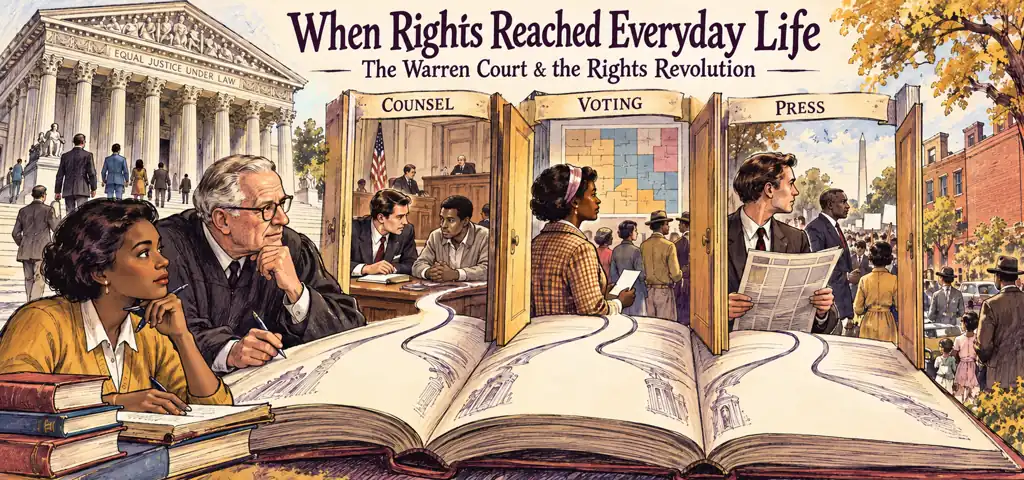
Chapter 13 of the CLEP History of the United States II study guide on Effortless Math covers The Warren Court and the Rights Revolution: the key terms, the core ideas, and worked examples showing how this topic is tested on the exam.
CLEP History of the United States II, Chapter 13
The rights revolution changed how federal guarantees reached the states
The Bill of Rights originally restrained the federal government. Through selective incorporation, the Supreme Court used the Fourteenth Amendment's Due Process Clause to apply particular guarantees against state and local governments. The process occurred case by case rather than through one ruling. Palko once declined to incorporate double jeopardy, while Benton v. Maryland later applied that protection to the states.
Criminal procedure rulings regulated police and courts
Mapp v. Ohio applied the exclusionary rule to evidence obtained through unconstitutional state searches. Gideon v. Wainwright required counsel for indigent defendants charged with serious crimes. Miranda v. Arizona required warnings before custodial interrogation so a suspect could understand the rights to silence and counsel. Each ruling addressed a different stage. Search, trial representation, and interrogation should not be collapsed into one generic "rights of the accused" answer.
Reapportionment turned population inequality into a constitutional issue
Baker v. Carr held that an apportionment challenge could be heard in federal court rather than dismissed as a political question. Reynolds v. Sims required substantially equal population in state legislative districts. The result strengthened growing urban and suburban populations whose representation had lagged behind demographic change. Gomillion v. Lightfoot addressed a different abuse: Alabama had redrawn Tuskegee's boundary to remove nearly all Black voters.
The Court protected criticism of public officials
In New York Times v. Sullivan, the Court held that a public official seeking damages for defamatory statements about official conduct must prove "actual malice," meaning knowledge of falsity or reckless disregard for truth. The rule did not excuse every false statement. It protected breathing space for criticism during the civil-rights struggle, when southern officials used libel suits against national reporting and movement advertising.
Religion cases distinguished government action from private choice
Engel v. Vitale struck state-composed prayer in public schools even though participation was described as voluntary. Epperson v. Arkansas invalidated a ban on teaching evolution because the state had acted to advance a religious viewpoint. Later cases developed tests for aid to religious schools. The recurring question was what government had sponsored, prohibited, or financed, not whether individual students or families could practice religion.
Privacy doctrine developed before the abortion cases
Griswold v. Connecticut recognized constitutional protection for married couples' use of contraception. Roe v. Wade later applied privacy doctrine to abortion, subject to a framework the Court subsequently changed and ultimately overruled in 2022. Loving v. Virginia invalidated bans on interracial marriage under equal protection and due process. These cases concern related liberties but different state restrictions and holdings.
Civil-rights enforcement used several constitutional powers
Heart of Atlanta Motel upheld Title II of the Civil Rights Act under the Commerce Clause. In Katzenbach v. Morgan, the Court sustained a Voting Rights Act provision under Congress's Fourteenth Amendment enforcement power. The cases demonstrate different routes to federal civil-rights legislation. A commerce rationale for accommodations and a Section 5 rationale for voting cannot be exchanged simply because both laws attacked discrimination.
Political rights expanded through amendments as well as cases
The Twenty-third Amendment gave District of Columbia voters participation in presidential elections. The Twenty-fourth prohibited poll taxes in federal elections. The Twenty-fifth provided procedures for presidential succession and disability and for filling a vice-presidential vacancy. These amendments solved different structural problems. Remember the institution involved: presidential electors, financial voting qualifications, or continuity of executive office.
Later decisions exposed limits and new conflicts
Milliken v. Bradley limited cross-district desegregation remedies when no interdistrict constitutional violation had been proved. Regents of the University of California v. Bakke rejected a fixed racial quota in medical-school admissions while allowing race to be considered within a broader admissions process. Goldberg v. Kelly required a hearing before terminating certain welfare benefits. The rights revolution produced arguments over remedies, administration, and conflicts among claimants rather than one steady line toward broader outcomes.
identify the government act and the remedy
Police seize evidence without a warrant, a legislature leaves urban districts underrepresented, and a school board recites an official prayer.
Remedies determined how constitutional rulings reached daily life
A court could identify a violation yet still face difficult choices about boundaries, timetables, transportation, hearings, and supervision. In school cases, freedom-of-choice plans often preserved segregation, while busing and redrawn attendance zones produced stronger resistance. In criminal procedure, exclusion of evidence or appointment of counsel changed courtroom practice through thousands of local decisions. Rights were therefore not self-executing statements. Their practical reach depended on remedies, lower courts, administrators, budgets, and the willingness of affected people to invoke them.
The rights revolution generated doctrines of restraint as well as expansion
The Court protected many claims but also defined standing, state action, federalism, and remedial limits that excluded others. A private injustice did not automatically become unconstitutional without sufficient government involvement; unequal outcomes did not always prove an intentional violation; and a remedy could be limited to the jurisdiction that caused the harm. These distinctions help explain why apparently sympathetic plaintiffs sometimes lost. The Warren Court is best understood through particular constitutional routes, not a presumption that the liberal claimant always won or that every social problem became a federal judicial question.
Watch the history in motion
This short lesson adds voices, images, and chronology to the ideas you just studied.
Video: The Warren Court Explained: US History Review, Hip Hughes (HipHughes).
Try four CLEP-style questions
- Which pairing correctly matches a ruling with the stage of criminal procedure it changed?
- Mapp: appointment of trial counsel for indigent defendants
- Gideon: warnings before custodial interrogation
- Miranda: exclusion of evidence from an unlawful search
- Gideon: provision of counsel for an indigent felony defendant
- Mapp: protection against double jeopardy in state court
- What did Baker v. Carr establish before Reynolds v. Sims announced the population rule?
- Congress alone could correct unequal state legislative representation.
- Every state had to elect legislators from a single statewide district.
- Federal courts could hear constitutional challenges to legislative apportionment.
- Racial gerrymandering and population imbalance were legally identical.
- State senates could represent counties without regard to population.
- Which comparison of Engel and Epperson is accurate?
- Both required public schools to offer equal time for religious instruction.
- Engel protected student-led prayer, while Epperson required creation science.
- Engel regulated federal schools, while Epperson applied only to private academies.
- Engel addressed state-composed prayer, while Epperson addressed a religiously motivated evolution ban.
- Both decisions prohibited individual religious expression by students.
- Why did New York Times v. Sullivan require actual malice for a public official's libel recovery?
- To prevent newspapers from reporting any allegation before a criminal conviction
- To protect room for mistaken statements in vigorous criticism of official conduct
- To make state officials immune from criticism involving civil-rights enforcement
- To transfer libel cases from state courts to congressional committees
- To treat every advertisement as a petition protected from damages
Check your answers and reasoning
Independent preparation. CLEP is a registered trademark of the College Board, which does not endorse this lesson.

Related to This Article
More math articles
- Exponent Rules Practice — Laws of Exponents Drills
- How to Prepare for Maths Exams?
- How to Prepare for the SAT Math Test?
- 6th Grade MCAS Math Worksheets: FREE & Printable
- How to Write Two-variable Inequalities Word Problems?
- 6th Grade NJSLA Math Worksheets: FREE & Printable
- Unlocking Solutions: A Step-by-Step Guide to How to Solve Non-linear Equations by Substitution
- The Best CHSPE Math Worksheets: FREE & Printable
- The Best Grade 6 ELA Practice Tests for West Virginia Students
- Prime Factorization Calculator (Factor Tree, Free)

















What people say about "The Warren Court and the Rights Revolution"?
No one replied yet.