Modern Liberalism, Its Achievements, and Its Critics
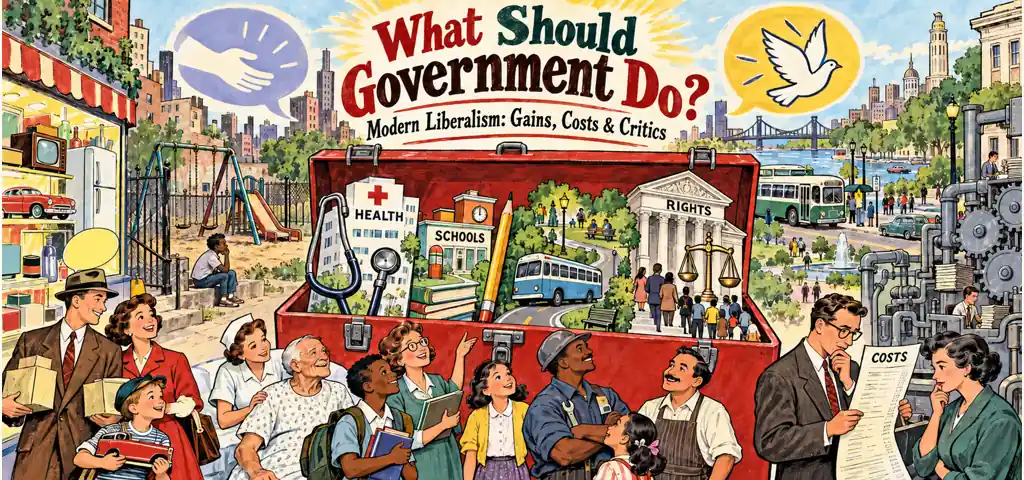
Chapter 13 of the CLEP History of the United States II study guide on Effortless Math covers Modern Liberalism, Its Achievements, and Its Critics: the key terms, the core ideas, and worked examples showing how this topic is tested on the exam.
CLEP History of the United States II, Chapter 13
Postwar liberalism accepted markets and assigned government a larger corrective role
Most postwar liberals did not seek federal ownership of the economy. They supported regulated capitalism, collective bargaining, social insurance, civil rights, public investment, and fiscal policy aimed at high employment. The New Deal supplied institutions, while the Great Society extended federal action into health, education, poverty, culture, and consumer protection. Disagreement centered on how much public power could correct unequal markets without producing costly bureaucracy or weakening local and private institutions.
Galbraith contrasted private abundance with public scarcity
In The Affluent Society, John Kenneth Galbraith argued that advertising-driven private consumption could coexist with neglected schools, parks, transit, and other public goods. Rising output did not automatically choose the best balance between private purchases and common investment. His argument supported a liberal case for public spending in an affluent economy. It did not deny that markets produced useful goods or claim that poverty had disappeared.
Mills described concentrated power behind pluralist appearances
C. Wright Mills's The Power Elite argued that corporate, military, and political leaders moved through connected institutions and made major decisions with limited popular control. The claim challenged the pluralist view that many competing groups dispersed power. Mills did not describe one secret organization commanding every event. He identified overlapping careers, interests, and institutions that narrowed the circle governing national choices.
Hartz located consensus in the absence of feudalism
Louis Hartz argued that the United States lacked a European feudal past and therefore developed inside a broad liberal tradition centered on individual rights and property. The thesis explained why socialist and conservative traditions took different forms in American politics. Critics said it understated slavery, racial hierarchy, Indigenous dispossession, class conflict, and ideological diversity. The useful question is what the framework reveals and what its consensus language pushes aside.
Bell announced an exhaustion of older total ideologies
Daniel Bell's The End of Ideology argued that grand nineteenth-century systems had lost force among many Western intellectuals as practical welfare-state bargaining replaced revolutionary programs. He did not predict the end of political disagreement. The upheavals of the 1960s soon made the title look premature. Bell's claim is best treated as evidence of postwar confidence in pragmatic, mixed-economy politics rather than a timeless description.
Hayek warned that economic planning threatened political freedom
Friedrich Hayek's The Road to Serfdom argued that extensive central planning concentrated coercive power and could endanger liberty even when planners began with egalitarian aims. American conservatives used the warning against New Deal and wartime planning. Hayek did not argue that every regulation instantly created dictatorship. His target was a system in which government had to direct production and allocate resources broadly enough to suppress independent choice.
National Review helped turn conservative ideas into a movement
William F. Buckley, Jr., founded National Review in 1955. The magazine brought together free-market advocates, anticommunists, and traditionalists who did not always agree. It offered arguments, networks, and a boundary against some competing right-wing tendencies. Movement building required more than a publication, but the magazine helped conservatives debate a common program outside the dominant liberal institutions they criticized.
Goldwater turned principle into a national campaign
Barry Goldwater opposed the Civil Rights Act of 1964 on constitutional grounds, advocated smaller federal domestic power, and defended a forceful anticommunism. His landslide defeat concealed organizational gains. Conservative activists built donor lists, local groups, and campaign experience that later aided Ronald Reagan. Goldwater's five Deep South victories also showed that resistance to federal civil-rights power could reshape party geography even when the national electorate rejected his candidacy.
Liberal achievements generated administrative and political criticism
Supporters credited civil-rights enforcement, Medicare, Medicaid, education aid, antipoverty programs, and consumer regulation with expanding access and security. Critics attacked costs, centralized rules, dependency, bureaucratic distance, and unintended incentives. Charles Murray later argued that welfare policy could reinforce poverty, a claim disputed over evidence and causation. Evaluation requires program-specific outcomes. One broad verdict cannot substitute for separate evidence on health coverage, school aid, income, work, and discrimination.
Federalism remained a practical fault line
The 1953 tidelands oil settlement gave coastal states control over submerged lands within their historic boundaries while the federal government retained the outer continental shelf. The dispute concerned revenue, ownership, and federal-state authority rather than social welfare. It illustrates why modern liberalism and conservatism repeatedly fought over the governing level even when both accepted some public role. Federalism arguments often joined constitutional principle to control of valuable resources.
test a claim at the level it makes
A writer argues that Great Society policy caused dependency.
Community action challenged local control within the War on Poverty
The Economic Opportunity Act supported Job Corps, Head Start, legal services, and community-action agencies. Its call for the "maximum feasible participation" of poor residents sometimes brought neighborhood organizers into conflict with mayors and established welfare agencies. Supporters saw participation as a way to identify needs and develop leadership; local officials feared unaccountable rival institutions. The controversy shows that antipoverty policy was a transfer of money. It also raised the political question of who would design and administer programs, a question that helped produce later demands for consolidation and local control.
Medicare and Medicaid used different federal arrangements
Medicare created national health insurance for older Americans through hospital and physician benefits, financed through payroll contributions and general revenue. Medicaid offered means-tested coverage through federal-state partnership, so eligibility and administration varied by state within federal rules. Both expanded access and sent public money through private providers, contributing to growth in the health sector. They were not one universal national health service. Distinguishing age-based social insurance from means-tested intergovernmental assistance clarifies later debates over cost, coverage, state discretion, and whether benefits should be understood as earned rights or public aid.
Watch the history in motion
This short lesson adds voices, images, and chronology to the ideas you just studied.
Video: The 1960s in America: Crash Course US History #40, CrashCourse.
Try four CLEP-style questions
- Which evidence would most directly support Galbraith's claim about private abundance and public scarcity?
- Equal spending growth in private and public sectors across every region
- Falling consumer output during a period of expanding municipal services
- A decline in advertising accompanied by higher corporate profits
- Federal ownership of most retail and manufacturing firms
- Rising household purchases alongside deteriorating schools, transit, and parks
- How did National Review contribute to modern conservatism?
- It joined market, anticommunist, and traditionalist arguments in a shared forum.
- It replaced both major parties with a single conservative organization.
- It administered federal grants to conservative state governments.
- It required southern Democrats to register as Republicans.
- It converted the Supreme Court into the movement's main policy branch.
- Which statement best distinguishes Mills from a simple conspiracy theory?
- He argued that elections had ceased and military officers formally governed the country.
- He claimed one private club issued binding orders to every corporation and agency.
- He treated organized labor as the sole institution controlling national policy.
- He traced overlapping leadership networks among major institutions rather than one hidden command center.
- He denied that corporate, military, and political leaders ever disagreed.
- What is the strongest way to evaluate a claim that an antipoverty program created dependency?
- Use one national poverty rate as proof of every local program's effect.
- Accept the claim if it is consistent with a general warning about planning.
- Reject the claim because every federal benefit increases household income.
- Measure the program's total budget without examining recipients or behavior.
- Compare its rules and outcomes with alternatives while testing rival causes of poverty.
Check your answers and reasoning
Independent preparation. CLEP is a registered trademark of the College Board, which does not endorse this lesson.

Related to This Article
More math articles
- How to Prepare for the ATI TEAS 7 Math Test?
- Stretching the Line: How to Multiply Fractions by Whole Numbers with Number Lines
- Federalist No. 78 and the judiciary
- Marriage Forms, Boundaries, and Partner Similarity
- The Best Grade 3 ELA Practice Tests for Indiana Students
- How to Solve One-step and Two-step Linear Equations Word Problems
- Full-Length 8th Grade Common Core Math Practice Test-Answers and Explanations
- How to Define Degrees and Radians
- Crypto Casinos vs. Traditional Online Casinos: The Math Differences
- Limited government


















What people say about "Modern Liberalism and Its Critics"?
No one replied yet.