Family, Household, Kinship, and Family Position
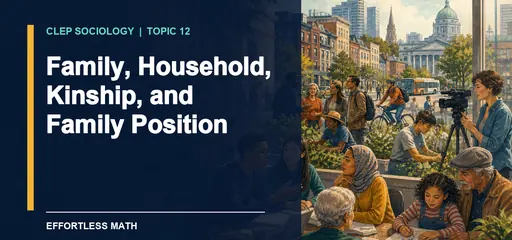
Chapter 12 of the CLEP Sociology study guide on Effortless Math covers Family, Household, Kinship, and Family Position: the key terms, the core ideas, and worked examples showing how this topic is tested on the exam.

CLEP Sociology – Chapter 12
Family, Household, Kinship, and Family Position
CLEP Introductory Sociology · Chapter 12
A family is a socially recognized group connected through birth, marriage, adoption, partnership, or another culturally accepted bond. Families commonly organize care, identity, inheritance, belonging, and obligations across generations. The definition is broad because societies and historical periods recognize family ties in different ways.
A household consists of people who share a dwelling. Residence is the deciding feature. A household can contain one person, unrelated roommates, one family, or members of several families. Family members can also live in different households because of migration, shared custody, education, military service, institutional care, or work.
Kinship is the culturally defined network of relatives and expected relationships among them. Biology can matter, but biology alone does not settle kinship. Adoption, clan membership, godparenthood, step-relations, and chosen family show how communities define bonds, names, duties, and claims.
Kinship has institutional consequences. A recognized relative may inherit property, authorize medical care, assume responsibility for a child, receive migration sponsorship, or be expected to support an older adult. Law, religion, custom, and everyday practice can draw the boundary differently. Luis’s friend may provide the most care while lacking rights granted automatically to a legal spouse.
A nuclear family centers parent-child relationships without additional relatives in the unit. Some introductory sources use two parents and dependent children, while others include one-parent units. Follow the convention stated in a question. An extended family adds active ties with relatives such as grandparents, aunts, uncles, or cousins. Neither label measures affection, health, morality, permanence, or social value.
The nuclear family is an analytic form, not a universal standard from which other arrangements depart. Extended, multigenerational, blended, adoptive, single-parent, same-gender-parent, child-free, and transnational families can all organize durable care and obligation. Variation within each form is usually greater than a label can show.
The family of orientation is the family into which a person is born, adopted, or raised. The family of procreation is the family a person forms through partnership and children. These terms describe a person’s position, not two kinds of moral worth. One household can be a family of procreation for a parent and a family of orientation for a child.
Membership and residence should be measured separately. A grandparent who lives nearby and provides daily child care may be central to the family without sharing the dwelling. An unrelated renter may share a kitchen without being treated as kin. A survey that asks only who sleeps at an address measures household composition, not every family tie.
Researchers can compare legal recognition, self-identification, caregiving, financial support, and residence. Different measures may identify different networks. That is not a measurement failure if each question is stated clearly. It reveals that family is both lived relationship and social institution.
Institutional records reveal why the distinction matters. A census may count everyone at one address as a household. A hospital form may recognize a spouse or legal relative while overlooking a friend who provides daily care. A school may ask which adults can authorize treatment, and an inheritance law may rank biological, adoptive, marital, and chosen ties differently. Each record draws a boundary for a specific purpose. None supplies a complete definition of the person’s family life.
Beginners sometimes treat nuclear and extended family as stages, as though one replaced the other. The terms describe structure. A couple and their children may live in one apartment while grandparents, cousins, and siblings exchange money, care, and decisions across several homes. The residential unit looks nuclear, but the active kin network is extended. A strong study names the bond being measured: shared residence, legal recognition, caregiving, descent, emotional commitment, or economic support. On a CLEP item, use household when the clue is one dwelling and family or kinship when the clue is a recognized bond or obligation.
Quick review: Family concerns socially recognized bonds and obligations. Household concerns shared residence. Kinship is a culturally defined network of relatives. Nuclear and extended describe structure, not quality. Orientation names the family in which one is raised, while procreation names a family one forms through partnership and children.
Watch the chapter connection
Theories About Family and Marriage gives you a second explanation of the chapter ideas surrounding this lesson. As you watch, pause when the lesson concept appears and explain how the example fits.
Use this lesson for CLEP practice
Write one original example, one close nonexample, and one observation that would help you choose between them. This turns vocabulary recognition into the kind of applied reasoning the exam expects.

Related to This Article
More math articles
- Unit Converter (Length, Mass, Volume, Temperature & More)
- How to Scale a Function Vertically?
- CLEP U.S. History I 076: Popular Print, Minstrelsy, and Contested Mass Culture
- Intelligent Math Puzzle – Challenge 79
- 8th Grade STAAR Math Practice Test Questions
- 10 Most Common 4th Grade OST Math Questions
- How to Prepare for the SBAC Math Test?
- The Fascinating Applications of Algebraic Manipulation in Limits
- Berlin, NATO, NSC-68, and Militarized Containment
- North Dakota Algebra 1 Free Worksheets: Free Printable Algebra 1 PDFs, No Signup


















What people say about "Family, Household, Kinship, and Family | CLEP Sociology"?
No one replied yet.