YOUR ASVAB Math STUDY COMPANION
ASVAB Shop Information Study Guide: A 28-Lesson Roadmap
Strong Shop Information results come from connecting a visible tool or setup to the job it must perform. You do not need a garage full of equipment to build that skill. You need a reliable way to read material, action, shape, access, and safety clues.
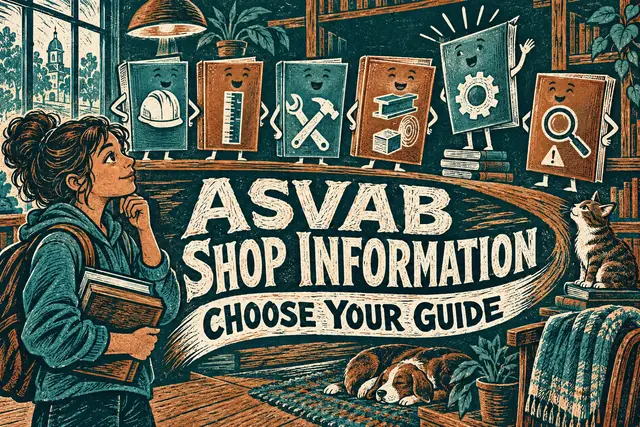
Strong Shop Information results come from connecting a visible tool or setup to the job it must perform. You do not need a garage full of equipment to build that skill. You need a reliable way to read material, action, shape, access, and safety clues.
This study guide gives you a sensible route through the 28 lessons in this collection. Start with safety and measurement, move into tools and materials, and finish with the recognition and troubleshooting habits that make an unfamiliar illustration manageable.
Use the lessons in order the first time. On later passes, return only to the sections that cost you time. That keeps review practical and prevents one difficult tool family from taking over your study session.
Use one question to organize every tool picture
Before you try to name a tool, ask: What material is involved, what action has to happen, and what visible feature makes that action possible? A serrated jaw points toward gripping pipe. A pointed bit suggests drilling or marking. A guard, fence, or vise is evidence that the question is testing control as well as recognition.
- Read the material and the action before studying answer choices.
- Find the working end, jaw, tooth pattern, blade, or control surface.
- Eliminate tools that cannot produce the required result safely.
- Choose the best-supported answer and keep moving.
Watch a timed Shop Information walkthrough
Automotive and Shop Info Practice Test for the ASVAB & PiCAT by Grammar Hero is a helpful companion when you are ready to apply the material under time pressure. Notice how the explanation starts with the job and the visible clue rather than treating every choice as a memory test.
Shop Information Flashcards
Use these short prompts for a quick daily review. Say the answer before opening each card; recognition becomes faster when you can connect the name to the working action.
What does a vise do?
It holds a workpiece steady so an operation can be controlled and hands stay out of the tool path.
What does a square check?
A right angle.
What does a level check?
Whether a surface is horizontal or level.
What does a plumb reference check?
Whether a line or reference is vertical.
Which saw cuts with wood grain?
A ripsaw.
Which saw cuts across wood grain?
A crosscut saw.
What does a countersink make?
A conical recess, commonly for a flat-head screw.
What does a counterbore make?
A cylindrical, flat-bottomed recess.
Why use a flat washer?
To spread load and protect the surface in the intended assembly.
What property resists indentation?
Hardness.
What property helps a material resist breaking under impact?
Toughness.
What is the first response to slipping or binding?
Stop, inspect the cause, and correct the setup instead of forcing the tool.
Follow the 28-lesson roadmap
Start with safe, controlled work
- Shop Safety, PPE, and First Checks
- Work Control: Hold the Work, Control the Hazard
- Measuring Tools: Choose the Right Reference
- Layout Tools: Square, Level, Plumb, and Straight
Read drawings, dimensions, and marks
Recognize hand tools and cutting actions
- Striking and Driving Tools: What Shapes Tell You
- Wrenches, Sockets, and Pliers: Making the Right Match
- Vises and Clamps: Holding Work Safely
- Handsaws: Match the Cut to the Grain
- Files, Rasps, and Abrasives: Shape and Finish
- Drill Bits and Hole Features: A Practical Guide
Choose fasteners and materials
- Screws, Bolts, Nuts, and Washers
- Rivets, Nails, and Wood Joints
- Shop Materials: Wood, Metal, Masonry, and Plastic
- Portable Power Tools: Action, Control, and Safety
- Material Properties: Hardness, Toughness, and More
- Surface Defects, Rust, and Finish Preparation
Work with machines and trade tools
- Hand Tool Care: Edges, Handles, and Storage
- Power Tool Care: Inspect Before You Use It
- Stock Removal Machines: What Each Tool Does
- Machine Controls: Guides, Guards, and Work Support
- Masonry and Plumbing Tools: Shapes and Jobs
- Sheet-Metal and Electrical Hand Tools
Build recognition and test-day judgment
- How to Identify Shop Tools From Their Shapes
- How to Select the Right Tool for the Job
- Shop Troubleshooting: Stop, Inspect, Then Decide
- Preparing for Shop Information Questions
Use official ASVAB resources wisely
Use the official resources below to confirm current test information and to see additional sample material. They open in a new tab so you can keep your place in this study guide.
- Official ASVAB Shop Information overview
- Official CAT-ASVAB information
- Official ASVAB sample questions
Make your review count
When you miss a question, write down the clue you overlooked: the material, the direction of motion, the shape of the working end, or the safety condition. Do not merely copy the correct name. A short contrast such as “socket surrounds; open-end approaches from the side” is more useful on the next question than a long unconnected list of tools.
Return to this roadmap after each practice session, choose the one lesson that matches your missed question, and study that relationship for five focused minutes. Small, targeted corrections are how a broad shop vocabulary becomes usable knowledge.
Official source: the content of each ASVAB subtest is described on the official ASVAB Enlistment Testing Program site at officialasvab.com.

Related to This Article
More math articles
- NYSTCE Multi-Subject Math Flashcards
- How to Prepare for the TASC Math Test?
- The Dust Bowl and the Environment of Crisis
- How to Compare Rational Numbers
- Free Grade 5 English Worksheets for Kansas Students
- Assembly, Testing, Storage, Charging, and Distribution
- The Best Grade 4 Math Book for Tennessee Students
- Best tools for Online teachers
- CLEP U.S. History I 014: Dutch New Netherland and Plural Middle Colonies
- Classification and Scientific Names













What people say about "ASVAB Shop Information Study Guide"?
No one replied yet.