Hand Tool Care: Edges, Handles, and Storage
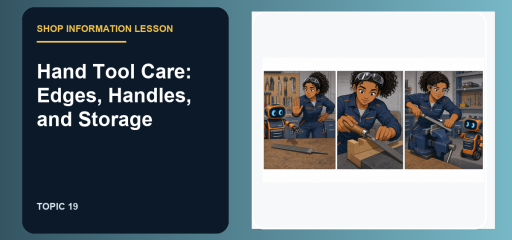
Care questions are not about making a tool look new. They ask whether the tool can still be used safely and accurately. A small defect at a handle or working end can turn into a much bigger problem once force is applied.
The practical task here is to remove the tool from use, repair it properly, or replace it before applying force. In a real shop, that choice controls the work before it becomes a mistake that is harder to undo.
What does hand tool care mean?
Hand tool care keeps working edges, handles, fasteners, and storage conditions safe and useful. A damaged handle, mushroomed striking face, bare file tang, loose head, or rusty cutting edge changes both tool performance and the risk to the person using it.
Which clues should you notice first?
Read the noun and the verb together. In this topic, a cracked handle, damaged striking face, bare tang, loose head, or corrosion is not scenery; it is the detail that tells you what the tool or setup must accomplish.
- Working clue: a cracked handle, damaged striking face, bare tang, loose head, or corrosion
- Best next move: remove the tool from use, repair it properly, or replace it before applying force
- Why it matters: the right setup protects the work, the tool, and the person using it.
How do the close choices differ?
| Tool or idea | What it does |
|---|---|
| File handle | protects the hand from the tang |
| Bare tang | can puncture the palm when pushing a file |
The distinction between File handle and Bare tang is useful because the tools may appear in the same answer set while doing different jobs. Match the stated feature, not the broad category.
Put the clue into a shop decision
Imagine that a question or illustration gives you a cracked handle, damaged striking face, bare tang, loose head, or corrosion. Before you look for a familiar name, say what the work actually needs: remove the tool from use, repair it properly, or replace it before applying force. Then test each choice against the physical result. A choice that cannot produce the needed result is out, even if it belongs to the same general family. This is also where the difference between File handle and Bare tang becomes useful. One clear reason is enough to reject a close distractor.
Watch the skill in context
How to Prevent Rust and Maintenance Hand Tools by Wood By Wright ASMR is a useful visual companion to this lesson. Use the video to reinforce the visible clue and the safe setup, not to memorize a brand or a particular model.
Use this four-step routine
- Inspect the handle and working end.
- Look for looseness, cracks, and corrosion.
- Clean and store the tool dry.
- Do not improvise a repair that changes safe use.
Try the decision, then check your reasoning
- You see a cracked handle, damaged striking face, bare tang, loose head, or corrosion. What detail should lead your decision? The condition that changes the tool choice or safe setup is the first clue.
- What is the best response when the task calls for a cracked handle, damaged striking face, bare tang, loose head, or corrosion? Remove the tool from use, repair it properly, or replace it before applying force.
- How is File handle different from Bare tang? File handle protects the hand from the tang; Bare tang can puncture the palm when pushing a file.
- What should you do if the tool, setup, or workpiece does not match the job? Pause and correct the mismatch before applying more force.
Keep building your shop vocabulary
Use the ASVAB topic archive to move through the lessons in a practical order. For your next review, cover the tool name, state the job in a few words, and then predict the feature you would expect to see.
Related lessons:

Related to This Article
More math articles
- The Civil War and Reconstruction
- Campaign organizations
- Political Opportunity and Framing
- 4th Grade MCA Math Worksheets: FREE & Printable
- SAT And ACT Tests Hacks and Tips
- Top 10 Tips to Overcome ATI TEAS 7 Math Anxiety
- ASWB Three-Option Questions: Use Evidence to Eliminate a Distractor (2027 Prep)
- Nevada Grade 2 Math Worksheets — Free Printable PDFs
- Domain and Range Calculator (Free, with Graph)
- 4th Grade MAP Math Practice Test Questions






















What people say about "Hand Tool Care: Edges, Handles, Storage"?
No one replied yet.