Masonry and Plumbing Tools: Shapes and Jobs
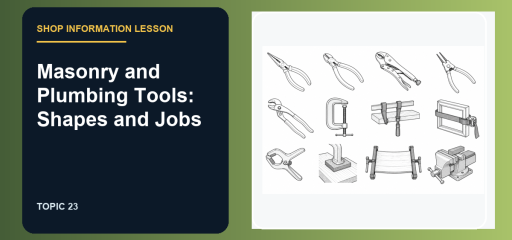
Trade-tool questions often include one detail that gives the answer away: serrated jaws for pipe, a carbide tip for masonry, a cutter wheel for tubing, or a broad trowel surface for mortar. Read the working end before the handle.
Small differences decide this kind of question. Once you spot pipe, tubing, masonry, mortar, a fitting, or a specialized working edge, you can stop treating every nearby tool as an equally good option.
What does masonry and plumbing tools mean?
Construction-trade tools reveal their job through shape and material. A masonry tool may strike, spread, chip, or finish cement-based material. A plumbing tool may grip pipe, cut tubing, ream an edge, or connect fittings without damaging the part being assembled.
Which clues should you notice first?
Do not rush past the physical clue. Pipe, tubing, masonry, mortar, a fitting, or a specialized working edge narrows the answer because it limits what a correct tool or setup can reasonably do.
- Working clue: pipe, tubing, masonry, mortar, a fitting, or a specialized working edge
- Best next move: match the distinctive working end to the material and trade operation
- Why it matters: the right setup protects the work, the tool, and the person using it.
How do the close choices differ?
| Tool or idea | What it does |
|---|---|
| Pipe wrench | uses serrated jaws to grip round pipe |
| Box-end wrench | fits a hex fastener and is not meant to grip pipe |
These two ideas are worth keeping separate. Once you can say why Pipe wrench differs from Box-end wrench, a picture-based question becomes a function question.
Put the clue into a shop decision
Imagine that a question or illustration gives you pipe, tubing, masonry, mortar, a fitting, or a specialized working edge. Before you look for a familiar name, say what the work actually needs: match the distinctive working end to the material and trade operation. Then test each choice against the physical result. A choice that cannot produce the needed result is out, even if it belongs to the same general family. This is also where the difference between Pipe wrench and Box-end wrench becomes useful. One clear reason is enough to reject a close distractor.
Watch the skill in context
Mark’s Favorite Entry Level Masonry Tools | Ask This Old House by This Old House is a useful visual companion to this lesson. Pay attention to the feature nearest the workpiece. It usually gives better evidence than the handle, color, or brand.
Use this four-step routine
- Name the trade material.
- Study the jaw, edge, or wheel.
- Match it to the operation.
- Avoid using a general hand tool where a specialized tool is required.
Try the decision, then check your reasoning
- You see pipe, tubing, masonry, mortar, a fitting, or a specialized working edge. What detail should lead your decision? The condition that changes the tool choice or safe setup is the first clue.
- What is the best response when the task calls for pipe, tubing, masonry, mortar, a fitting, or a specialized working edge? Match the distinctive working end to the material and trade operation.
- How is Pipe wrench different from Box-end wrench? Pipe wrench uses serrated jaws to grip round pipe; Box-end wrench fits a hex fastener and is not meant to grip pipe.
- What should you do if the tool, setup, or workpiece does not match the job? Pause and correct the mismatch before applying more force.
Keep building your shop vocabulary
Use the ASVAB topic archive to move through the lessons in a practical order. When you miss a question, record the evidence you overlooked, not just the correct name. That is the detail that will transfer to the next unfamiliar picture.
Related lessons:

Related to This Article
More math articles
- The Best Grade 7 ELA Practice Tests for Idaho Students
- The Best Grade 5 ELA Practice Tests for Alaska Students
- Fifth Grade Writing: Opinion, Informative, and Narrative Expectations Explained
- State action requirement
- Enhanced ACT Math 2026: The New 45-Question Section, Explained
- Political advertising
- How to Determine If (x, y) Is a Solution to a System of Equations
- The Best Calculators for Back to School 2026
- Formation of political attitudes
- The income effect follows real purchasing power






















What people say about "Masonry and Plumbing Tools"?
No one replied yet.