Plot, Conflict, and Resolution
Every story moves. Something happens, tension builds, and eventually things settle down again. When a test question asks what a story is “mostly about” or what changed by the end, it is really asking you to follow that movement.
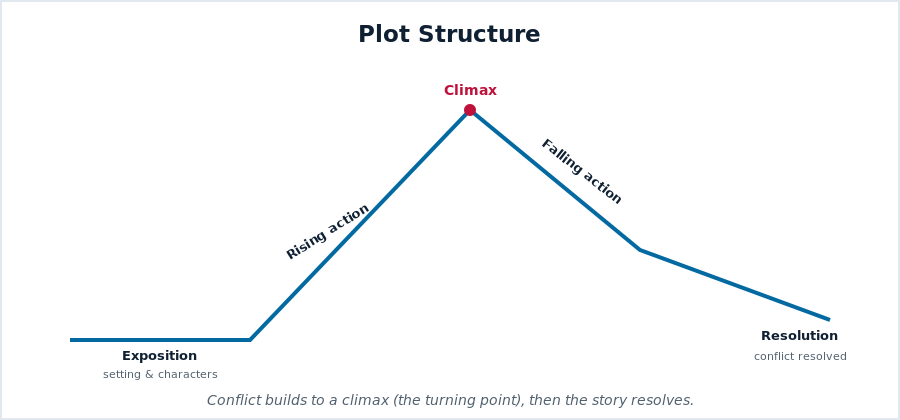
The plot is the sequence of events in a story, arranged to build and release tension. It usually moves through five stages: exposition (the setup), rising action, climax (the turning point), falling action, and resolution (how things end). The problem that drives it all is the conflict.
The Stages of a Plot
Think of a plot as a climb. The exposition introduces the characters, the setting, and the situation — who these people are and where they are. The rising action is the series of events that build tension and complicate things. The climax is the turning point, the moment of greatest tension where the outcome is decided. After that comes the falling action, where the results play out, and finally the resolution, where loose ends are tied up. For example, in a story about a girl entering a science fair, the exposition shows her building a project, the rising action piles up setbacks, the climax is the judging, and the resolution shows how she feels afterward.
Conflict and Resolution
Every plot is powered by a conflict — a problem or struggle the character faces. Conflicts come in two kinds. An external conflict is a struggle against something outside the character: another person, nature, or a situation, like racing to catch a train. An internal conflict happens inside the character’s own mind, like deciding whether to tell the truth. The resolution is how the conflict is finally settled. To spot it, ask: what problem did the character have, and how was it solved by the end? A character who wanted to prove herself and finally does has reached her resolution. Naming the conflict early makes the whole plot easier to follow.
Watch: A Short Video Lesson
Mr. Armstrong Teaches gives a clear overview to go with this lesson:
A Routine for Tracking Plot
- In the opening, note who the characters are and where they are (exposition).
- Identify the main conflict — the problem the character faces.
- Watch for the climax, the moment of highest tension.
- Check how the conflict is settled by the end (resolution).
Practice
- What is a plot?
- Name the five stages of a plot in order.
- What is the climax?
- What is the difference between internal and external conflict?
- What is the resolution?
- Which stage introduces the characters and setting?
Answers
- The sequence of events in a story, arranged to build and release tension.
- Exposition, rising action, climax, falling action, resolution.
- The turning point, the moment of greatest tension.
- Internal is a struggle inside the character’s mind; external is against an outside force.
- How the conflict is finally settled.
- The exposition.
Where This Fits in Your RLA Prep
Following a plot works hand in hand with character motivation and change and setting and context. See every topic on the Language Arts Prep Hub.
Recommended Prep Books
Keep building momentum with a full study guide and practice tests:

Related to This Article
More math articles
- Other Punctuation Marks
- Adding Fractions with Unlike Denominators for 5th Grade
- The Ultimate 6th Grade ISASP Math Course (+FREE Worksheets)
- The Ultimate OAR Math Course (+FREE Worksheets)
- Failures, Wet Packs, Recalls, and Corrective Action
- Bargaining and persuasion
- The Best Grade 3 ELA Practice Tests for Iowa Students
- Grade 6 Math: Area of Rectangles and Squares
- New Jersey NJSLA Grade 7 Math Worksheets: 95 Free Printable PDFs for Home Learning
- 6th Grade MEAP Math Practice Test Questions















What people say about "Plot, Conflict, and Resolution"?
No one replied yet.